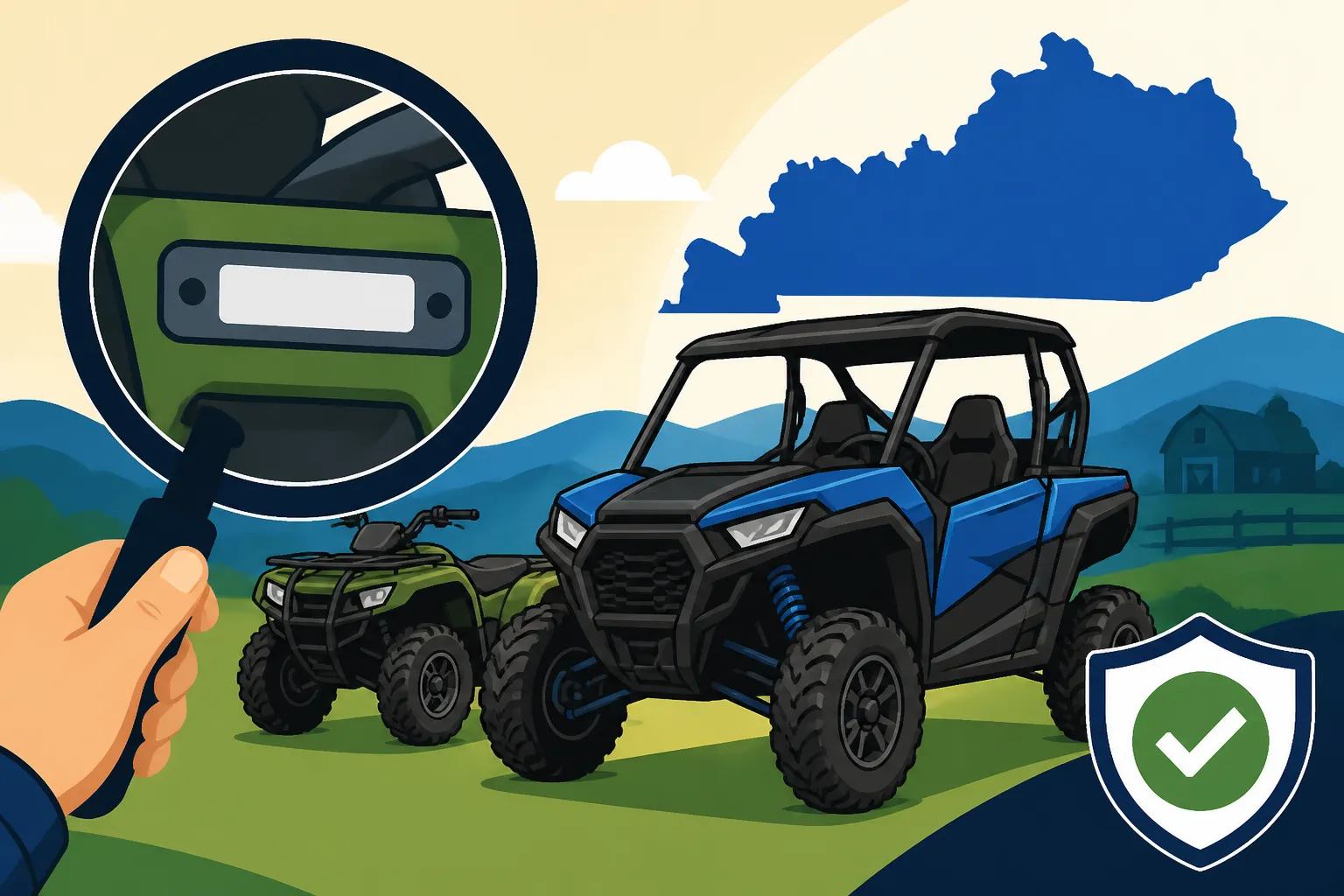
Checking a VIN Before a Kentucky Purchase
Buying an ATV or UTV in Kentucky can feel like navigating a minefield, especially when you're handed a title and told it's good to go, only to find out later that something is off with the Vehicle Identification Number (VIN). This guide is all about empowering you with the knowledge to thoroughly check a VIN before you finalize that purchase, saving you headaches, money, and potential legal trouble down the road.
Why the VIN is Your First Line of Defense When Buying an ATV in Kentucky
When you're looking at a used ATV or UTV in Kentucky, whether it's on a roadside lot or a private seller's backyard, the VIN isn't just a series of numbers and letters. It's the machine's unique fingerprint, its life story encoded into seventeen characters. Ignoring it, or giving it a cursory glance, is one of the biggest mistakes a buyer can make, potentially leading to a nightmare scenario. Think of it as the ultimate background check for your potential new ride.
More Than Just a Number: The VIN as a Machine's Identity
Every single ATV and UTV manufactured since 1981 has a unique 17-character VIN. This isn't just a random serial number; it's a carefully structured code that reveals a wealth of information about the vehicle. It tells you the manufacturer, the country and plant of assembly, the model year, the engine type, and even specific features. For example, a VIN can clearly distinguish between a high-performance sport quad and a utility UTV designed for farm work, even if they look similar on the outside. This identification is absolutely critical because it ties the machine to its entire history, from the moment it left the factory floor to every recorded ownership change, lien, or reported incident.
The VIN is the backbone of proper [Titling an ATV in Kentucky]. Without a valid, untampered VIN that matches all associated paperwork, you simply won't be able to legally register and title your machine in the Commonwealth. The county clerk's office relies on this number to ensure the vehicle's legitimacy and to properly record you as the new owner. If there's a discrepancy, you'll be sent home empty-handed, and likely with a very expensive, unrideable paperweight.
Avoiding Stolen Machines and Title Scams
One of the most disheartening experiences for any ATV enthusiast is to discover that the machine they just bought is stolen. A thorough VIN check is your absolute best defense against this kind of fraud. A stolen vehicle might look perfectly legitimate, but its VIN will be flagged in national databases. If you unwittingly purchase a stolen ATV, law enforcement can (and will) confiscate it without compensation, leaving you out of pocket with no recourse against the seller, who has likely vanished.
Furthermore, a VIN check helps expose title scams. Some unscrupulous sellers might present a fraudulent title, or a title that doesn't actually belong to the machine they're selling. They might try to use a bill of sale that looks official, but if the VIN on that document doesn't match the machine, or if the title itself is doctored, you're in for a world of hurt. The VIN is the direct link that proves a title truly belongs to that specific machine. Any mismatch between the VIN on the physical ATV and the VIN on the title or any [Kentucky Bill of Sale for an ATV] should immediately raise a huge red flag. Protecting yourself upfront with a thorough VIN verification can save you from substantial financial loss and the stress of dealing with legal repercussions.
Ensuring a Smooth Kentucky Titling Process
The Kentucky County Clerk's office is the gatekeeper for titling ATVs and UTVs in the state. Their primary job is to ensure that every machine titled within their jurisdiction is legitimate and that the ownership transfer is legal and transparent. A clean VIN is not just preferred; it's absolutely essential. When you walk into the clerk's office with your signed-over title and [Kentucky Form TC 96-182 Explained], the first thing they'll do is compare the VIN on your documents with their records. If there are any discrepancies – missing characters, numbers that don't add up, or a VIN that's been reported as stolen or tampered with – your titling process will grind to a halt.
Imagine buying a machine, driving it home, and then discovering you can't get it titled. This happens far more often than you'd think. The clerk simply won't process the title if the VIN is questionable. This means you might miss the [Kentucky's Fifteen-Day Titling Deadline], accrue late fees, or worse, be stuck with a machine you can't legally own or ride. Performing a diligent VIN check before the purchase gives you the confidence that the machine is legitimate and that you'll have a smooth experience at the counter, ensuring you can hit the trails legally without unnecessary delays or frustrations.
Decoding the Kentucky VIN: What Each Section Tells You
While Kentucky doesn't have a unique VIN system, the standard 17-character VIN is what you'll encounter and what the state's titling process relies on. Understanding what each section of this complex code represents can give you a deeper insight into the machine's origins and characteristics, helping you spot inconsistencies that a casual glance might miss. It's like having a secret decoder ring for your ATV's identity.
Understanding the Seventeen-Character Standard
The 17-character VIN standard was established in 1981 by the National Highway Traffic Safety Administration (NHTSA) to create a universal identification system for all motor vehicles, including ATVs and UTVs. Before this, VINs were often shorter, varied widely by manufacturer, and could be quite confusing. Kentucky adheres strictly to this 17-character rule for machines purchased after July 2010. If you're looking at a newer machine with anything other than 17 characters, it's an immediate red flag, unless it's an older model (pre-1981) where different rules apply. [Kentucky's Seventeen-Character VIN Rule] is in place to provide clear, consistent identification.
Each position in the VIN carries specific information. It's not just a random string; it's a carefully crafted alphanumeric code. Familiarizing yourself with the general breakdown helps you quickly verify if the VIN on the machine aligns with what the seller is telling you about its origin, age, and type. This systematic approach to identification makes it incredibly difficult for legitimate manufacturers to duplicate VINs and provides a robust framework for tracking vehicle history.
Breaking Down the World Manufacturer Identifier (WMI)
The first three characters of the VIN form the World Manufacturer Identifier (WMI). This segment tells you two crucial pieces of information: the country of origin and the manufacturer.
- First Character: This denotes the geographic region where the manufacturer is located. For example, "1," "4," or "5" often means North America (U.S., Canada, Mexico), "J" is Japan, "3" is Mexico, "S" is Europe, and "L" is China. If a seller claims a machine was made in Japan, but the VIN starts with a "1," that's a sign to dig deeper.
- Second Character: This identifies the specific manufacturer. For example, "H" might be Honda, "Y" could be Yamaha, and so on. These codes are standardized, so you can often look up the manufacturer based on this character.
- Third Character: This position is combined with the first two to uniquely identify the manufacturer and often the vehicle type. For instance, a common combination might be "1HF" for a specific Honda ATV type from the USA.
Knowing these first three characters allows you to quickly verify the stated manufacturer and origin of the ATV, adding an initial layer of authenticity to the seller's claims. If these don't align, it's a sign to proceed with caution and ask more questions.
The Vehicle Descriptor Section (VDS) and the Vehicle Indicator Section (VIS)
Characters 4 through 9 make up the Vehicle Descriptor Section (VDS). This part of the VIN describes the general attributes of the vehicle. For ATVs and UTVs, this typically includes:
- Vehicle Type: Is it an ATV, UTV, or another type of off-road vehicle?
- Engine Type: What kind of engine does it have? This can include displacement, fuel type, and number of cylinders.
- Model Line or Series: Specific details about the model, such as "Raptor," "Ranger," or "Foreman."
- Body Style: Though less diverse for ATVs, it can indicate variations like a two-seater vs. a single-seater.
- Gross Vehicle Weight Rating (GVWR): Sometimes included, though less common for ATVs.
- Safety Features/Restraint System: Information about airbags (not typically on ATVs), seatbelts, etc.
The VDS is crucial for confirming that the VIN matches the actual machine you're looking at. If the VDS section of the VIN indicates a 250cc sport quad, but you're looking at a 700cc utility UTV, then something is definitely wrong. This section ensures the VIN accurately describes the machine's basic specifications.
Characters 10 through 17 form the Vehicle Indicator Section (VIS). This is the truly unique part of the VIN for each individual vehicle and contains vital information about its production and individual identity:
- Tenth Character: This is the model year identifier. It uses letters (excluding I, O, Q, U, Z) and numbers to represent the year. For example, "A" might be 2010, "B" 2011, "J" 2018, "L" 2020, and so on. This is extremely helpful for verifying the machine's age against the seller's claim or the title date.
- Eleventh Character: This identifies the specific manufacturing plant where the vehicle was assembled.
- Characters 12 through 17: These are the sequential production numbers, or the unique serial number of that specific vehicle as it came off the assembly line. This six-digit sequence makes each VIN distinct.
One of the most important characters is the ninth character, which is the "check digit." This is a single digit (0-9 or X) that is mathematically derived from all other characters in the VIN. It's designed to catch transcription errors and VIN tampering. There's a specific algorithm (a weighted sum formula) that, when applied to the entire VIN, should result in this check digit. If you run a VIN through a checker and the check digit doesn't match, it means the VIN is either incorrect, a typo, or potentially altered. While you might not perform this calculation yourself, many online VIN decoders will automatically verify the check digit for you.
The Red Flags: What a Shady VIN Looks Like in Kentucky
When you're inspecting a potential ATV or UTV purchase, your eyes need to be sharp, and your gut feeling needs to be listened to. A clean VIN is smooth, uniform, and consistent. Anything that deviates from this standard should immediately make you wary. These red flags aren't just minor imperfections; they can be indicators of theft, fraud, or a severely problematic machine that you absolutely do not want to bring home.
Signs of Tampering and Alteration
This is perhaps the biggest red flag you can encounter. A tampered VIN indicates that someone has deliberately tried to obscure the machine's true identity, often because it's stolen, salvaged fraudulently, or has a dark history they want to hide. Look for:
- Grinding or Filing Marks: The area around the VIN should be smooth and untouched. If you see any signs that the metal has been ground down, sanded, or re-stamped, walk away immediately. These are common tactics used to remove the original VIN.
- Uneven or Mismatched Characters: The characters in a factory-stamped VIN will be uniformly spaced, of consistent size, and in a straight line. If some numbers or letters are larger, smaller, crooked, or appear to be stamped deeper or shallower than others, it's a strong indication of re-stamping.
- Welding or Plate Alterations: Some manufacturers use a plate with the VIN attached to the frame. Look for signs of welding, rivets that look new or out of place, or a plate that appears to have been removed and reattached. If the VIN plate looks like it's been tampered with, it's highly suspect.
- Different Fonts or Typefaces: All characters in a genuine VIN will be in the same font. If you see a mix of fonts, or characters that just don't look like they belong with the others, it's a huge warning sign.
Any of these signs mean the machine's identity has likely been compromised. If you buy a machine with a tampered VIN, you risk having it confiscated by law enforcement, and you'll have no legal claim to it, regardless of how much you paid.
Missing or Inconsistent Characters
A 17-character VIN is standard for machines produced since 1981. If you encounter a VIN with fewer than 17 characters on a machine that clearly isn't vintage, that's an immediate problem. It could be a simple mistake in stamping, but more often, it points to a deeper issue. Even if the VIN has 17 characters, inconsistencies between the physical VIN and the paperwork are equally problematic.
- VIN on Machine vs. Title: Always, always compare the VIN stamped on the ATV's frame directly against the VIN listed on the title. Every single character must match perfectly. A single digit or letter difference can mean you're looking at a completely different machine, or worse, a fraudulent title. The same goes for the VIN on any bill of sale or previous registration.
- Unreadable Characters: Sometimes, due to rust, damage, or wear, some VIN characters might be hard to read. While this isn't necessarily a sign of fraud, it is a major hurdle for titling. If the clerk can't clearly read and verify the full 17-character VIN, they won't process your title application. If you can't read it clearly, neither can they.
- Engine Number Confusion: Some older machines might have an engine number that sellers try to pass off as a VIN. This won't fly in Kentucky. [Why a Motor Number Will Not Do in Kentucky] is clear: the VIN must be the frame-stamped, 17-character identifier.
VINs That Don't Align with the Machine's Age or Type
As we discussed in the "Decoding the VIN" section, certain characters reveal the manufacturer, model year, and type of vehicle. If the VIN's decoded information doesn't match the machine in front of you, it's a serious inconsistency.
- Incorrect Model Year: The tenth character of the VIN tells you the model year. If the VIN indicates a 2015 model year, but the machine looks like it's from the late 90s, or vice versa, something is wrong. This could be a clerical error on a title, or it could be a deliberate attempt to misrepresent the machine's age and value.
- Incorrect Manufacturer/Model: If the WMI (first three characters) indicates the machine is a Yamaha, but the badges and visible components clearly show it's a Polaris, that's a major red flag. Similarly, if the VDS describes a utility UTV, but you're looking at a sport quad, you have a problem. This type of mismatch suggests a "chop shop" operation where parts from different machines have been assembled, or again, an attempt at outright fraud. Always cross-reference the VIN's decoded information with the actual physical characteristics of the ATV.
Where to Check the VIN on Your Potential Kentucky ATV Purchase
Knowing where to find the VIN on an ATV or UTV is just as important as knowing what to look for once you find it. These machines aren't cars with a VIN visible through the windshield. You'll often need to get down and dirty to locate it, and it's essential to check multiple locations if possible to ensure consistency.
Primary Locations on the Frame
Manufacturers typically stamp the VIN directly onto the frame of the ATV or UTV. These locations are generally consistent across brands and models, though slight variations exist. Here are the most common places to check:
- Front Left Frame Rail: Many ATVs have the VIN stamped on the left side (as you're sitting on the machine) of the main frame rail, often near the front wheel well or where the A-arms attach. It might be on the top, side, or bottom of the rail.
- Under the Seat: On some models, especially UTVs, the VIN might be found on a crossmember or a frame section located under the seat. You might need to lift or even remove the seat to access it.
- Near the Foot Peg or Footwell: For ATVs, check the frame section adjacent to the left foot peg or within the left footwell area.
- Steering Stem Area: Occasionally, the VIN is located on the steering neck or a plate attached to it, where the handlebars connect to the frame.
Always bring a flashlight and a rag when you're inspecting a VIN. The area might be covered in mud, dirt, or even rust, making it difficult to read. Clean the area thoroughly to get a clear view of all 17 characters. This physical inspection is non-negotiable for anyone considering [Buying a Used ATV in Kentucky].
Cross-Referencing with the Title and Other Documents
Once you've located the physical VIN on the machine, your next critical step is to compare it meticulously with all available paperwork. This includes the current title, any previous registration documents, and particularly the [Kentucky Bill of Sale for an ATV] that the seller provides or that you create.
- Exact Match Required: Every single character on the frame must exactly match every single character on the title. Even a single number or letter being different is a deal-breaker. A mismatch could mean the title is for a different machine, or that the machine itself has a problematic history.
- Multiple Documents: If the seller provides old registration cards or maintenance records, check the VIN on those documents too. While these might not be the primary source of truth for ownership, consistent VINs across multiple documents add credibility. Inconsistencies, however, reinforce suspicion.
- Seller's ID: Ensure the name on the title matches the seller's photo ID. This helps confirm they are the legal owner entitled to sell the machine. If the name doesn't match, ask why, and be extremely cautious. This is part of the broader due diligence when purchasing an off-road vehicle. For a machine to be legally transferred at [Titling at a Kentucky County Clerk], all this information must align.
Checking for Secondary VIN Locations
While less common on ATVs and UTVs compared to cars, some manufacturers do include secondary VINs or partial VINs in other discreet locations. These are often added as anti-theft measures or for internal manufacturing processes.
- Hidden Locations: These might be on the engine block, transmission casing, or even stamped on smaller components. These locations are harder to find and might require more in-depth knowledge of specific models.
- Purpose of Secondary VINs: If you happen to find a secondary VIN, it should match the primary VIN. Discrepancies here are a strong indication of a "cut and shut" job (two vehicles welded together) or other serious tampering. While you may not always find a secondary VIN, being aware that they can exist is part of a comprehensive inspection. If you're highly suspicious, taking the machine to a reputable dealership for a pre-purchase inspection might uncover these.
Tools and Resources for Verifying a VIN in Kentucky
You don't have to rely solely on your eyesight and the seller's word when checking a VIN. There are several powerful tools and resources available that can help you dig deeper into a machine's history, providing peace of mind or confirming your suspicions. Leveraging these resources is a smart move for any savvy buyer in Kentucky.
Using Online VIN Check Services
There are various third-party online services that offer VIN checks and provide comprehensive history reports for a fee. While I can't recommend specific live services, they generally work by compiling data from various sources, including police reports, insurance companies, salvage yards, and titling agencies across different states. These reports can reveal a wealth of information:
- Theft Records: The most critical check is whether the VIN has been reported as stolen.
- Accident History: Has the machine been involved in any reported accidents that resulted in significant damage?
- Salvage or Flood Titles: Has the vehicle ever been declared a total loss by an insurance company, or sustained flood damage? These types of titles can severely devalue a machine and indicate potential hidden problems.
- Lien History: Are there any outstanding loans or liens against the machine? You certainly don't want to buy a machine only to find out it's still collateral for someone else's debt. [Titling a Machine With a Lien in Kentucky] is a complex process you want to avoid.
- Odometer Rollbacks: While less common on ATVs than cars, some reports can flag suspicious mileage readings.
- Number of Previous Owners: This can give you an idea of how many hands the machine has passed through.
These services can be incredibly valuable, especially for a significant purchase. The small fee for a report is often well worth the protection and information it provides. For documentation, platforms like LawDepot can assist you in generating comprehensive documents, ensuring all necessary fields like the VIN are included for your records and for the clerk's office, making your purchase more secure.
Leveraging the Kentucky County Clerk's Office
Your local County Clerk's office isn't just for titling; it can also be a resource for preliminary VIN verification. While they can't run full history reports like third-party services, they can check their local and state databases for certain information.
- Pre-Purchase Verification: If you have strong concerns about a VIN, you might be able to visit the county clerk's office (with the seller, ideally, or with the VIN details) and ask if they can verify the VIN's legitimacy against their system. They can usually tell you if a title exists in that VIN's name, if it's been reported stolen within Kentucky, or if there are any immediate flags in their records. This can be a crucial step before you commit to buying. [Checking a Frame Number at a Clerk's Window] can save you a lot of trouble.
- Titling Requirements: The clerk's office is the ultimate authority on [Kentucky ATV VIN Requirements]. They will tell you exactly what paperwork, including proof of ownership and a valid VIN, is needed. Knowing this upfront helps you prepare and ensures your purchase will meet their standards.
- Form TC 96-182: This form is central to the titling process. The clerk's office can guide you on how to properly fill it out, ensuring the VIN and other details are correctly transcribed.
Consulting Law Enforcement
If you encounter a VIN that shows clear signs of tampering, or if an online check flags it as stolen, the absolute first step you should take is to contact your local law enforcement agency. Do not confront the seller yourself if you suspect criminal activity.
- Reporting Suspected Theft: Provide law enforcement with the VIN, the seller's information (if you have it), and the location of the ATV. They can run the VIN through national databases (like NCIC) to confirm if it's stolen.
- Professional Inspection: In cases of severe suspicion, law enforcement has the resources and expertise to perform a forensic inspection of the VIN, which can uncover sophisticated tampering that a layperson might miss. They can identify re-stamping, VIN plate alterations, and other signs of fraud.
- Legal Guidance: If a machine is indeed stolen, law enforcement will guide you through the proper procedures for reporting it and will likely confiscate the vehicle. While this can be an uncomfortable situation, it's far better to uncover it before you've paid money for the machine. This is a critical step, especially if you're asking [Should You Buy a Quad Advertised With No Title?] or one with a dubious VIN.
What to Do When the VIN Raises Questions Before a Kentucky Purchase
It's an uncomfortable situation, but sometimes, despite your best efforts, a VIN check will raise more questions than answers. How you react in this moment can save you from a huge financial mistake and a lot of legal headaches. Knowing when to walk away, when to seek more information, and when to involve authorities is paramount.
When to Walk Away: Non-Negotiable Red Flags
There are certain red flags that should make you hit the brakes immediately and walk away from the deal, no matter how good the price seems or how much you've fallen in love with the machine. These are non-negotiable issues that almost always indicate serious problems.
- Tampered or Altered VIN: Any sign of grinding, re-stamping, welding around the VIN, or mismatched characters is an absolute deal-breaker. This indicates someone has deliberately tried to hide the machine's true identity, which is a hallmark of stolen vehicles or those with major underlying issues. Buying such a machine means you risk confiscation without compensation, and potentially becoming embroiled in a legal investigation.
- Reported Stolen: If an online VIN check or a query with the county clerk or law enforcement confirms the VIN is associated with a stolen vehicle, end the transaction immediately. Do not try to "help" the seller resolve it, and do not attempt to buy it. Report the information to the authorities.
- No Title and Suspect VIN: While [Why an Older Machine May Have No Title] is a thing for very old quads, if a relatively new machine has no title and a questionable VIN, it's a massive red flag. Kentucky generally requires titles for ATVs bought after July 2010. Even if the seller offers to provide a "bill of sale only," without a clean, legitimate VIN on a valid title, you won't be able to legally title it in Kentucky. Even if the machine seems perfect otherwise, without a clear chain of ownership established by a proper title and matching VIN, you're buying a headache.
Seeking Further Clarification from the Seller
Not every discrepancy means the machine is stolen or completely fraudulent. Sometimes, there might be minor inconsistencies that can be explained. However, it's up to the seller to provide those explanations, and you need to be critical of their answers.
- Minor Typo on Documents: If the physical VIN is clean, but there's a single digit off on a bill of sale (not the title), it could be a typo. Politely point it out and ask the seller to correct the document. If they refuse or get defensive, consider it a warning sign.
- Missing Historical Documentation: If an online VIN check shows gaps in a machine's history (e.g., no records for several years), ask the seller about it. They might have a legitimate explanation, such as the machine being stored, used only on private land, or bought in a non-titling state before moving to Kentucky. Request any old bills of sale or registration documents they might have. Even if the seller provides their own documentation, it’s wise to use a reputable service like LawDepot to create a clear [A Kentucky Bill of Sale for an ATV] that explicitly states the VIN and purchase price, protecting both parties.
- Out-of-State Purchase: If the machine was recently brought into Kentucky from a non-titling state, the seller should have documentation from that state, such as an old registration or a comprehensive bill of sale. Understand the specific requirements for [Buying an Out-of-State Machine for Kentucky] before proceeding.
Always listen to your gut feeling. If the seller's explanations feel forced, vague, or they become defensive, it's a sign to be extremely cautious.
Involving the Kentucky County Clerk's Office Early
Instead of waiting until after you've paid for the machine to discover titling issues, you can proactively involve the county clerk's office before finalizing the purchase. This is particularly useful if you have minor concerns about a VIN's clarity or if the machine has a complex history.
- Pre-Purchase Consultation: You can call or visit your local county clerk's office and explain your situation. With the VIN in hand, they might be able to offer preliminary advice or check their immediate records. Some buyers even arrange to meet the seller at the clerk's office to attempt a transfer on the spot, contingent on the VIN being clear.
- Understanding [Kentucky ATV Title Paperwork]: The clerk's office is the definitive source for understanding all the required forms and procedures. They can tell you exactly what you'll need to bring to ensure a smooth [Titling at a Kentucky County Clerk] experience. Knowing this upfront means you can insist the seller provide all necessary documents before you hand over any money.
- Protecting Your Investment: The clerk's office's approval of the VIN (or lack thereof) is the ultimate litmus test. If they indicate there will be problems, heed their warning. It's far better to walk away from a potential purchase than to be stuck with an ATV or UTV that you can't legally title or operate in Kentucky. For those purchasing an ATV or UTV, especially privately, having all your paperwork in order is critical. Platforms like LawDepot can assist you in generating comprehensive documents beyond just a bill of sale, ensuring you have all your ducks in a row for the Kentucky titling process.
VIN Check Scenarios: A Quick Guide
Here's a quick look at common VIN check scenarios and what they mean for your purchase:
| Scenario | Physical VIN Condition | Title/Paperwork Match | Online Check Results | Recommended Action |
|---|---|---|---|---|
| Clean & Clear | Clearly legible, 17 characters, no tampering | Perfect Match | No theft, no salvage, clear history | Proceed with purchase, confident in [Kentucky ATV Title Paperwork] |
| Minor Mismatch (Paperwork) | Clearly legible, 17 characters, no tampering | 1-2 characters off on bill | No theft, no salvage, clear history | Ask seller for correction, consider using LawDepot for a new bill of sale. |
| Unreadable Characters | Partially obscured by rust/damage | Perfect Match | No immediate red flags | Request seller clean/clarify. If still unreadable, clerk may reject. Consider passing on purchase. |
| Obvious Tampering | Grinding marks, re-stamping, uneven chars | May or may not match | High likelihood of theft/fraud flags | WALK AWAY IMMEDIATELY. Contact law enforcement. Do NOT buy. |
| Reported Stolen | Physically clean and legible | May or may not match | Confirmed stolen in database | WALK AWAY IMMEDIATELY. Contact law enforcement. Do NOT buy. |
| Salvage/Flood Title | Physically clean and legible | Perfect Match | Shows salvage/flood history | Proceed with extreme caution. Understand the risks and significant depreciation. Get professional inspection. |
| No Title, New Machine | Physically clean and legible | No Title | History may be incomplete | WALK AWAY. [Should You Buy a Quad Advertised With No Title?] if it's a newer machine? Generally, no. |
| Mismatch (Machine vs. VIN Info) | Physically clean and legible | Perfect Match | VIN decodes to different make/model/year than unit | WALK AWAY. Indicates potential "chop shop" or identity fraud. |
This article is for general informational purposes only and does not constitute professional advice. Laws, prices and regulations vary by location and change over time. Consult a qualified professional for guidance on your specific situation.