Why Kentucky Mandates No Safety Course
Why Kentucky Mandates No Safety Course
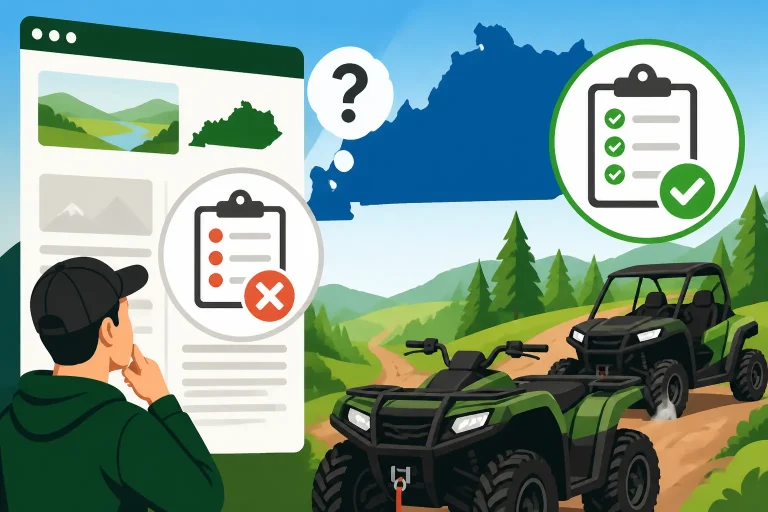
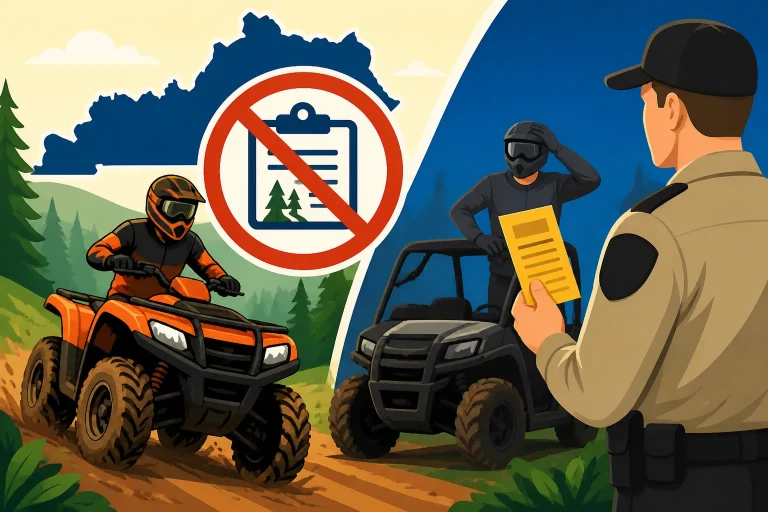
Kentucky riders often hear that no ATV or UTV safety-course certificate is required and assume that means no training, permits, or other rules matter. Those are separate questions. This guide explains what the absence of a statewide course mandate means, where other requirements may still apply, and how to make a safer plan before riding.
What Kentucky’s Lack of a Course Mandate Means
For ordinary off-road ATV and UTV use, Kentucky does not impose a general statewide requirement that every rider complete a safety course before operating a machine. That is the narrow answer. It does not mean that every rider can go anywhere, that every park has identical rules, or that training has no value.
A safety course is instruction: it may cover controls, protective equipment, terrain, passenger safety, and how to respond to common hazards. A trail permit is permission to use a particular riding area under its rules. A title is an ownership document. A driver’s license or road-use qualification is a separate issue again. One does not automatically replace another.
That distinction matters because riders sometimes focus on the wrong paperwork. A course card may be useful evidence that you have learned basic skills, but it is not a statewide trail pass. A park permit does not show that you know how to handle a steep descent. And being legally allowed to ride on a certain property does not make an unfamiliar machine or trail safe.
The state-level answer also does not settle every situation. A private park, rental operator, land manager, event organizer, insurer, or employer may set conditions for its own activity. Those conditions can differ by place and can change. Check the current rules for the exact location and type of ride rather than treating the absence of a statewide course requirement as a blanket exemption.
The main takeaway is simple: Kentucky’s general approach does not make a course certificate the universal gate to off-road riding. Riders still need to check the laws that apply to the machine and location, and they remain responsible for making sensible decisions about skill, equipment, passengers, and conditions. For a broader overview, see Kentucky ATV Safety Course Requirements and Does Kentucky Require an ATV Safety Course?.
Why There Is No Universal Statewide Course Requirement
There is no single reason a state chooses whether to require training. A statewide course mandate can be designed in different ways: it might apply to all operators, only younger riders, certain machine types, or use on particular land. Kentucky’s lack of a general off-road course requirement means the state has not made completion of a course the universal condition for ordinary ATV and UTV operation.
It is tempting to read that policy as a judgment that training is unnecessary. That would be a mistake. A legal requirement and a safety recommendation answer different questions. A government may set a minimum legal standard without claiming that the minimum is the best preparation for every rider. A course can be valuable even when the law does not require one.
Several practical considerations help explain why course rules are not always simple to make universal:
- Riding happens in different settings. A person may ride on private ground, at a managed off-road area, on a trail system, or as part of a rental or guided outing. Hazards, supervision, and access conditions differ.
- Machines are not all alike. A small youth ATV, a single-rider quad, and a multi-seat UTV have different controls, handling, and passenger considerations. A single course requirement may not address every difference equally well.
- Access rules are spread across different authorities. State law, local rules, land-manager policies, and private-property conditions may all affect where a machine can be used. A statewide certificate would not replace those separate rules.
- Riders have different experience levels. Some riders are new to motorized recreation; others have years of experience but may be new to a particular machine or terrain. A course can address fundamentals, while practical familiarization is still needed for each machine.
- A course mandate needs a workable system. Any mandatory program raises questions about which courses qualify, how completion is recorded, how age groups are handled, and how enforcement works. A state may choose other ways to regulate use instead.
These points are context, not a claim about a specific legislative motive. The useful conclusion is that “no universal course mandate” describes the rule’s scope; it does not tell you whether your machine, trail, or riding group has additional conditions.
Kentucky’s approach also makes it important not to rely on a vague memory from another state. A visitor might have needed a course credential where they usually ride. That does not automatically mean the same certificate is a Kentucky trail permit—or that a Kentucky permit will satisfy the visitor’s home-state rules when they return. Review Kentucky Rules for a Visiting Rider before planning an out-of-state trip.
What Still Governs Your Ride
A missing course requirement does not cancel the rules that apply to the rider, machine, road, or property. Before riding, identify which rules apply to the specific activity. The answer may change if you move from private land to a public trail, carry a passenger, enter a road, or use a rental machine.
Rider age and supervision
Age-related requirements deserve particular attention when children or teenagers are riding. A manufacturer’s age label, the machine’s size and power, the rider’s ability, and any rules for supervision all matter. A child who can reach the controls is not necessarily ready to operate a particular machine safely.
Do not use the absence of a course mandate as a substitute for age-appropriate instruction. Start with a machine the rider can control, teach on suitable ground away from traffic and obstacles, and maintain close supervision. Review Kentucky Rules for Riders Under 16 and Kentucky Parental Supervision Rules Explained for the rules that may apply to younger operators.
A youth course can be especially useful because it gives the child and supervising adult a shared vocabulary for basic safety. It still does not settle whether a particular machine is appropriate for that child. A course certificate cannot compensate for a machine that is too large, too powerful, or difficult for the rider to control.
Helmets and protective equipment
A course is not protective equipment. A helmet, eye protection, gloves, suitable clothing, and sturdy footwear each address a different part of the risk. Requirements can vary by rider, activity, and location, so confirm the rules that apply before you ride.
Even when a particular item is not legally required in a given situation, it may still be a prudent choice. A helmet should fit properly and be secured; borrowed or poorly fitting gear may offer less useful protection. Goggles can help with dust, mud, branches, and debris. Gloves improve grip and help protect hands from abrasion, while boots can protect feet and ankles from impacts and hot components.
For the legal side, check Kentucky Helmet Law for ATV Riders and any rules posted by the land manager. For the practical side, make sure each rider has gear that fits rather than assuming that a course, permit, or waiver covers protective equipment.
Roads and public access
Permission to ride off-road is not permission to use public pavement. Road rules are a separate issue, and Kentucky’s restrictions on ordinary ATV use on public roads are not changed by completing a safety course. Special-purpose vehicle provisions and local rules can also be distinct from ordinary trail riding.
If your plan includes crossing a road, using a road to reach a trail, or operating a machine that someone describes as “street legal,” verify the exact legal category and applicable conditions. Do not assume that adding lights, mirrors, or other equipment makes any ATV or UTV lawful on every road. Start with Kentucky Rules for ATVs on Public Roads and Are ATVs Street Legal in Kentucky?.
Property permission and trail access
A machine’s ownership paperwork does not grant permission to ride on someone else’s land. On private ground, get permission from the person or organization that controls the riding rights. On managed trails and parks, follow the posted access rules, designated routes, hours, and closures.
The right to ride can also be narrower than it first appears. A landowner may allow access only for a particular purpose or area. A trail manager may close a route when conditions are unsafe or damage is likely. A local permit may apply only to the area that issued it. For private ground, see Kentucky Landowner Permission Requirements. For public or managed land, check the relevant land manager’s rules directly.
Safety Courses, Permits, and Reciprocity Are Different
The phrase “reciprocity” can be confusing because it may refer to permits, registrations, training certificates, or other credentials. Those do not necessarily transfer from one jurisdiction or riding area to another. A course certificate records training; a permit gives access under a particular authority’s conditions. Neither should be assumed to replace the other.
Kentucky does not have a single statewide trail sticker that provides access to every riding area. Individual parks and land managers may have their own permit systems, and those permits generally relate to access at the place that issued them. A safety course does not make those local access requirements disappear.
| Item | What it generally shows | What it does not automatically provide |
|---|---|---|
| Safety-course certificate | The rider completed a course or training program | Permission to use a trail, park, or private property |
| Trail or park permit | The holder has access under that provider’s rules | Proof of training, ownership, or road legality |
| ATV or UTV title | A record of ownership under the applicable process | Permission to ride on a specific property |
| Out-of-state registration or document | A record recognized for a particular administrative purpose | A universal Kentucky trail permit or course waiver |
| Rental waiver or agreement | The renter accepted stated rental conditions | A guarantee that the renter is skilled or allowed to ride everywhere |
This is why a rider who has completed a course should still ask whether a permit is needed at the destination. A rider with a current park permit should still check whether the route is open and whether passenger, helmet, machine-width, or age rules apply. A title or registration document is not a substitute for either.
The statewide-versus-local distinction is covered in Kentucky Trail Permits Explained and Why Kentucky Has No Statewide Trail Sticker. If you are visiting from another state, do not assume that your home-state registration, permit, or course card is recognized for every Kentucky riding area. Check Does Kentucky Honor Out-of-State Registration? and the rules for the specific destination.
A useful way to avoid confusion is to ask three separate questions:
- May I operate this machine under the laws that apply to this rider and location?
- Do I need a permit or other permission to enter this property or trail system?
- Does the operator, park, rental company, event, or land manager require training or other qualifications?
Answering all three is more reliable than asking only whether Kentucky requires a safety course.
When Training or Other Conditions May Still Be Required
Even without a universal state course mandate, a particular provider can set conditions for participation. Those conditions are not automatically statewide laws, but they can still determine whether you may take part in that provider’s activity.
Private parks and land managers
A privately operated park or a public land manager may set its own access rules. Those might involve permits, age limits, safety equipment, route restrictions, machine requirements, or instructions at check-in. Whether a course is required is a question for the specific operator; do not assume that every location uses the same policy.
Check the provider’s current rules before loading the machine. Read signs and notices at the entrance, too. If a rule seems unclear, ask the staff or land manager before riding rather than relying on what another visitor says. Rules can also be different between designated trail areas, adjacent roads, and nearby private property.
For riding on federal land or in a specific recreation area, confirm the rules that apply there. The absence of a statewide certificate requirement does not override land-manager restrictions. See [Kentucky Rules for Riding a National Forest] and Kentucky Rules for Riding Land Between the Lakes for more on those distinct settings.
Rentals and guided rides
Rental companies commonly have their own eligibility, briefing, waiver, and equipment procedures. A provider may explain the controls and local hazards, require the renter to meet its conditions, or limit who may operate or ride as a passenger. Those are provider-specific terms, not proof that Kentucky has a general course mandate.
Before booking, ask what instruction is included and whether it is a short machine orientation or a formal course. Ask who may operate, whether passengers have separate requirements, what happens if a rider is not comfortable, and whether the permitted route is limited to certain areas. Read the agreement before signing, especially any terms about damage, recovery, and where the machine may go.
A guided ride may provide helpful instruction, but it is not automatically equivalent to a certified safety course. Likewise, a completed course does not automatically qualify someone to rent a particular machine. Review [Renting an ATV in Kentucky] and Kentucky Rental Age and License Rules for issues to check with a provider.
Events, organized rides, and work use
An organized event, race, guided tour, club ride, or work assignment may have conditions beyond the general rules for an individual recreational ride. The organizer or employer may require a briefing, a particular qualification, an equipment check, or proof of experience. Ask the responsible organization what applies, and get the answer before you arrive.
A worksite can present different hazards from a recreational trail. A machine may be used around vehicles, equipment, slopes, or other workers, and an employer may have training procedures of its own. Do not assume that the lack of a recreational course mandate settles workplace training obligations. Follow the applicable workplace rules and the employer’s instructions.
Insurance and waivers
A waiver is not a safety course, and signing one does not make a rider trained. An insurance policy or rental agreement may also have conditions that affect coverage or participation. Read the actual terms and ask the provider or insurer about anything that is not clear. Avoid relying on a verbal claim that “everyone is covered” or “no experience is needed.”
Why a Course Is Still Worth Considering
Training can make a meaningful difference even when it is optional. Many ATV and UTV incidents involve decisions that can be practiced: choosing a manageable line, controlling speed, keeping a safe following distance, recognizing when to turn back, and understanding how a machine responds on a slope or loose surface.
A good course or supervised introduction can help a rider learn:
- How to use the controls and shut the machine down safely.
- How to shift body position and maintain balance on an ATV.
- How a UTV’s weight, seating position, and rollover risk differ from a quad.
- Why passengers affect handling and should follow the machine’s seating design.
- How to approach slopes, turns, water, mud, and changing traction.
- How to inspect the machine before a ride and recognize a problem.
- How to communicate in a group and avoid crowding on narrow trails.
- When to stop, turn around, or ask for help rather than pushing on.
A course is most useful when it matches the rider and machine. A child needs instruction designed for a young rider, not just a general overview. Someone new to a side-by-side should learn its controls and passenger limits, even if they have ridden ATVs for years. An experienced rider trying a different terrain type may still benefit from local guidance.
If a formal course is not practical, make the first ride a deliberate learning session. Use a suitable, open practice area where riding is allowed. Start slowly, avoid steep or crowded routes, and have an experienced person demonstrate the controls and safe stopping. Practice one skill at a time. Do not teach a new rider by putting them into a fast group ride or a difficult trail and expecting them to keep up.
A course also does not replace machine-specific instruction. Before each ride, confirm where the controls are, how the brakes work, how to select drive modes, and what the warning indicators mean. For a rental, ask staff to show the controls and let you become comfortable in a safe area before joining a route. If you are not confident after the orientation, speak up rather than treating the booking as an obligation to ride.
Choosing gear and training materials
Training can be paired with a basic equipment check. Prioritize properly fitted protective gear and follow the machine maker’s instructions. When comparing helmets, goggles, gloves, and other riding equipment, Amazon may help you review product descriptions and customer feedback, but verify that an item meets the relevant safety standard and fits the actual rider. A listing or review is not a substitute for a correct fit.
Amazon can also be one place to compare printed guides or basic maintenance supplies, but do not assume a general guide covers Kentucky access rules or a specific park’s requirements. Use official rules from the land manager for access questions, and the machine’s manual for model-specific operation and maintenance.
If you shop on Amazon for replacement gear or supplies, compare specifications carefully instead of choosing only by a broad product title. For protective equipment, the exact model, fit, condition, and intended use matter more than a generic claim that an item is “for ATV riding.” Follow the manufacturer’s instructions and replace damaged safety equipment when needed.
A Practical Checklist Before You Ride
You can make a sound decision without turning every outing into a paperwork exercise. The goal is to verify the few things that actually control your ride: who may operate, where the machine may go, what access permission is needed, and whether the rider is prepared.
- Identify the machine and activity. Is it an ATV or UTV? Will the ride be on private property, a managed trail, a park, or a road? Is the machine rented or personally owned? These details affect which rules to check.
- Check rider readiness. Consider age, experience, physical ability, and familiarity with that particular machine. For a younger rider, review the applicable rules and manufacturer’s age guidance. Do not use a course certificate as the only measure of readiness.
- Confirm property access. Get permission for private land or check the current permit and entry conditions for a managed area. Verify that the route is open and that your machine type is allowed.
- Ask about training conditions. Contact a rental company, park, event organizer, or land manager if the rules are unclear. Ask directly whether a course certificate, orientation, or other qualification is required for your specific activity.
- Check equipment and machine condition. Inspect the tires, controls, brakes, lights where relevant, and other basic components. Use properly fitting protective gear and carry what the route reasonably requires.
- Plan for conditions. Consider weather, daylight, trail surface, water crossings, communications, fuel, and the skill level of everyone in the group. Tell someone where you are going and when you expect to return.
- Ride within the least experienced person’s ability. Agree on a pace, regrouping points, and a plan for turning around. Do not pressure a new rider to follow a faster or more experienced group.
If you are visiting Kentucky from elsewhere, add one more check: do not assume a course credential or riding permit from home covers the destination. Ask the Kentucky park or land manager what it accepts, and separately confirm any rules that apply to your home state when you return.
The clearest answer to “Why Kentucky mandates no safety course” is therefore also the most useful one: Kentucky does not make a statewide off-road course certificate the universal entry requirement for ordinary ATV and UTV riding. That leaves room for location-specific conditions, and it leaves riders responsible for deciding whether their training and skills match the machine and terrain. Treat the lack of a mandate as a legal distinction—not as a recommendation to skip preparation.
Disclaimer
This article is for general informational purposes only and does not constitute professional advice. Laws, prices and regulations vary by location and change over time. Consult a qualified professional for guidance on your specific situation.