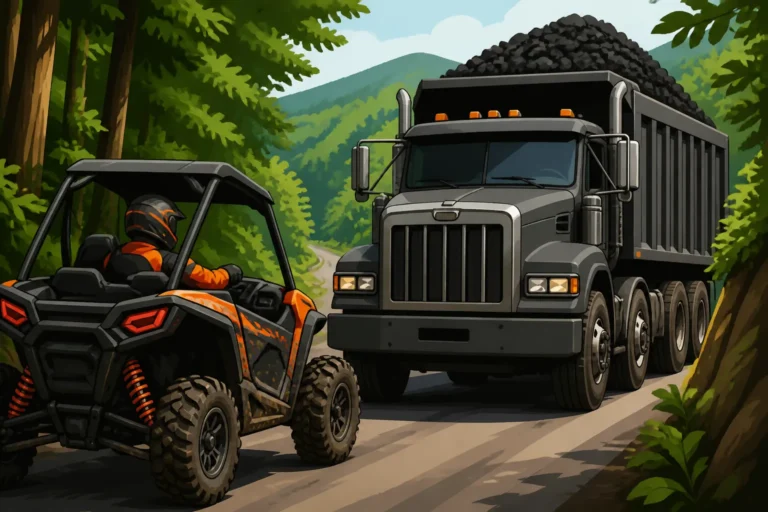
Rush Off-Road Loops a Stock Machine Can Handle
A stock ATV or UTV can be a sensible way to explore Rush Off-Road, but “stock” does not automatically mean “ready for every trail.” A machine’s clearance, tires, width, and condition matter, and so do recent rain and the route you choose. This guide explains how to plan manageable loops, avoid preventable trouble, and adjust your ride to the conditions.
What makes a Rush Off-Road loop manageable for a stock machine
Stock capability depends on more than engine size
A factory-standard machine may have plenty of power and still struggle on a route that is too rocky, steep, narrow, or slick for its setup. Ground clearance affects whether the underside catches on obstacles. Tire tread and tire pressure influence traction. Wheelbase and overall width can make tight turns or uneven ground feel less forgiving. On a UTV, the extra width can be just as important as the engine or drivetrain.
Before you plan a loop, check your machine’s owner’s manual for its operating limits and inspect the machine itself. Look for worn tires, loose steering components, weak brakes, a damaged skid plate, and a winch or recovery point that is not secured properly. A machine that was fine on a short neighborhood ride may reveal problems after hours on rougher terrain.
It also helps to be honest about what “stock” means for your vehicle. A factory winch, skid plate, or tire package may make a meaningful difference, while a standard machine with worn tires or low clearance may need a more conservative route. If you are comparing trail terrain with your setup, Kentucky Trail Difficulty Ratings offers useful context for thinking about difficulty beyond engine size.
A loop is only as easy as its hardest section
The word “loop” can sound reassuring: start at one point, ride around, and return. But a route may include a short section that is much tougher than the rest. A rocky pinch point, steep climb, tight turn, or muddy low spot can set the real difficulty for a stock machine, even when most of the loop feels comfortable.
That is why it is smart to ask about the entire route, not just its general rating or the first stretch from the staging area. Check whether the loop includes obstacles that could challenge your ground clearance, width, or traction. If you are riding with friends, choose a route that works for the least capable machine and least experienced rider in the group. Nobody has to prove anything by pushing through a section that feels wrong.
Start with shorter, easier-looking routes and treat the first ride as a chance to learn the park. The trail surface can change after rain or heavy traffic, so a loop that was manageable on one visit may not feel the same on another. For a broader look at the park and its riding options, see Rush Off-Road in Eastern Kentucky and Kentucky Trails for Beginners.
How to choose a loop before leaving the staging area
Check the current map and ask about conditions
Use the park’s available trail information to identify routes that fit your machine and experience, then confirm that the information is current. Park maps and signs can help you understand the trail network, but they may not tell the whole story about a washed-out section, a temporary closure, or a difficult obstacle that developed after recent weather. When in doubt, ask park staff what they recommend for a stock ATV or UTV.
A navigation app can be useful for reviewing your position and following a planned route. For example, onX Offroad can help riders look at routes and keep track of where they are, but it should complement—not replace—current park signs, posted closures, and staff guidance. Download or prepare the information you need before you head into areas where phone reception may be unreliable.
Bring a map you can consult without relying on cell service, and make sure everyone in the group understands the route. Kentucky Trail Maps Worth Carrying and Kentucky Trail Conditions Before You Ride cover the planning side in more detail. A map does not guarantee that a route is open or suitable today, so verify the conditions at the park before committing to a loop.
| What to check | Why it matters for a stock machine | A sensible response |
|---|---|---|
| Trail width | A UTV may not fit comfortably through tight sections | Confirm width suitability before setting out |
| Clearance and obstacles | Rocks, ruts, and ledges can catch the underside | Choose a route that matches your ground clearance |
| Recent rain | Wet ground can reduce traction and deepen ruts | Ask about mud, runoff, and closures |
| Route length | A long loop can leave little room to recover from a delay | Start short and leave time to return |
| Group ability | One rider may have less experience or a less capable machine | Pick a route everyone can handle |
| Navigation and communication | Cell service may be inconsistent away from the staging area | Carry a map and agree on regrouping points |
Plan a route with an easy way to turn around
A good first loop is not necessarily the shortest one on the map. It is the route where you can make a calm decision if the surface, grade, or obstacle feels harder than expected. Before you leave, identify places to stop safely, regroup, or turn back. Tell someone in your party what the plan is, and agree that turning around is an acceptable outcome.
Use a conservative pace while you learn the terrain. Approaching an unfamiliar climb slowly gives you more time to read the surface and choose a line. Keep enough space between machines to avoid dust and give each rider room to stop. On a narrow section, don’t crowd the machine ahead or assume the trail is clear around a blind bend.
If you use onX Offroad to follow a route, compare what you see on the screen with the trail markings and conditions in front of you. A digital route can help with orientation, but it cannot tell you whether a muddy section is passable for your particular setup. Your map, the posted information, and your judgment should all point in the same direction before you continue.
Adjust your plans for terrain and weather
Rain can change the difficulty quickly
Wet ground can turn an ordinary-looking trail into a traction problem. Tires may spin where they would normally grip, ruts can become deeper, and water may hide rocks or holes. A stock machine with standard tires may be especially limited when the surface is slick. Trying to maintain momentum through mud can also make it harder to steer or stop safely.
After heavy rain, ask whether routes are open and what conditions riders are encountering. Follow any closure notices rather than treating them as suggestions. If a route is deteriorating, continuing can damage the trail, increase the chance of getting stuck, and create a recovery problem for your group. Kentucky Riding After Heavy Rain and Kentucky Trail Closures to Check First explain why a quick conditions check is worth building into the day.
Be prepared to change your plans even after you have started riding. If water is running across the trail, a slope looks slick, or the ground is breaking away under the tires, stop somewhere safe and reassess. Turning back before a machine is bogged down is usually easier than arranging a recovery after the fact.
Match tire condition and technique to the surface
A stock tire can work well within its limits, but tread condition matters. Worn, damaged, or poorly maintained tires make a challenging surface more difficult than it needs to be. Before your ride, check for cuts, bulges, loose hardware, and pressure that falls outside the manufacturer’s guidance. Avoid making changes based on a guess; use the manual or ask a qualified technician if you are unsure.
On rocky or uneven terrain, choose a careful line rather than aiming directly at the most obvious obstacle. Keep your speed controlled and avoid abrupt steering or throttle inputs. On a climb, pause before entering if you cannot see the path clearly, and make sure there is room to stop without blocking other riders. If an obstacle appears beyond your ability or the machine’s capability, do not let group pressure make the decision for you.
Different surfaces call for different preparation, and tire choice is only one part of the picture. Tire Choice for Kentucky Rock and Mud offers additional guidance on thinking about traction and terrain. Even well-equipped tires cannot make an unsuitable route safe, so use them as one factor—not a reason to push beyond the machine’s limits.
Ride within your limits and keep the group together
Set expectations before the first turn
Before starting a loop, agree on who leads, who rides at the back, and where the group will regroup if someone gets separated. The lead rider should know the planned route and be willing to slow down. The last rider should not be left to catch up alone. If a rider needs to stop, the group should have a clear way to communicate and wait safely.
Keep a comfortable following distance, especially on dusty stretches, hills, and narrow trails. Give the rider ahead time to clear an obstacle before you enter it. If you meet another group, slow down and make space where the trail allows. Courtesy matters on tight routes: a blind corner is no place to assume another machine will yield.
On a mixed group ride, don’t treat the strongest machine as the standard for everyone else. A high-clearance ATV and a wider stock UTV can experience the same section very differently. Choose the pace and route around the most constrained rider, not the person who is eager to go farther.
Know when to stop rather than force a section
Warning signs are often practical rather than dramatic: repeated tire spin, the underside contacting rocks, a machine leaning more than feels controlled, or a rider becoming anxious about a descent. Stop in a safe place and talk through the options. If you cannot identify a line that feels manageable, turning around is a sound choice.
Avoid improvised recovery attempts that put someone in the path of a moving machine or under a vehicle that could shift. Use equipment only as intended, keep people clear of tensioned recovery gear, and ask park staff for help when the situation exceeds your experience. A recovery plan is not a substitute for choosing a route within your limits; it is a backup for problems that can still happen.
A comfortable day at Rush Off-Road is not measured by how difficult a loop was. It is measured by making good decisions, getting everyone and every machine back safely, and leaving the trail in good condition. For practical advice on sharing narrow routes, read Kentucky Trail Etiquette on Narrow Benches. If you want a deeper look at the park’s operating details before you go, Rush Off-Road’s Daily Hours and Rush Off-Road Permit Cost are useful planning topics to check alongside current information from the park.
Disclaimer
This article is for general informational purposes only and does not constitute professional advice. Laws, prices and regulations vary by location and change over time. Consult a qualified professional for guidance on your specific situation.