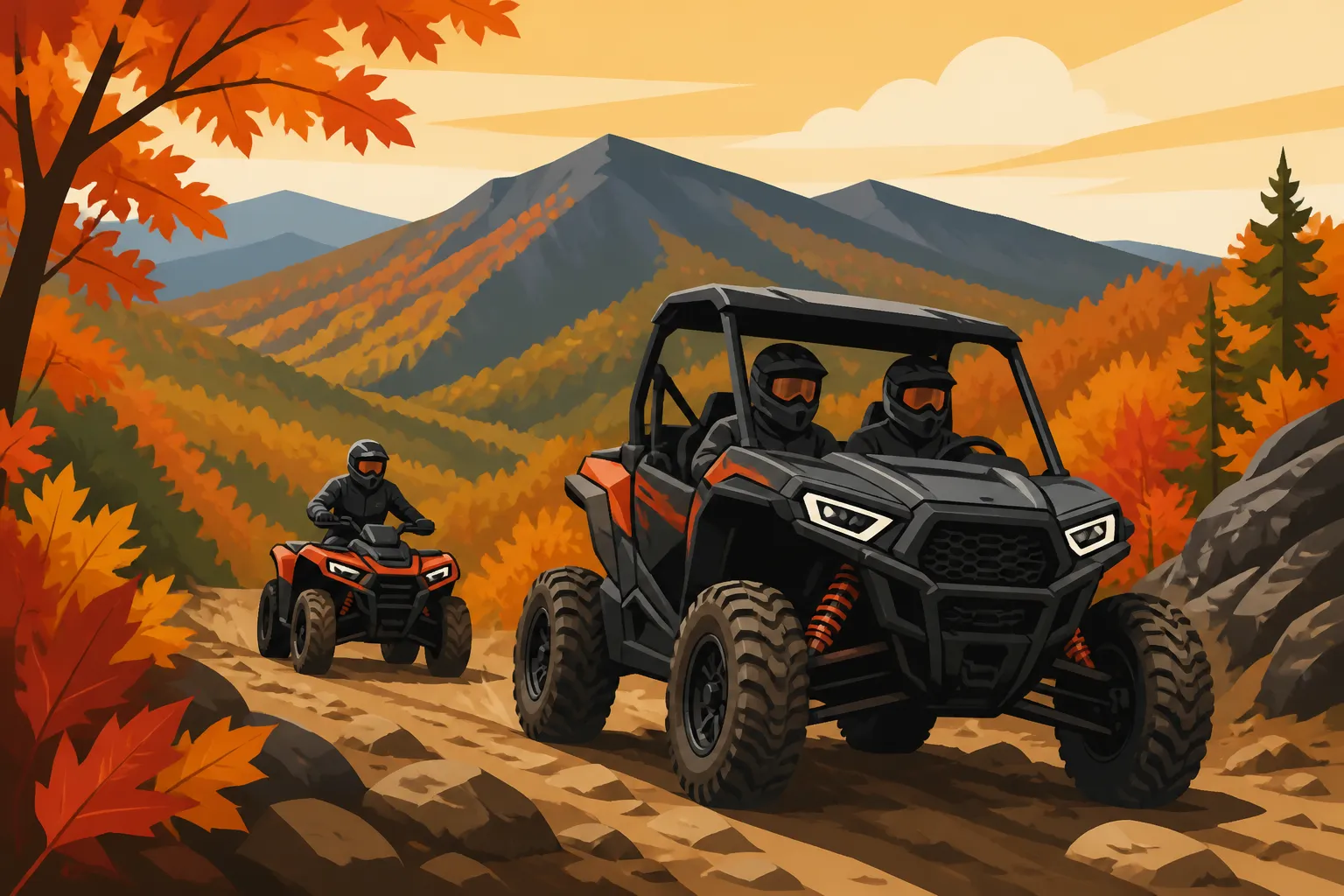
Riding Black Mountain in Autumn
Autumn can make a ride at Black Mountain Off-Road Adventure Area feel unforgettable, but changing leaves and cooler air don’t guarantee easy trail conditions. Wet leaves can hide rocks, mountain weather can shift quickly, and daylight disappears earlier than it does in summer. This guide covers how to plan a safer fall ride near Evarts and Putney, from checking access to packing for the trail.
What makes an autumn ride at Black Mountain different
Expect changing weather and trail conditions
Fall temperatures in the mountains can vary considerably between a sunny afternoon and a shaded hollow. A ride that feels comfortable at the staging area may feel chilly on an exposed ridge or after a stop. Rain can also change the character of a route: leaves may cover rocks, roots, ruts, and other obstacles, while damp ground can make climbs and descents more demanding.
Check the forecast for the area you’ll actually be riding, not just the conditions at home. Look at the expected temperature range, rain, wind, and the timing of sunset. A forecast is only one part of the plan, though. Ask about recent conditions and closures before unloading, especially after a stretch of heavy rain. [Kentucky Riding After Heavy Rain] offers useful context for thinking through how wet weather can affect a ride.
Autumn foliage is a bonus, not a reason to take unnecessary risks. Stop in a safe, permitted place if you want to enjoy the view or take photos. Avoid pausing around blind corners, on narrow sections, or where another rider may not have room to pass. If fog or low cloud moves into the mountains, slow down and be ready to turn back rather than push on toward an overlook.
Choose a route that fits the least experienced rider
Black Mountain’s terrain can be challenging, and a group’s pace is usually set by its least experienced rider. Before setting out, talk through what everyone is comfortable handling: steep climbs, loose or rocky surfaces, narrow trail sections, and longer stretches away from the trailhead. An autumn ride can be a poor time to discover that a newer rider is uneasy on a descent or that a machine is too wide for the route.
Ask park staff or the people responsible for access about current route conditions and difficulty. Conditions can change, and a route that seemed manageable in dry weather may feel very different after rain or beneath a layer of leaves. Don’t assume that a trail’s appearance from the staging area tells you what the full route will be like. For a broader look at the area and its terrain, see [Black Mountain Off-Road Adventure Area in Kentucky] and [Kentucky Trail Difficulty Ratings].
Plan a ride with a clear turnaround point and enough time to get back before dark. If the group is split between confident riders and beginners, choose a route that allows everyone to stay together rather than relying on faster riders to wait farther ahead. [Riding Black Mountain for a Weekend] can help you think through how to pace a longer visit instead of trying to fit every ride into one outing.
Plan your route before leaving the trailhead
Pick your starting point and confirm access
Black Mountain rides commonly begin from the Evarts or Putney side, but your best starting point depends on your day’s plan, lodging, and the routes available. Confirm the appropriate trailhead and access arrangements before you load up. Check what the park requires for entry, where to park and unload, and whether any area-specific instructions apply to your machine or group.
Give yourself time for check-in, gearing up, and a quick machine inspection. Rushing straight from the trailer onto the trail can mean overlooking a loose strap, low tire pressure, a missing tool, or an unclear route plan. If you’re traveling with several machines, agree on a meeting place in case anyone gets separated before the ride begins. [Starting From the Evarts or Putney Trailhead] is a useful related guide for comparing those starting points.
Don’t count on every road or trail connection being open simply because it appears on a map. Confirm current access with the park before departure and again at check-in if conditions have changed. [Kentucky Trail Closures to Check] and [Kentucky Trail Conditions Before You Ride] are helpful reminders to make that check part of your routine, not an afterthought.
Carry maps and make a backup plan
Mountain terrain can make navigation harder than it looks from home. A phone may lose signal in a hollow, its battery may drain faster in cold weather, or a route may be difficult to interpret while you’re stopped on a narrow trail. Download any maps you plan to use before leaving an area with reliable service, and bring a backup option that doesn’t depend on a live connection.
A tool such as onX Offroad can help you review a route and keep track of your location, but don’t treat a digital map as permission to ride every line it displays. Confirm that your planned route is open and authorized, and follow posted signs and staff instructions. Before the ride, make sure each group member knows the intended route and where to regroup if someone has to turn around.
Tell someone who isn’t riding where you plan to go and when you expect to return. That person should know who to contact if the group is overdue. Carry a charged phone, but plan for dead zones rather than assuming you’ll be able to call from anywhere on the mountain. [Kentucky Trail Maps Worth Carrying] and [Cell Dead Zones in a Holler] cover two practical parts of this preparation.
Pack and prepare for fall trail conditions
Dress for cool starts and warmer afternoons
Layering makes it easier to adjust as the temperature changes. Start with clothing that stays comfortable under your riding gear, then add a warm layer for the ride to the trailhead or a stop at an exposed location. Bring rain protection even if the forecast looks favorable. Once clothing is wet, a cool breeze or a long wait can make a pleasant ride uncomfortable.
Gloves that work in cooler weather can help with comfort, but they still need to give you good control of the machine. Pack a dry spare pair if your route is likely to involve wet conditions. Eye protection is important too: dust, mud, falling leaves, and debris can all affect visibility. Keep extra layers and personal items secured so they can’t fall off on a rough section.
Take particular care with visibility as daylight fades. Avoid letting a scenic stop or a slow stretch push the group into an unplanned ride after dark. Check the sunset time, set a turnaround time with some margin, and make sure your lighting is in good working order before you leave. When the route is unfamiliar, allow more time than your map estimate suggests.
Check the machine before the ride
A short inspection at the trailer can prevent a long, frustrating delay on the trail. Check tire condition and pressure, brakes, steering, lights, fuel, and visible fasteners. Make sure any cargo is secure and that the machine is appropriate for the routes you intend to ride. If you’re uncertain about a mechanical issue, address it before leaving the staging area instead of hoping it will hold up on a remote climb.
Bring basic tools and supplies suited to your machine, along with water, snacks, a first-aid kit, and a way to contact your group. Fuel planning matters on a mountain ride: don’t assume you’ll find fuel where you need it or that a route will take exactly as long as expected. Build in a reserve, particularly if cold weather, mud, or slower riding could increase the time you’re out. [Planning Fuel Across a Mountain Loop] and [Tire Choice for Kentucky Rock and Mud] can help you prepare for those practical details.
| Autumn concern | Why it matters | Practical response |
|---|---|---|
| Wet leaves | They can hide rocks, roots, and ruts | Reduce speed and avoid abrupt turns or braking |
| Cooler temperatures | Conditions can feel different at the trailhead and on exposed routes | Dress in removable layers and pack dry clothing |
| Shorter daylight | A delayed return may leave the group riding in low light | Set a firm turnaround time and check sunset |
| Limited cell service | Calls and online maps may not work in some areas | Download maps and share the route with someone at home |
| Changing access | Weather or park decisions may affect planned routes | Confirm current conditions and follow posted notices |
Ride responsibly and leave room for changes
Respect park instructions and other trail users
Follow the park’s current access rules, permit requirements, signs, and staff directions. Requirements can depend on where you’re riding and how the area is operating, so confirm details directly before your trip rather than relying on an old post or a friend’s recollection. For related background, see [Kentucky Trail Permits Explained].
On narrow routes, keep a controlled pace and give other riders room. Be especially alert around blind corners, steep sections, and places where machines may need to pass carefully. If you encounter a work vehicle or other permitted road traffic, follow posted instructions and move only when it is safe. Staying on authorized routes helps protect the area and reduces the chance of taking an accidental wrong turn onto land where riding isn’t allowed.
Keep the group together without crowding. Agree on a lead rider and a sweep rider, and choose safe places to stop where the whole group can get out of the way. If anyone wants to leave early, decide how they’ll return before the ride begins. [Kentucky Trail Etiquette on Narrow Benches] has more advice for sharing confined mountain routes.
Know when to shorten or cancel the ride
A good plan includes permission to change the plan. Heavy rain, fog, a mechanical problem, an unexpectedly slow pace, or a rider who is getting cold can all be reasons to turn back. Don’t let the time and effort spent getting to the park convince you to continue when conditions no longer feel safe.
If the group is running late, choose the simplest safe route back rather than adding one last climb or scenic detour. If someone becomes separated, use the agreed meeting point and communication plan instead of sending other riders off in different directions. If a machine develops a problem, stop somewhere safe and assess it before attempting a difficult section.
For an overnight visit, make lodging and trail access part of the plan. Check how far your accommodation is from the starting point, whether parking and unloading are suitable, and what services are available nearby. [Where to Camp Near Black Mountain] and [Camping Near Kentucky ATV Trails] can help you explore stay options. With a flexible route, suitable gear, and a realistic return time, fall riding at Black Mountain can be rewarding without turning the day into a race against the weather.
Disclaimer
This article is for general informational purposes only and does not constitute professional advice. Laws, prices and regulations vary by location and change over time. Consult a qualified professional for guidance on your specific situation.