Kentucky Riding in Hunting Season
A fall ride in Kentucky can turn from a quiet trail outing into a close encounter with hunters, parked trucks, or a trail closure you didn’t expect. Hunting season doesn’t automatically shut every riding area, but it does change what you should check before unloading. This guide covers planning, visibility, trail etiquette, and ways to ride more thoughtfully around hunting activity.
Plan your Kentucky ride around hunting activity
Hunting seasons overlap with prime riding weather: cool mornings, colorful hillsides, and trails that are more comfortable than they are in midsummer. That combination draws both riders and hunters outdoors. The key is not to assume a familiar route is open or that everyone using the landscape is there for the same reason.
Check the riding area before you leave
Start with the land manager or riding area, not an old social media post or a map showing a trail as open. Rules can differ between a private off-road park, a national forest route, a wildlife area, and a trail system on leased land. A seasonal closure may affect only certain roads or dates, while another area may remain open under specific conditions.
For example, riders planning a trip to Black Mountain Off-Road Adventure Area near Evarts, Leatherwood near the Perry and Letcher county area, or Turkey Bay OHV Area in Land Between the Lakes should check the relevant operator or land manager’s current notices before hauling. Confirm that the trails you intend to use are open, ask whether hunting activity changes access, and check for restrictions on parking or staging. Don’t assume conditions are the same across Kentucky simply because the trip falls within a familiar season.
If your plans include public land, check which roads and trails are designated for motorized use. Hunting access does not automatically grant ATV access, and an open hunting area is not necessarily an open riding area. Guides such as [Kentucky's National Forest Riding] and [Kentucky Rules on Land Between the Lakes] can help you think through the difference between a riding destination and land that happens to be open for other recreation.
Before departure, check the weather and trail notices again. A wet week can lead to closures even when hunting is not the reason. In eastern Kentucky, steep, narrow routes may become slick after rain; in a hollow, a short downpour can make a crossing or low spot much harder to manage. For riding-specific weather considerations, see [Kentucky Riding After Heavy Rain].
Choose your timing and route deliberately
A late start can put you on a trail when other visitors are already heading back to their vehicles. An early start can also mean riding near hunters traveling to a spot before daylight. Neither timing is automatically safer. Look at the area’s posted hours, the season’s conditions, and the likely activity on the route, then plan a ride that leaves enough daylight to return without rushing.
Keep your route simple enough that you can change it. If you encounter a marked closure, a group of hunters, or a stretch where you cannot safely pass, turn around rather than trying to find an unmarked shortcut. A dead-end spur or narrow bench road can make it difficult to turn a wide side-by-side around. A little advance planning is easier than improvising on a steep hillside with limited visibility.
A navigation app such as onX Offroad can help you review routes and keep track of your position, especially when a familiar ride includes several trail junctions. Treat any digital map as a planning aid, not proof that a route is open or that you have permission to cross private property. Confirm access with the park or land manager and follow posted signs. You can also prepare with [Kentucky Trail Maps Worth Carrying] and [Kentucky Trail Closures to Check First].
Make your machine and group easier to see
Hunters and riders may use the same broad area, but visibility is often reduced by trees, bends, hills, and changing light. A machine can appear suddenly on a trail, and a rider may not notice a person set back from the path. Slow, predictable riding gives everyone more time to recognize what is ahead.
Improve visibility without relying on color alone
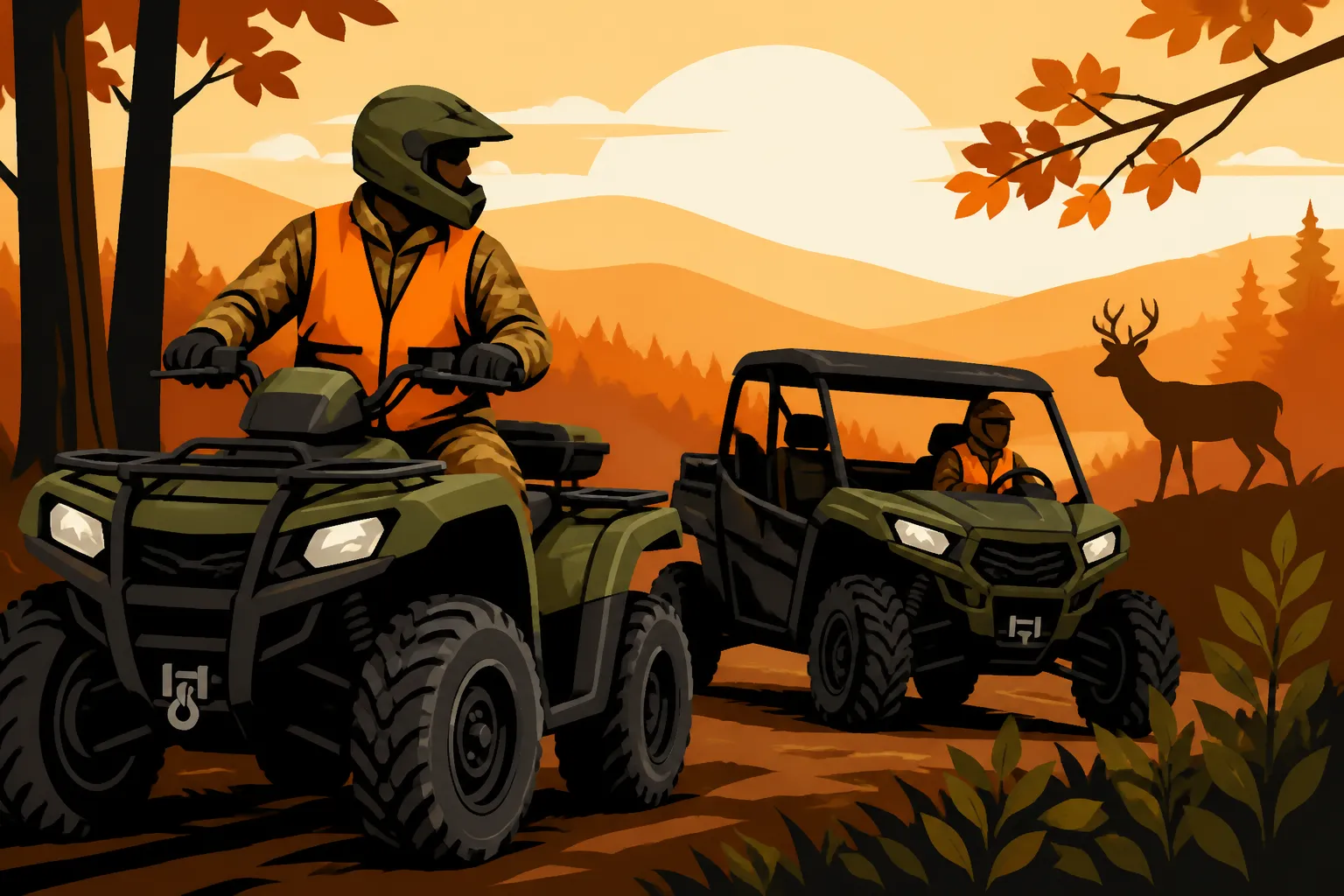
Wear clothing that stands out against the season. Autumn browns, dark greens, and camouflage can blend into woodland edges, while a bright outer layer is easier to notice. Follow any requirements set by the riding area and any applicable hunting rules. Because requirements can vary by activity and location, don’t treat general riding advice as a substitute for checking the specific rules.
Visibility also depends on where you ride and how you ride. Use the machine’s required lighting when conditions call for it, keep lenses and lights clean, and avoid cresting a hill or rounding a blind bend at a speed that leaves no time to react. Dust, leaves, and low sun can make it harder to see another person even when the trail seems clear.
For example, a rider approaching a wooded bend on a narrow route near Harlan may see only a few yards ahead. If the group is spread out, the first rider may meet someone before the last rider knows there is a reason to slow down. Keep the group together enough to communicate, and use sensible spacing rather than letting faster riders disappear around corners. [Kentucky Trail Etiquette on Narrow Benches] offers more context for sharing tight routes.
Ride at a pace that leaves room to stop
Hunting-season rides are a poor time to treat a familiar trail as a racecourse. Ride slowly enough to stop within the visible path, especially near trail intersections, parking areas, gates, cabins, and places where another route joins yours. Be extra cautious when foliage blocks sightlines or when a trail passes close to a road or a likely access point.
Use a simple group routine. Agree on a comfortable pace before leaving, identify the lead and sweep riders, and decide how the group will handle a turn-around or unexpected stop. If the lead rider sees people or a vehicle ahead, they should slow down early and signal the rest of the group. Avoid sudden swerves that could send another rider into a ditch or off the edge of a narrow trail.
Sound and speed matter, too. A loud machine can surprise someone who is focused on hunting, while fast riding gives both parties less time to respond. Don’t use the throttle to announce your presence. Reduce speed, give people room, and wait for a clear indication that it is safe to pass. If you’re riding with children, newer riders, or passengers, discuss these expectations before you start. Related guidance appears in [Riding With Children at a Kentucky Park].
Share trails and access points respectfully
A trailhead or access road may serve several groups at once. Hunters may be carrying equipment, loading a vehicle, or walking away from a parking area. Riders may be checking permits, unloading machines, or waiting for friends. Calm, courteous behavior reduces the chance that a brief encounter turns into a conflict.
Handle an encounter with hunters calmly
If you see hunters near the trail, ease off the throttle and give them space. Don’t ride toward a person to ask a question if doing so would bring the machine close to them or their equipment. Stop at a safe distance, make yourself visible, and communicate in a calm voice if the situation allows. If you are unsure whether a route is open, turn around and contact the land manager or park staff rather than trying to negotiate access in the moment.
Never assume that a person standing off the trail is on public land or that a visible track is an invitation to ride there. A route can cross private land, leased property, or an area with access restrictions. Map tools such as onX Offroad may help you understand where you are, but boundaries and access permissions still need to be confirmed through appropriate channels. A map is not a substitute for permission.
If someone asks you to leave an area, don’t escalate the encounter. Move back to a known authorized route and report any access concern to the property owner or riding-area staff. For broader guidance on property access, read [Kentucky Landowner Permission Rules] and [Kentucky Trespass Rules for Riders]. These principles matter whether you are near a public trail, a private park, or a route that crosses land with separate ownership.
Keep trailheads and shared roads clear
At a busy access point, park and unload only where the operator allows. Keep trailers, trucks, and machines out of gates, narrow roads, and signed access lanes. A vehicle blocking a gate can prevent emergency access or make it difficult for another group to reach a legal parking area.
When passing people on foot or near vehicles, slow down substantially and leave a generous margin. Avoid spinning tires or throwing mud and debris toward people, parked vehicles, or equipment. If there is not enough room to pass safely, wait. A short delay is better than forcing someone to step into brush or onto an unstable slope.
If you come across a closed gate, a temporary notice, or a blocked trail, don’t move the barrier or ride around it. Closures can protect visitors, wildlife, property, or trail surfaces, and the reason may not be obvious from the trail. Check the posted notice and contact the operator if you need clarification. [Kentucky Trail Closures to Check] and [Kentucky Trail Conditions Before You Ride] are useful reminders to verify conditions before committing to a route.
Use a practical pre-ride checklist
Hunting-season riding is easier to manage when you check the essentials before the truck leaves the driveway. A short checklist can prevent a long drive to a closed trailhead or an uncomfortable encounter on a route you had not researched.
Compare the main risks before you choose a route
Use this table as a planning prompt, not a substitute for a park’s rules or an official closure notice.
| What to check | Why it matters | What to do |
|---|---|---|
| Trail status | Seasonal or weather-related closures may affect access | Confirm directly with the riding area or land manager |
| Hunting activity | Other visitors may be using nearby land or access roads | Ask about restrictions and choose a route with clear access |
| Daylight | Shorter days can leave less time for an unhurried return | Set a turnaround time and avoid stretching the ride |
| Visibility | Trees, bends, dust, and low light can hide people or machines | Wear visible clothing and slow down where sightlines are short |
| Property boundaries | A track on a map does not establish riding permission | Stay on authorized routes and verify access |
| Group readiness | A separated or inexperienced group may react slowly | Agree on pace, signals, and what to do if the group stops |
Follow a step-by-step pre-ride routine
- Choose a destination with confirmed access. Check the riding area’s own notices and ask about hunting-season restrictions, trail closures, and parking instructions.
- Review your route. Use a dependable trail map to understand junctions and possible turnarounds, but verify that each route is open and authorized.
- Set a realistic schedule. Account for daylight, travel time, breaks, and the possibility of turning around early.
- Brief everyone in the group. Agree to ride at a pace suited to the least experienced person and to slow down near blind bends, trailheads, and people on foot.
- Pack for changing conditions. Bring suitable clothing, water, basic recovery and repair supplies, and a charged phone or other communication option. Don’t count on reliable cell service in every hollow or remote area.
- Recheck before unloading. Look for new signs, gates, or notices at the trailhead. If conditions differ from what you expected, ask staff or choose another legal route.
The best hunting-season ride is not necessarily the longest one. It is the one where the route is open, the group can see and hear what is happening around them, and everyone is willing to slow down or turn back when conditions call for it. A little courtesy goes a long way when hunters, hikers, landowners, and ATV and UTV riders are sharing Kentucky’s outdoors.
Disclaimer
This article is for general informational purposes only and does not constitute professional advice. Laws, prices and regulations vary by location and change over time. Consult a qualified professional for guidance on your specific situation.