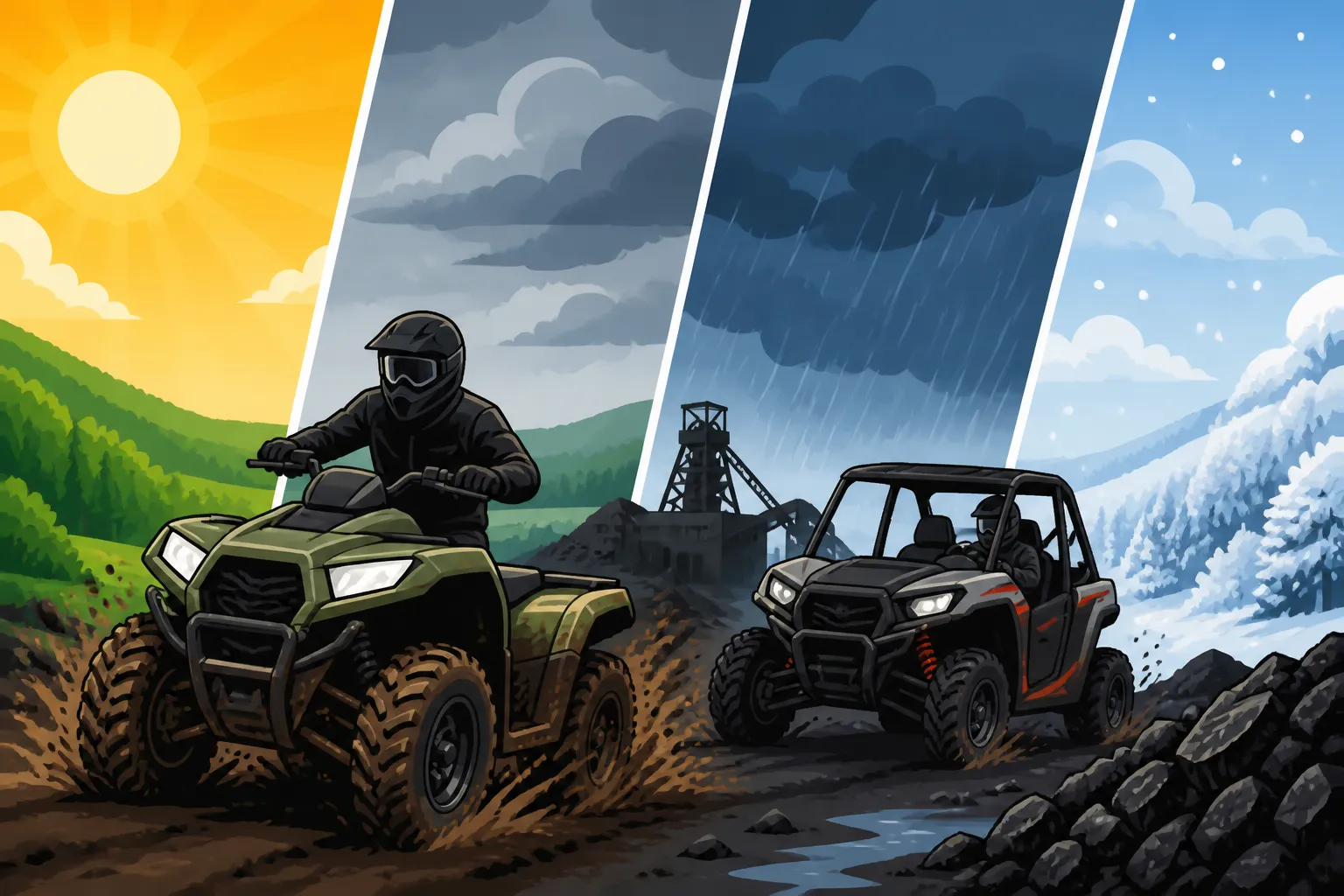
Kentucky Riding in Coal Country Weather
Coal-country rides can change character quickly: a dry ridge may stay dusty while a shaded hollow turns slick, and a brief storm can leave water moving across a trail long after the rain stops. This guide explains how weather affects ATV and UTV riding in eastern Kentucky, what to check before you haul, and how to adjust your plans when conditions shift.
Why weather changes so quickly in Kentucky coal country
Ridges, hollows, and mine roads behave differently
Around Harlan, Evarts, and Putney, steep slopes and narrow hollows can make one ride feel like several different weather days. A ridge may be exposed to wind and direct sun, while a lower trail stays shaded, damp, and cooler. Coal benches and old haul roads can also be open to the elements, with little cover when rain or fog rolls in.
That variation matters because a forecast for a nearby town cannot tell you exactly what is happening on every section of a trail system. A dry parking area does not guarantee dry climbs farther up the mountain. Likewise, a passing shower may leave one exposed stretch wet while a sheltered route remains mostly dry. Build your decision around the conditions on the trail, not just what the sky looks like at the trailhead.
In steep terrain, water tends to run downhill and collect in low spots. A shallow crossing early in the day can become deeper or faster after a storm upstream. If you are planning a ride near Black Mountain Off-Road Adventure Area or another Harlan County trail system, treat hollows and creek crossings as places to reassess rather than obstacles you must get through.
Weather can affect the surface after the sky clears
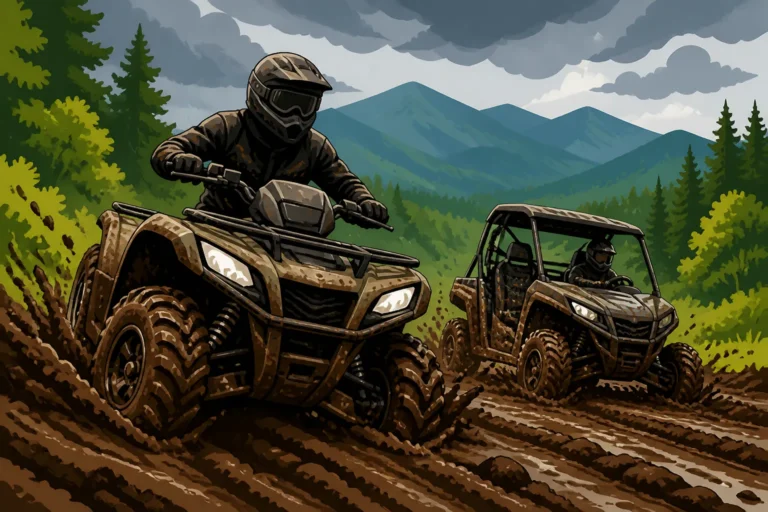
Rain does not stop influencing a ride when the clouds pass. Water can keep draining off slopes, loosen gravel, and soften sections of trail. On a steep climb, that can mean less predictable traction; on a descent, it can make braking and steering more difficult. A route that was manageable on a dry day may require slower, more deliberate riding after rain.
Coal-country trails can include a mix of surfaces, including dirt, rock, gravel, and older roadbeds. Each responds differently to moisture. Smooth rock may become slippery, loose soil may turn muddy, and gravel can move under a tire. The change may be especially noticeable in shaded areas that take longer to dry. For more on post-storm planning, see [Kentucky Riding After Heavy Rain] and [Mud After a Week of Mountain Rain].
The reverse can also be challenging. During a dry spell, exposed roads may become dusty, reducing visibility for riders following behind. A dust cloud can hide a rut, a stopped machine, or a bend in the trail. Leave space between machines and slow down when you cannot clearly see what lies ahead.
Planning around rain, mud, and water
Check trail status before you load
A forecast is only one piece of the planning puzzle. Before leaving home, check the riding area’s own notices, operating information, and trail updates. A park may close trails or restrict access when the ground is saturated, even if the rain has ended. Closures help protect both riders and trail surfaces, and trying to work around a closed gate can create a safety and access problem.
If you are headed to Turkey Bay OHV Area, Black Mountain, Leatherwood, Rush Off-Road, or another managed riding area, confirm the details directly with the operator before you tow. Do not assume that a trail is open because it was open on your last visit or because a general map shows a route. Conditions and access can vary by location and change after weather events. For a practical pre-trip checklist, read [Kentucky Trail Closures to Check] and [Kentucky Trail Conditions Before You Ride].
It helps to check again on the morning of your trip. If rain is forecast during the drive, conditions at your destination may be different from those where you started. Keep a flexible plan: choose a shorter route, delay departure, or reschedule if the operator reports poor conditions. A long drive and a loaded trailer can make it tempting to ride anyway, but sunk travel time is not a good reason to enter unsafe or closed terrain.
Treat crossings as decision points
Creeks and low spots deserve extra attention after rain. A crossing that looks familiar may have a different depth, current, or bottom after water has moved through the area. Never assume that a route is safe just because another machine crossed earlier. Water can rise quickly, and the footing beneath it may be hidden.
If you cannot judge the depth or current, do not enter. Turn around, choose a confirmed alternative, or wait for conditions to improve. Avoid riding into moving water to test it, and do not cross where you cannot see the exit or understand the surface beneath the water. Narrow valleys can also funnel water and debris toward a crossing, so leave yourself room to stop and reconsider. See [Flash Flooding in a Narrow Valley] for more on why these locations need extra caution.
Wet ground can make recovery harder, too. A machine that gets stuck on a muddy slope may be difficult to move without putting other riders at risk. Before you set off, agree with your group on a turnaround point and a plan for keeping everyone together. If conditions worsen, turning back is a sound riding decision, not a failed trip.
Riding through heat, cold, fog, and changing light
Summer heat needs a slower pace and regular breaks
A hot ride can wear down even experienced riders, especially when the route includes sustained climbs or long stretches without shade. Protective riding gear is important, but it can also trap heat. Drink water regularly, take breaks before you feel exhausted, and pay attention to how everyone in the group is coping. Children and newer riders may need more frequent stops.
Plan your route with the day’s conditions in mind. A shorter loop with an easy return option may be more sensible than a long ride that leaves the group far from the trailhead during the hottest part of the day. If someone develops unusual weakness, confusion, dizziness, or nausea, stop riding and seek appropriate help rather than trying to push through. For more warm-weather considerations, see [Kentucky Riding in Summer].
Dust is another summer concern. On a dry road, a machine ahead can obscure visibility for the riders behind it. Increase following distance, use suitable eye protection, and avoid riding at a pace that leaves you unable to see the trail surface. When dust is heavy, wait for it to settle before continuing.
Cold, fog, and fading daylight change what you can see
A cool morning can become a cold ride when the group is moving through wind or staying in shaded terrain. Dress in layers that let you adjust as conditions change, and keep dry gloves or an extra layer protected from rain. Wet clothing can make a chilly ride uncomfortable and distract you from riding safely.
Fog can reduce contrast and hide bends, drop-offs, other machines, and trail markers. On a narrow bench road or ridge, slow down and use a clear stopping distance. If visibility is too poor to identify the route or see hazards in time, stop in a safe location and wait for it to improve or turn back. A downloaded map can help with orientation, but it cannot reveal a washed-out section or an obstacle hidden by fog. [Riding a Mountain Park in Fog] offers additional planning ideas.
As daylight fades, familiar terrain can become harder to read. Check the expected return time before you begin, and leave enough margin for slower travel, breaks, and unexpected stops. Do not plan a route that depends on racing back before dark. Weather, mud, or a minor mechanical issue can easily add time.
Match your route and gear to the forecast
Use the forecast to make a flexible ride plan
Rather than asking only whether it will rain, consider when rain is expected, how long it may last, and what part of the ride could be affected. A brief shower while you are close to the trailhead is different from steady rain expected during a long loop. Wind, temperature, fog, and the timing of sunset can matter just as much as rainfall.
| Conditions to consider | What may change on the trail | A practical adjustment |
|---|---|---|
| Recent or expected rain | Mud, runoff, slick rock, and uncertain crossings | Check park notices, shorten the route, and avoid questionable water |
| Hot, dry weather | Dust, heat stress, and reduced visibility behind other machines | Increase spacing, carry water, and plan more breaks |
| Cold or wet conditions | Lower comfort, reduced dexterity, and fatigue | Bring layers and dry gear, and reassess the ride length |
| Fog or low cloud | Poor visibility and difficulty reading turns or trail markers | Slow down, keep the group together, and turn back if needed |
| Early darkness | Harder-to-see obstacles and a rushed return | Set a conservative turnaround time and choose an achievable route |
Use this as a planning aid, not a guarantee about any particular trail. Conditions can differ across a park, and the riding area’s posted notices should guide decisions about access. If you use a mapping tool such as onX Offroad, save the information you may need before leaving an area with limited reception. A map can support navigation, but it does not replace checking official access details or observing the ground in front of you.
A useful backup plan is specific. Decide which shorter loop you could ride, where you would turn around, and what conditions would make you cancel. “We’ll see how it goes” is not much help if the group is already deep into a route and rain begins. Agreeing on a clear stop-or-turn-back rule beforehand takes pressure off the person making the call.
Pack for the conditions you may meet, not only the conditions at home
Before departure, check that each rider has weather-appropriate clothing, eye protection, water, and a way to contact or regroup with the others. Protect phones and paper documents from rain and mud. If you are riding with children or new riders, explain the plan in simple terms: where the group is headed, what to do if someone stops, and when you will turn around.
A navigation app such as onX Offroad can be useful for reviewing a planned route and saving map information before the ride. Use it as one part of your preparation, not as proof that a trail is open or passable. Weather can change the surface after a map was made, and a displayed route may not tell you whether a section is muddy, closed, or blocked. Keep a paper backup or another way to orient yourself if your phone battery runs low.
For groups, make sure riders know who is leading and who is riding last. The lead rider can set a pace that accounts for visibility and surface conditions; the last rider can help confirm that no one has been left behind. A brief stop at a trail junction is a good time to check comfort, weather, and remaining daylight. If the group’s pace is slower than expected, adjust the route rather than letting the schedule dictate risky decisions.
Make a safer call when conditions change
Know when to slow down, reroute, or stop
A safe ride does not require perfect weather. It does require being honest about what the conditions are doing. Slow down when visibility drops, the ground becomes slick, or the group starts spreading out. Reroute when a planned section looks more difficult than expected. Stop or turn back if water is moving through a crossing, fog prevents you from seeing the route, or anyone in the group is too cold, hot, tired, or uncomfortable to continue safely.
Do not let the effort of reaching the trailhead decide for you. Riders often feel pressure to make the most of a trip after a long drive, especially when everyone has taken time off and the machines are unloaded. But an early return is often far less frustrating than a preventable injury, a difficult recovery, or a damaged trail. A good group agrees that anyone can raise a concern without being mocked or pushed to continue.
If weather forces a change, use a clear regrouping point and make sure everyone knows the revised plan. Avoid splitting the group to look for a way around a closure or difficult section. If you are uncertain about access, ask the riding area’s staff rather than guessing. The right route is the one that is open, appropriate for your group, and manageable in the conditions you actually have.
Treat local knowledge as a supplement, not a substitute
A local rider may know how a particular trail behaves after rain, where fog tends to linger, or which road is exposed to wind. That knowledge can be valuable, but conditions still vary from one ride to the next. A route that was passable yesterday may be unsafe today after overnight rain. Combine local advice with the riding area’s current notices and your own assessment at the trail.
Keep an eye on your group’s energy as well as the weather. A cold, wet rider may struggle to focus, while a tired rider may make poor decisions on a technical descent. Check in at natural stopping points, especially after a difficult climb or a long stretch in the sun. If someone says they need to stop, take that seriously.
The best coal-country ride is not always the longest one. Sometimes it is a shorter loop with clear visibility, manageable ground, and enough daylight to return without rushing. Planning around weather gives you more room to enjoy the scenery and less reason to make a hurried decision when the mountain changes. For seasonal trail considerations, see [Riding After the First Frost in the Mountains] and [Kentucky Trail Seasons and Closures].
Disclaimer
This article is for general informational purposes only and does not constitute professional advice. Laws, prices and regulations vary by location and change over time. Consult a qualified professional for guidance on your specific situation.