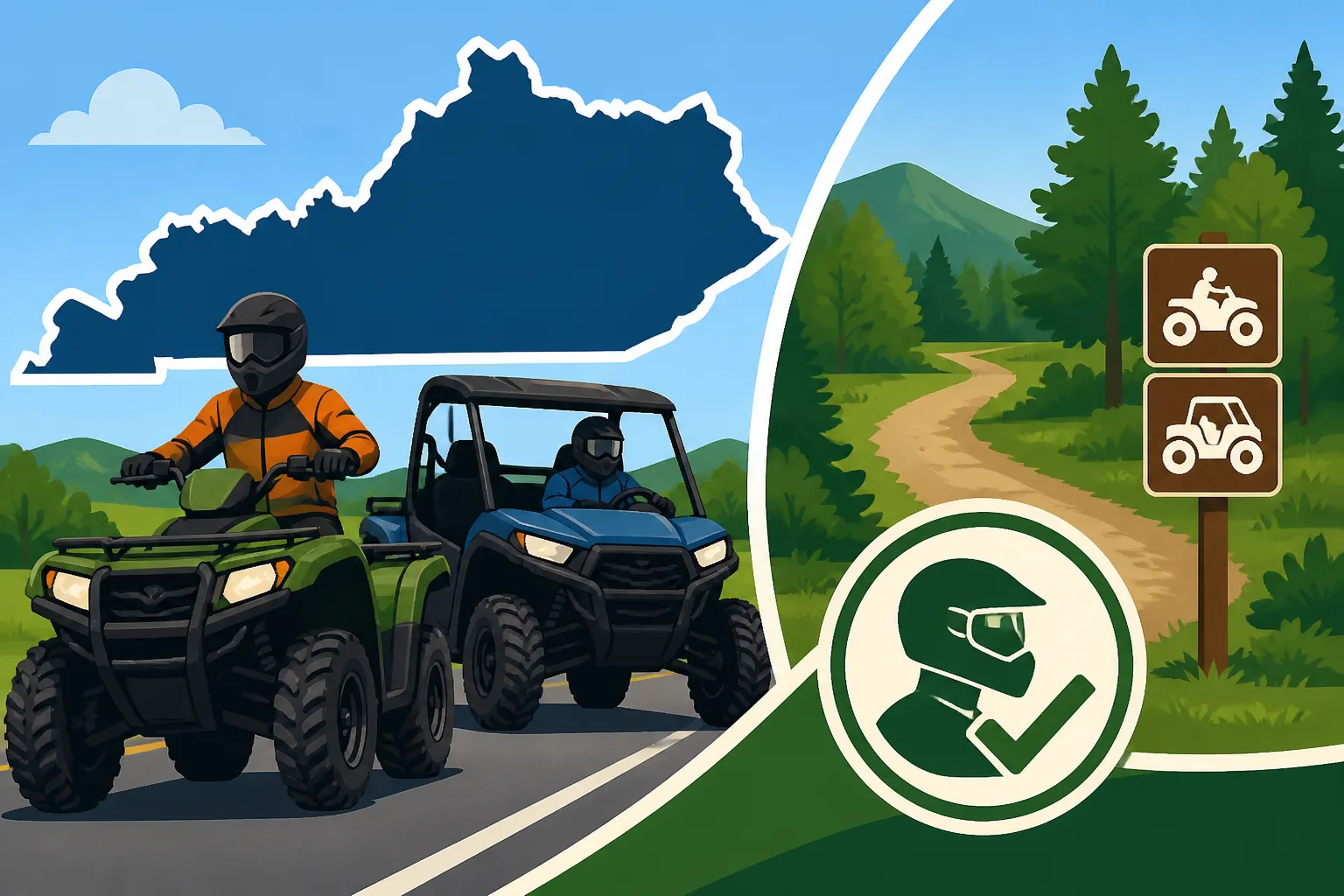
Kentucky Rules for Riding to a Trailhead
It's incredibly frustrating when you're geared up for an epic ride, the trailhead is just a stone's throw away, but you're left scratching your head wondering if you can even legally get there without trailering your machine. Kentucky's rules around ATV and UTV use on public roads can feel like a tangled mess of regulations, leaving many riders confused and worried about getting a ticket before they even hit the dirt. This guide will untangle those rules, clarify what's allowed and what's not, and offer practical advice for safely and legally reaching your favorite Kentucky riding spots.
The Harsh Reality: Why Kentucky Roads Are Generally Off-Limits for ATVs
Let's get this out of the way upfront: by default, ATVs and UTVs are not street legal in Kentucky. This isn't a unique Kentucky thing; many states have similar blanket prohibitions. The intention behind these laws is primarily safety, as these machines are designed for off-road environments, not for navigating traffic alongside cars, trucks, and motorcycles. It's a common point of contention for riders, especially when a trailhead is just a short hop down a county road.
Understanding Kentucky's Default Stance
Kentucky Revised Statutes are pretty clear: an ATV, as defined by the state, is not considered a "motor vehicle" for general highway use. This distinction is crucial because it means all the usual rules for cars, like registration, inspection, and standard licensing, don't apply to ATVs – but neither do the privileges of operating on public roads. You can't just slap a license plate on your quad and expect to ride it to the grocery store, no matter how much you wish you could. This default prohibition means that if you're on a public road in Kentucky with your ATV, you're likely breaking the law unless you fit into one of the very specific, narrow exceptions we'll dive into shortly. It’s a bitter pill to swallow when you're looking at a mere half-mile of pavement separating you from an amazing trail system, but understanding this fundamental principle is the first step toward staying out of trouble.
The state's definition of an ATV, which includes things like having four low-pressure tires and a straddle seat, is key here. If your machine doesn't fit that narrow definition, it might fall under a different category, like a side-by-side, which has its own set of rules. However, even side-by-sides, which feel more like a traditional vehicle, face similar restrictions on public roads unless they qualify as a Special Purpose Vehicle (SPV) under specific local ordinances or meet certain criteria. The frustration comes from seeing other vehicles on the road and wondering why your perfectly capable machine is singled out. It’s not about the machine’s capability, but rather its classification under state law for highway use. Many riders find themselves asking [Are ATVs Street Legal in Kentucky?] and the short answer, unfortunately, is almost always no, in the traditional sense.
The Rationale Behind the Restrictions
Kentucky's lawmakers have several reasons for keeping ATVs off the vast majority of public roads. Firstly, safety is paramount. ATVs and UTVs handle differently than street vehicles. They have a higher center of gravity, different braking characteristics, and are generally less visible to other drivers. Imagine pulling out onto a busy highway with your quad – it's a risky proposition for both you and other motorists. Many ATVs also lack essential safety features required for road-legal vehicles, such as turn signals, proper headlights and taillights, and even side mirrors. These aren't just suggestions; they're critical components for safe operation in traffic.
Secondly, these machines aren't subject to the same rigorous safety and emissions standards as road-going vehicles. While many modern ATVs and UTVs are incredibly advanced, they aren't designed to meet the same benchmarks set for highway use. Finally, there's the issue of liability and insurance. Standard auto insurance policies typically don't cover off-road vehicles when operated on public roads. This creates a huge headache in the event of an accident, leaving riders vulnerable to significant financial and legal consequences. The state tries to avoid these complications by drawing a clear line, even if that line feels arbitrary and inconvenient to riders simply trying to reach a trail. Understanding [Why Kentucky Roads Are Closed by Default] helps shed light on the legislative intent, even if you disagree with the outcome.
The Problem with Riding an Unlicensed Machine on Pavement
Riding your ATV or UTV on a public road where it's not permitted can lead to a host of problems far beyond just an inconvenience. The most immediate concern is a citation. Law enforcement in Kentucky, especially in areas with popular trail systems, is generally well-versed in ATV laws. A deputy or state trooper isn't likely to give you a pass just because the trailhead is "right there." You could face significant fines, and in some cases, your machine could even be impounded. That's a surefire way to ruin a riding trip and add a hefty bill to your adventure.
Beyond the immediate legal trouble, there's the risk of an accident. Even a short distance on a paved road exposes you to traffic you're not equipped to handle safely. If an accident occurs, even if it's not your fault, you're operating an uninsured and unregistered vehicle on a public roadway. This can lead to massive liability issues. Your personal auto insurance likely won't cover you, and your off-road policy might also deny coverage for an on-road incident. This could leave you on the hook for property damage, medical bills, and even lawsuits. It's a risk that most riders simply can't afford to take. Some riders might try to argue they are just riding [0.2 Mile and Not a Yard More] but without understanding the specific conditions, this can still lead to trouble.
Navigating the Nuances: Limited Exceptions for Trailhead Access
While the general rule is "no ATVs on public roads," Kentucky does offer a few very specific, limited exceptions. These aren't broad exemptions that allow for casual cruising, but rather carve-outs designed for extremely short distances or particular activities, often with strict conditions. Knowing these exceptions inside and out is crucial for any Kentucky rider hoping to minimize trailer time and maximize trail time.
The 0.2 Mile Crossing Rule: A Tiny Window of Opportunity
This is perhaps the most talked-about exception for riders wanting to connect trails or cross a road to reach a staging area. Kentucky law allows an ATV or UTV to cross a two-lane public highway at a ninety-degree angle, provided the crossing is made safely and directly, and only if the road has a speed limit of 55 miles per hour or less. The critical detail here, and one that often causes confusion, is the "0.2 mile" part. This isn't a distance you can ride along the road; it's the maximum width of the road you can cross. You must proceed directly across the roadway, not turn onto it and ride down for any distance.
This rule is designed for situations where a trail system is literally bisected by a road, allowing riders to move from one section to another. It's not a license to ride a short distance to a trailhead if that trailhead is located down the road. When making such a crossing, you must yield to all oncoming traffic. Think of it as crossing a street on foot – you stop, look both ways, and only proceed when it's safe. While it offers a small bit of flexibility, it's easily misunderstood, and misinterpreting it can lead to trouble. Many riders mistakenly believe they can use this rule to connect to a trailhead a quarter-mile down the road, which is a definite no-go. For more details, look up [Crossing a Two-Lane at Ninety Degrees in Kentucky].
The Farm Exemption: Riding for Agricultural Purposes (and its limits for trailhead access)
Kentucky law provides a specific exemption for ATVs and UTVs used for agricultural purposes. This means if you're operating your machine as part of a legitimate farming operation, you can use public roads to move between fields or transport equipment, provided you do so safely and adhere to certain conditions. The key phrase here is "agricultural purposes." This exemption does not extend to recreational riding, even if your farm happens to be adjacent to a popular trail system.
For example, if you live on a farm and the trailhead is just across your property line, you might use your ATV to move fencing materials or check livestock. In that context, riding on a short stretch of public road between two parts of your farm would likely fall under the exemption. However, if you then decide to peel off from that agricultural task and head straight onto the recreational trail, you've stepped outside the bounds of the exemption. Law enforcement will be looking at the intent and actual use of the machine. Hauling feed down a holler road is one thing, but heading out for a joyride is another entirely. This exemption has [Why Kentucky's Farm Exception Has No Limit] on mileage because it's tied to the activity, not a set distance, but that activity must truly be farming.
Local Ordinances and Designated SPV Routes
This is where things get a little more complex and hyperlocal. While the state generally restricts ATVs and UTVs on roads, Kentucky law does allow individual counties and cities to pass ordinances that permit the use of Special Purpose Vehicles (SPVs) on certain public roads. These SPVs are essentially UTVs or side-by-sides that have been modified with specific safety equipment (like turn signals, seatbelts, illuminated speedometer, and mirrors), inspected, and registered as an SPV. They also require special insurance. This isn't for your typical ATV, but rather for larger UTVs that can be made to resemble small cars.
If a local jurisdiction has opted into this program, they will designate specific roads or routes where SPVs are allowed. This could potentially include roads leading directly to a trailhead. However, you absolutely must check with the specific county or city you plan to ride in. What's allowed in Harlan County might be completely illegal in Perry County. These local ordinances are usually very detailed about which roads are permitted, the speed limits, and the operating hours (often daylight only). Never assume a road is open to SPVs just because it's a rural area. Always verify with the county clerk or local law enforcement. For instance, [Kentucky Cities That Opted Into Street Riding] will have specific rules you need to be aware of. Also, be mindful that [Kentucky's 2025 Special Purpose Vehicle Law] may have updated conditions or a pilot program that has sunset. Always check the very latest information directly from the county or city.
| Feature | General ATV/UTV Road Rule | 0.2 Mile Crossing | Farm Exemption (Agricultural Use) | Local SPV Ordinance (UTV Only) |
|---|---|---|---|---|
| Machine Type | No | ATV/UTV | ATV/UTV | UTV (Special Purpose Vehicle) |
| Primary Use | N/A | Trail connection | Agricultural work | Recreational/Commute |
| Road Type | N/A | Two-lane, <= 55mph | Any public road | Designated local roads |
| Distance Allowed | N/A | Max 0.2 mile wide cross | No mileage cap (activity-based) | Specific road segments |
| Direction | N/A | 90-degree angle direct cross | Any direction for farm work | Any direction on designated roads |
| Special Equip. | N/A | None | None | Turn signals, mirrors, horn, etc. |
| Registration | N/A | None | None | SPV registration required |
| Insurance | N/A | Standard ATV policy (off-road) | Standard ATV policy (off-road) | Motorcycle-level insurance |
| Driver's License | N/A | None | None | Yes |
Practical Advice for Getting to the Trailhead Legally and Safely
Given the restrictive nature of Kentucky's ATV road laws, your best bet is always to minimize your time on pavement. However, there are times when a short, legal crossing or connection is unavoidable. When that's the case, planning and preparation are your best friends. Don't leave it to chance; approach any road use, however brief, with the same caution you'd give to a challenging trail section.
Planning Your Route: Minimizing Road Exposure
Before you even load your machine, take a good look at a map. Whether it's a paper map or a digital one, identify every stretch of public road between your staging area and the trailhead. Your goal is to find a route that either completely avoids public roads or relies exclusively on the allowed exceptions. If you're utilizing the 0.2-mile crossing rule, make sure the road you're crossing is indeed a two-lane road with a speed limit of 55 mph or less, and that you can make a direct, ninety-degree crossing. Don't try to stretch this rule for a long ride down the shoulder.
If you're relying on a local SPV ordinance, ensure you know exactly which roads are designated and that your machine meets all the inspection and registration requirements. Sometimes, what looks like a private drive on a map is actually a short, unmarked county road. When riding in an area for the first time, it's always a good idea to confirm road classifications with the local county clerk's office or even by simply driving the route in your tow vehicle first. Remember, ignorance of the law is not an excuse. Many riders, including those who outfit their machines with quality aftermarket parts from companies like SuperATV, understand the importance of knowing their route and staying legal. Planning also involves knowing [Where to Ride an ATV in Kentucky] legally.
Essential Gear and Best Practices for Brief Road Crossings
Even for a very short, legal road crossing, you should always treat it with the utmost seriousness. Wear your full riding gear – helmet, goggles, gloves, long pants, and sturdy boots. Just because you're on pavement for a minute doesn't mean the risk of injury disappears. Ensure your machine's lights are working perfectly. While not always legally required for a brief crossing, having your headlights on (even in daylight) and taillights glowing significantly increases your visibility to other drivers.
Approach the crossing with caution. Slow down, stop completely at the edge of the roadway, and look both ways multiple times. Just like crossing a railroad track, you want to be absolutely certain the path is clear. Accelerate smoothly and directly across the road. Do not attempt any stunts, wheelies, or quick turns. Maintain a straight line of travel across the pavement. If you're riding with a group, communicate clearly about when and how each rider will cross. Consider having a spotter at busy intersections if absolutely necessary, though it's best to avoid such crossings entirely if possible. Riding [Daylight Only Under the Statute] is also a good practice for all brief road use. Having a quality helmet, perhaps one that SuperATV also carries accessories for, can be a lifesaver.
Alternatives to Riding on Pavement: Trailering and Staging
Frankly, for most riders, the safest and most legally compliant way to get your ATV or UTV to the trailhead is by trailering it. This might seem like an obvious answer, but it bears repeating because it eliminates all the guesswork and stress associated with road legality. Invest in a good trailer that can safely transport your machine, and use your truck or SUV to haul it directly to the designated staging area or parking lot at the trailhead.
If trailering is not feasible for every short jump between trails, consider using a designated staging area if one is available. Many larger parks, like [Black Mountain Off-Road Adventure Area in Kentucky] or [Leatherwood Off-Road Park in Kentucky], have extensive parking lots where you can unload your machine and begin your ride directly on the trails. Look for opportunities to park your tow vehicle as close as possible to the beginning of the trail system. Sometimes, a little extra driving in your truck can save you a lot of headache and potential legal trouble on your ATV. Even if a local ordinance allows SPVs on some roads, if you’re riding an ATV, you’re almost always better off on a trailer.
The Consequences of Ignoring Kentucky's Road Rules
Disregarding Kentucky's rules for riding ATVs on public roads isn't just a minor infraction; it can lead to serious legal and financial repercussions. It's easy to think "it's just a short distance," but that short distance can quickly turn into a costly mistake. Understanding the potential consequences should be enough to deter most riders from taking unnecessary risks.
What Happens If You Get Caught: Fines and Penalties
If you're caught riding your ATV or UTV on a public road where it's not permitted in Kentucky, you're likely facing a citation. The specific fines can vary, but they can be substantial, often ranging from hundreds of dollars. Beyond the monetary penalty, you might also incur court costs and fees, further adding to the expense. In some instances, depending on the severity of the infraction or if it's a repeat offense, law enforcement may even have the authority to impound your machine. Imagine having your ATV towed away, incurring impound fees on top of the fines – that's a nightmare scenario for any rider.
Furthermore, getting a citation for illegal road use can stay on your record, potentially impacting future vehicle insurance rates or even leading to more scrutiny from law enforcement in the future. It's not just a slap on the wrist; it's a legal process that can be time-consuming, expensive, and stressful. A fun day of riding can quickly turn into a headache lasting for weeks or months. For example, getting [Ticketed at Black Mountain for an Untitled Quad] can be expensive, and illegal road use often carries similar penalties.
Insurance Implications and Liability
This is arguably the most critical and often overlooked consequence. Your standard ATV insurance policy is specifically designed to cover off-road use. When you operate your machine on a public roadway in violation of state or local laws, you've likely voided your coverage for that incident. If you're involved in an accident with another vehicle or person while illegally riding on a road, your insurance company could deny any claims.
This leaves you personally responsible for all damages, injuries, and legal fees. Imagine hitting a car, injuring a pedestrian, or causing significant property damage – you could be facing tens or even hundreds of thousands of dollars in costs, completely out of pocket. This financial risk alone should be a powerful deterrent against illegal road use. Even if your machine is equipped with top-tier safety accessories from a brand like SuperATV, if you're on the wrong road, your insurance might not have your back. It's a risk simply not worth taking, especially when the alternative (trailering) is so much safer and more secure.
The Broader Impact on the Riding Community
Every time a rider illegally uses an ATV or UTV on a public road, it casts a negative shadow on the entire riding community. Incidents of illegal road use lead to complaints from residents, increased scrutiny from law enforcement, and can even influence lawmakers to pass even stricter regulations. It provides ammunition to those who wish to see off-road riding restricted or even banned in certain areas.
Responsible riders are crucial for maintaining access to trails and ensuring the future of the sport. By adhering to the rules, even the inconvenient ones, you're contributing to a positive public image for ATV and UTV enthusiasts. Conversely, reckless or illegal behavior jeopardizes access for everyone. Let's all do our part to ensure that our favorite Kentucky trails remain open and accessible for generations to come, by respecting the laws that govern our use of these incredible machines. This includes understanding and respecting [Kentucky Rules for Riding to a Trailhead] and all other regulations.
Disclaimer
This article is for general informational purposes only and does not constitute professional advice. Laws, prices and regulations vary by location and change over time. Consult a qualified professional for guidance on your specific situation.