Are ATVs Street Legal in Kentucky?
Ah, the age-old question that plagues every ATV or UTV owner in the Commonwealth: "Can I just ride my machine down the road to the store, or to the next trail?" It's a common frustration, especially when you're just a short hop from where you need to be and don't want the hassle of loading and unloading a trailer. This guide will dive deep into the often-confusing world of Kentucky's laws regarding ATV and UTV use on public roads, helping you understand the rules, the exceptions, and the very specific requirements you might face.
The Harsh Reality: Kentucky's Default Ban on ATVs on Public Roads
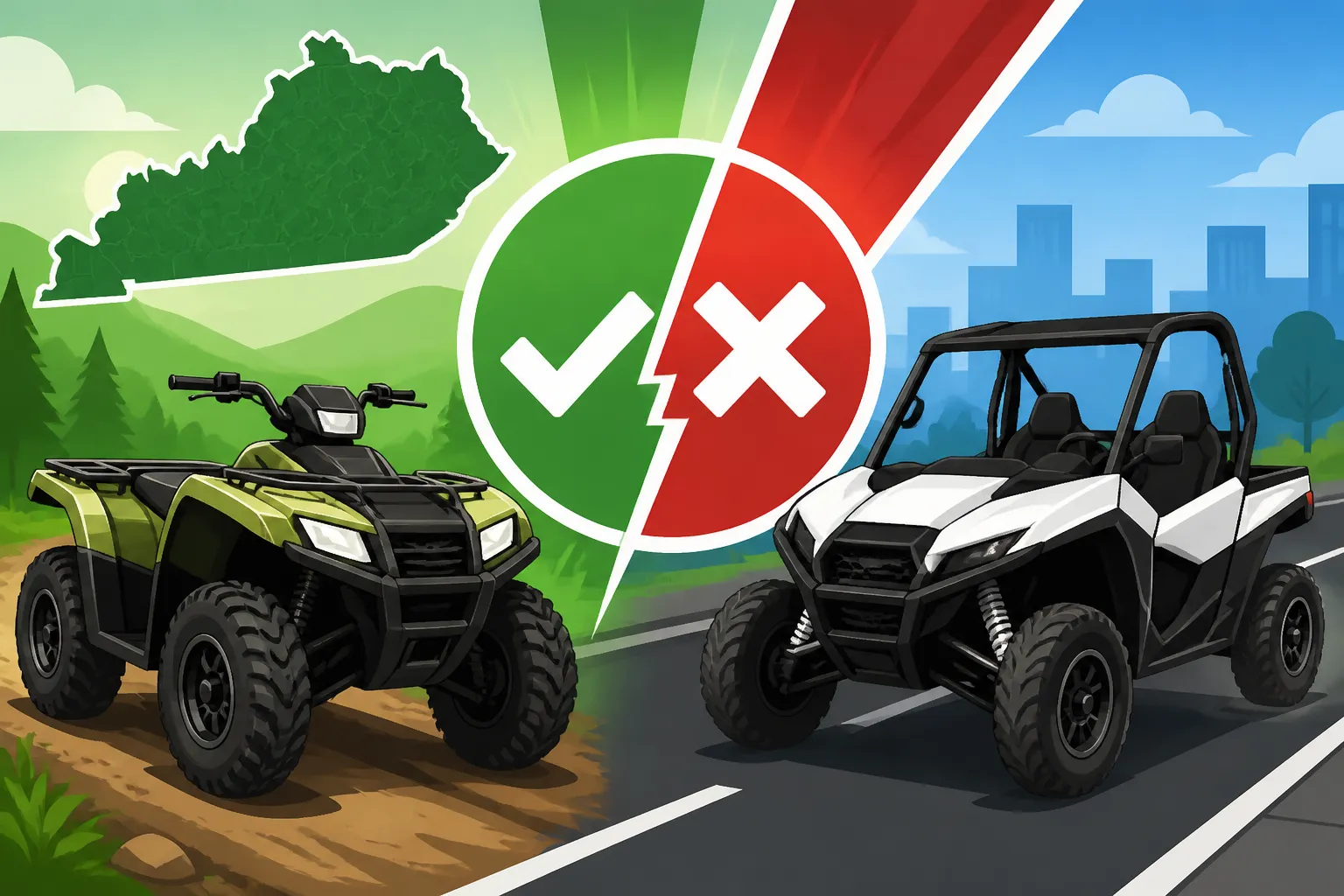
Let's cut right to the chase because this is where many riders get into trouble. In Kentucky, the general rule is a resounding NO when it comes to riding your ATV on public roads. This isn't just a suggestion; it's enshrined in state law, and deputies and state troopers are well-versed in enforcing it. It can feel incredibly restrictive, especially if you're used to other states with more lenient rules, or if you simply bought your machine assuming you'd have some freedom of movement.
Why "No" Is the Starting Point for Most Riders
Imagine this scenario: you're out enjoying a fantastic ride on some private land, maybe a friend's property or one of the many fantastic trail systems Kentucky offers. Suddenly, you realize you're low on fuel, or you need a quick snack from the convenience store just a mile down the county road. Your first instinct might be to just hop on the road and go, but that's precisely where the law draws a hard line. Most ATVs are simply not designed, equipped, or permitted for highway use, and the state's statutes reflect that. The legislature views these machines as off-road recreational vehicles, not street-legal transportation, primarily due to safety concerns like stability, lighting, and signaling capabilities compared to traditional automobiles.
This default prohibition is a constant source of headaches for riders, especially those who live in rural areas where "the road" might be the only way to get from one section of their property to another, or from their home to a nearby trail access point. It forces many to always use a truck and trailer, even for the shortest distances, which adds significant time and effort to every outing. It’s a bitter pill to swallow when you see vehicles of all shapes and sizes on the road, but your perfectly capable ATV is stuck in the ditch, so to speak.
What Kentucky Law Defines as an ATV (and Why It Matters)
Understanding the specific legal definition of an ATV in Kentucky is crucial because it dictates how the "no public roads" rule applies. For the purposes of road use, Kentucky law defines an "all-terrain vehicle" (ATV) as a motor vehicle that meets certain criteria: it's 50 inches or less in width, has a dry weight of 1,200 pounds or less, travels on three or more low-pressure tires, and has a seat designed to be straddled by the operator. It's built for off-road use, pure and simple.
This definition matters immensely because it clearly distinguishes an ATV from other types of vehicles. A standard passenger car, a motorcycle, or even a golf cart (which has its own specific set of rules) are treated differently under the law. Side-by-sides, also known as UTVs, often fall into a somewhat ambiguous gray area under the traditional ATV definition due to their width, weight, and seating arrangements, but they are still generally prohibited from public roads unless they meet the more stringent [Kentucky Street Legal UTV Requirements] for a "Special Purpose Vehicle" (SPV), which we'll discuss shortly. The key takeaway here is that if your machine fits that 50-inch, straddle-seat, low-pressure tire description, you are almost certainly banned from general road use.
Slivers of Opportunity: Exceptions to the Statewide Prohibition
While the blanket ban on ATVs on public roads can be disheartening, Kentucky law does carve out a few very specific, narrowly defined exceptions. These aren't loopholes to exploit, but rather acknowledgments of practical necessities in certain situations. It's vital to understand that these exceptions are not an open invitation to cruise around town; they come with strict conditions and limitations.
The Critical 0.2-Mile Crossing Rule Explained
One of the most common and often misunderstood exceptions is the "0.2-mile crossing" rule. This allows an ATV to cross a public highway or road for a very short distance. The intent behind this is to enable riders to get from one section of private property to another, or to access a trail that requires crossing a road, without having to load the machine onto a trailer. But here's the kicker: it's extremely limited. You can only cross a two-lane highway or road at a ninety-degree angle, and the distance traveled on the pavement absolutely cannot exceed 0.2 miles. That's a mere 1,056 feet, or roughly the length of three football fields.
Let's imagine you're on your friend's farm, and to get to their back pasture where some fantastic riding trails begin, you need to cross a short stretch of rural road. The [Crossing a Two-Lane at Ninety Degrees in Kentucky] rule allows for this. However, if that road happens to be a multi-lane highway, or if the crossing isn't a straight ninety-degree shot, or if the distance you need to travel is even a yard longer than 0.2 miles, you're out of luck and breaking the law. It's a precise measurement, and law enforcement isn't going to be lenient if you're clearly using it as an excuse to travel further. Remember, it's [0.2 Mile and Not a Yard More]. This rule is for getting across a road, not down a road.
Farm, Mining, and Logging Exemptions: Real-World Use Cases
Beyond the crossing rule, Kentucky law provides exemptions for ATVs used in specific work-related contexts: farming, mining, and logging. These are generally for machines being used for their intended utilitarian purpose, not for recreation. For instance, a farmer using an ATV to check fences, herd cattle, or carry tools across their expansive property, which might involve brief stretches on a county road that cuts through their land, would typically fall under the [Why Kentucky's Farm Exception Has No Limit] provision. This allows for necessary travel related to agricultural operations without the strict 0.2-mile limit, as long as the machine is actually being used for farm work.
Similarly, in Kentucky's robust coal country, machines used for mining operations or logging can utilize roads necessary for those activities. This means you might see UTVs and ATVs on private haul roads or even short stretches of public road connecting mine sites or logging tracts. The key here, again, is the purpose of the travel. You won't be able to ride your ATV for fun on a county road just because there's a mine somewhere nearby. These exemptions are very specific to the actual work being performed and are not for general recreational riding. If you are operating under these exemptions, you should still be mindful of safety, traffic, and always yield to larger vehicles.
The "Street Legal" Twist: Understanding Kentucky's Special Purpose Vehicle (SPV) Law
Here's where things get a bit more interesting, especially for UTV and side-by-side owners who dream of truly street-legal machines. Kentucky introduced legislation that allows certain vehicles, typically side-by-sides, to be registered as "Special Purpose Vehicles" or SPVs, making them street legal under very strict conditions. This isn't a free pass for every ATV, and it's a process that requires significant commitment and modification.
Differentiating an SPV from a Standard ATV or UTV
A Special Purpose Vehicle (SPV) is a distinct classification under Kentucky law, designed to bridge the gap between off-road utility vehicles and street-legal transportation. Critically, most traditional ATVs (the straddle-seat, handlebar-steered variety) generally don't qualify for SPV status due to inherent design limitations, particularly width and stability. SPV status is primarily intended for UTVs, or side-by-sides, which often feature steering wheels, bucket seats, and a more car-like control scheme. The distinction is not merely semantic; it's about meeting specific safety and equipment standards that a typical ATV simply cannot achieve without a complete overhaul.
Think of it this way: an ATV is built for nimble off-road adventures, often requiring the rider to shift their weight. A UTV, particularly one modified for SPV status, is designed to be more stable, with features akin to a small car or truck. This differentiation is important because you shouldn't expect to convert your sport quad into an SPV. Instead, manufacturers like Polaris, Can-Am, and even custom builders often design UTVs with SPV conversion in mind, making it easier to add the necessary street-legal components. Some owners turn to aftermarket suppliers like SuperATV for these specific conversion kits.
The Gauntlet of Requirements for SPV Operation
Getting an SPV title and registration in Kentucky is not for the faint of heart. It involves a rigorous process and a long list of equipment requirements designed to bring the vehicle up to a standard acceptable for road use. We're talking about more than just adding a couple of blinkers. To even be considered, your UTV must undergo a thorough [The $25 Kentucky Inspection] by a certified inspector. If it passes, you'll get a special title and license plate.
Here's a breakdown of some of the key requirements you'll face for [Kentucky Street Legal UTV Requirements]:
- Lighting: Your SPV must have proper headlights (at least [One Headlight and Two Taillights in Kentucky]), taillights, brake lights, turn signals on both front and rear, and a license plate light. This isn't just about being seen; it's about signaling your intentions to other drivers.
- Mirrors: You'll need at least two rearview mirrors, typically one on each side, offering a clear view to the rear.
- Horn: A working horn is mandatory for signaling.
- Windshield: A DOT-approved windshield, often with a wiper, is required.
- Tires: Your tires must have at least 2/32 inch of tread depth.
- Brakes: Fully functional brakes on all wheels are essential.
- Seatbelts/Roll Cage: Factory-installed seatbelts for all seating positions and a roll cage or similar occupant protection system are necessary.
- Speedometer: An illuminated speedometer is needed to monitor your speed on public roads.
- Insurance: You'll need [Motorcycle-Level Insurance for a Kentucky SPV], which is a higher level of coverage than basic liability.
- Driver's License: The operator must hold a valid [A License for Kentucky Highway Operation].
This list is not exhaustive, and the exact requirements can sometimes be updated, so always check with the Kentucky Transportation Cabinet or your local County Clerk's office for the most current information. Failing to meet even one of these could result in your SPV application being rejected or, worse, a citation if you're pulled over on the road.
The Local Opt-In: Why City and County Rules Are Paramount
Even if your UTV meets every single SPV requirement and you've got your special license plate, you're still not entirely free to roam every road in Kentucky. This is perhaps the most frustrating aspect of the SPV law: it operates on a local "opt-in" basis. What does that mean? It means that individual cities and counties have the power to decide whether or not they will allow SPVs on their public roads.
Just because Kentucky state law allows for SPVs doesn't mean your hometown or the county you're visiting automatically permits them. Many municipalities have chosen not to allow SPVs, or they've put additional restrictions in place, such as capping speeds on certain roads or designating specific routes. This creates a confusing patchwork of regulations across the Commonwealth. You might be perfectly legal riding your SPV on a county road in one jurisdiction, but cross into the next county or city limit, and suddenly you're breaking the law.
Understanding [Why a Kentucky City Must Opt In] is crucial. It’s about local control and local concerns regarding traffic, safety, and infrastructure. Before you ever hit a paved road in your SPV, you must verify the local ordinances for every single city and county you plan to operate in. Ignorance of these local rules is no excuse, and getting a ticket because you didn't check can be a very expensive lesson. This system certainly doesn't make things easy for riders, but it's the reality we operate in.
Practical Steps for Kentucky Riders: Navigating the Legal Labyrinth
Given the complexities of Kentucky's ATV and UTV road laws, knowing how to navigate them effectively can save you a lot of grief, time, and money. It requires diligence and a proactive approach, whether you're sticking to off-road trails or attempting to make a UTV street-legal.
Checking Local Ordinances Before You Roll Out
This cannot be stressed enough: always check local ordinances before you even consider taking your ATV or SPV onto any public road. This applies whether you're trying to use one of the limited exceptions for an ATV or operating a fully state-compliant SPV. Many riders assume that because a state law exists, it overrides local rules, but for SPVs, local approval is the linchpin. You can typically find this information on a city or county's official website, often under their code of ordinances. You might need to search for terms like "ATV," "UTV," "Special Purpose Vehicle," or "off-road vehicles."
If the information isn't readily available online, don't hesitate to call the local city hall or county clerk's office. They can direct you to the correct department or provide the specific ordinance numbers. Imagine planning a trip to a new trail system, only to find out that the county roads leading to it prohibit SPVs, forcing you to find an alternative route or rethink your plan entirely. Taking the time to do this homework upfront is infinitely better than facing a citation. For example, knowing the [Kentucky Rules for Riding a County Road] in your area is the first step to staying legal.
Essential Gear and Mindset for Any Road-Adjacent Riding
Even when operating legally, whether it's for a 0.2-mile crossing or on an approved SPV road, a defensive and safety-conscious mindset is paramount. Remember, ATVs and UTVs are smaller, often slower, and less visible than typical automobiles. Other drivers might not expect to see you on the road, especially in rural areas.
Always wear appropriate safety gear, including a helmet, eye protection, and sturdy riding apparel. Even if the law doesn't explicitly mandate a helmet for a brief crossing, it's just smart practice. Ensure your machine's lights are clean and fully functional, even in broad daylight, to maximize your visibility. If you've modified your UTV for SPV status, consider aftermarket lights from companies like SuperATV to enhance brightness and visibility, as factory lights might not always cut it on busy roads. Drive predictably, use hand signals in conjunction with turn signals, and maintain a safe following distance. Remember that your machine handles differently on pavement than it does off-road, especially when braking or turning. Respecting other drivers and exercising extreme caution will not only keep you safe but also help maintain a positive image for all off-road enthusiasts.
| Vehicle Type | General Road Legality (Kentucky) | Key Requirements/Exemptions | Primary Use Case |
|---|---|---|---|
| Traditional ATV | Generally Illegal | – 0.2-mile crossing (strict conditions) | Off-road recreation, limited farm/mine/logging work |
| – Farm/mining/logging exemption (work-related) | |||
| – No SPV conversion possible for most ATVs | |||
| UTV/Side-by-Side | Generally Illegal (unless SPV) | – Can be registered as an SPV if specific criteria met | Off-road recreation, utility, light work |
| – SPV requires extensive equipment mods & inspection | |||
| – SPV requires city/county opt-in for road use | |||
| Special Purpose Vehicle (SPV) | Legal on approved roads | – Valid SPV registration & license plate | Street-legal transportation on approved roads |
| – Helmet, insurance, driver's license, extensive safety gear | |||
| – Only on roads in cities/counties that have opted in |
Disclaimer
This article is for general informational purposes only and does not constitute professional advice. Laws, prices and regulations vary by location and change over time. Consult a qualified professional for guidance on your specific situation.