Replacing an ATV Title Lost in a Move
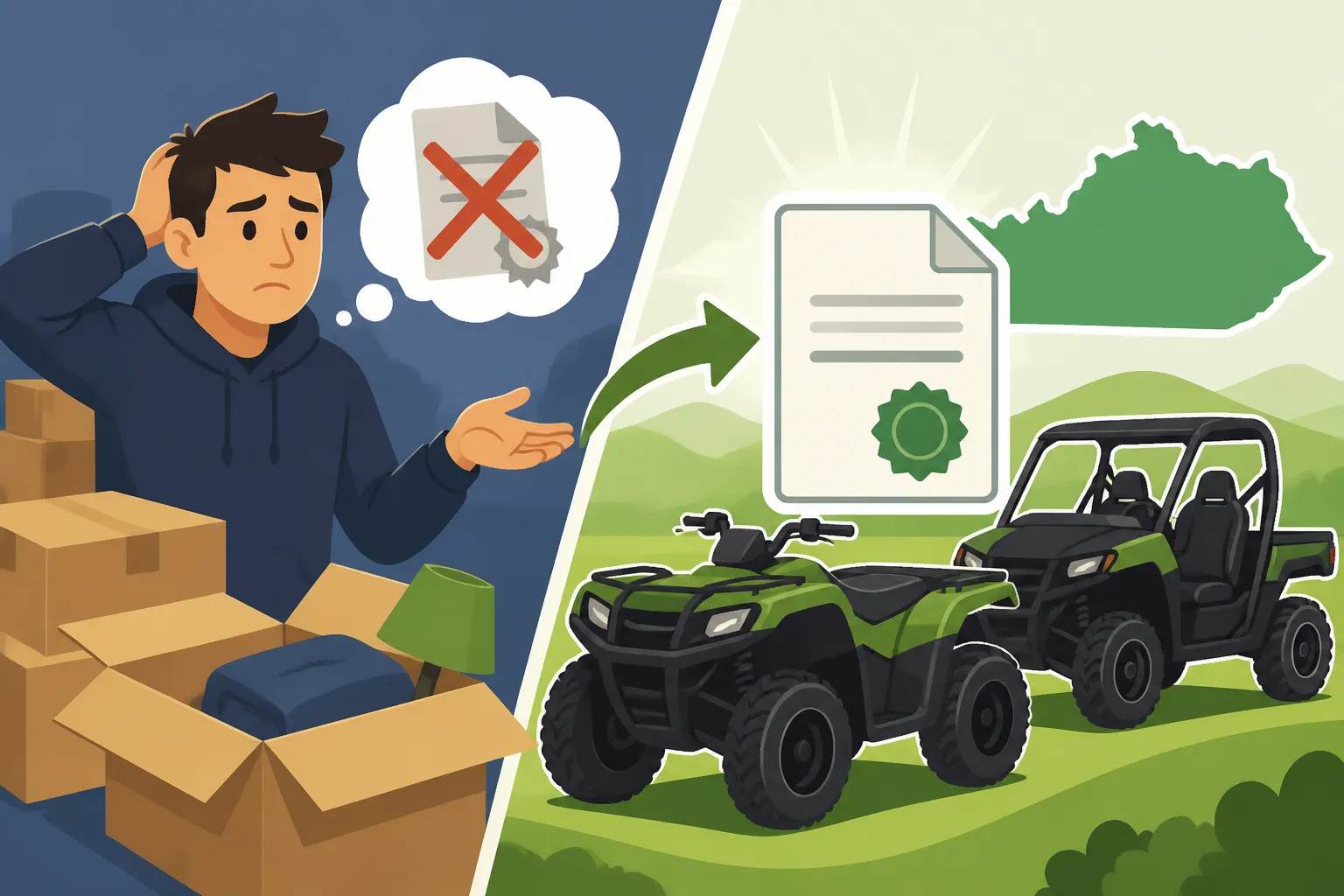
We've all been there: the boxes are finally unpacked, the last piece of furniture is wrestled into place, and you're ready to hit the trails on your ATV. Then, a wave of dread washes over you as you realize that crucial piece of paper – your Kentucky ATV title – is nowhere to be found. Losing important documents, especially after the chaos of a move, is incredibly frustrating and can leave you wondering if you'll ever get back to riding. This guide will walk you through the precise steps to replace an ATV title that's gone missing after a move in Kentucky, ensuring you can get back to what you love.
The Unique Stress of Losing a Title After a Move
There’s losing something in your own home, and then there’s losing something in the grand, unsettling adventure of moving. When boxes are shuffled, packed, unpacked, and re-packed, it's incredibly easy for something as seemingly small, yet critically important, as an ATV title to get misplaced. The sheer volume of items, the pressure of deadlines, and the emotional toll of relocating can all contribute to essential documents slipping through the cracks. It's not just a piece of paper; it's your proof of ownership, your ticket to selling your machine, and often, your peace of mind. Without it, you might feel stranded, unable to make important decisions about your off-road vehicle.
Imagine you've just settled into a new place in, say, Pikeville or Bowling Green. You're trying to establish residency, change your address, and generally get your life in order. The last thing you need is a bureaucratic hurdle for your recreational vehicle. The frustration of knowing you had the title, that it exists somewhere in a pile of half-opened boxes or perhaps was accidentally tossed, can be immense. You want to focus on enjoying your new surroundings and getting out on the trails, not on hunting down a lost document or navigating government offices.
Why Your County Clerk Still Has Records (Usually)
Here's the silver lining: while your physical title might be gone, the state of Kentucky, through your local county clerk's office, generally has a digital record of your ATV's title. When you originally titled your machine, that information was entered into the statewide system. This means you're not starting from scratch trying to prove you own the ATV. The clerk's office should have your name, the ATV's Vehicle Identification Number (VIN), and the date you acquired it, all on file. This digital trail is what makes replacing a lost title a process of requesting a duplicate, rather than having to re-title the machine from the ground up.
However, it's important to remember that while the system should have your information, it's always best to be prepared. Occasionally, details can be misfiled, or older records might require a bit more digging. This is why having any other supporting documentation, even if it's just a faded copy of your original bill of sale or a past insurance card showing the VIN, can be incredibly helpful. It acts as an additional layer of verification, giving the clerk's office more to work with if there's any ambiguity in their system.
Understanding the Importance of Your Physical Title
Even though there's a digital record, the physical title document itself remains paramount in Kentucky. It's the official, negotiable proof of ownership. If you ever want to sell your ATV, gift it, or use it as collateral for a loan, you will absolutely need that original, signed title in hand. A bill of sale alone, while useful, is generally not sufficient to transfer ownership without a properly executed title. Think of it like the deed to your house or the paper title to your car; it's the ultimate evidence that the machine belongs to you, free and clear (or with any outstanding liens noted on it).
Without the physical title, you might encounter significant delays or even be unable to complete these transactions. Imagine finding the perfect buyer for your well-loved quad, only to discover you can't complete the sale because the title is lost. It's a frustrating scenario that can easily be avoided by promptly replacing your lost document. This is why addressing a lost title is not just a "nice to do," but a "must do" for any responsible ATV owner. [Kentucky's ATV Title Rule Explained] is a good resource to understand why the physical title is so crucial.
Getting Started: The First Steps to Replacing Your Title
Okay, deep breaths. The title's gone, but it's not the end of the world. The first thing you need to do is gather your thoughts and prepare for a visit to your local county clerk's office. This isn't a process you can typically complete entirely online or through the mail for a first duplicate request, especially after a move where your address might have changed.
Identifying Your Local County Clerk's Office
Kentucky's ATV titling system is decentralized, meaning you deal with your county clerk, not a state-level Department of Motor Vehicles. If you've just moved to a new county within Kentucky, you'll generally need to visit the county clerk's office in your new county of residence. They will be able to access your records from your previous county (if also in Kentucky) and process the duplicate title request.
A quick search online for "[Your County Name] County Clerk" will usually bring up their official website, complete with office hours, location, and sometimes even a list of required documents or forms you can download in advance. Make sure you note their operating hours – nothing's worse than showing up just to find the doors are closed. For example, if you moved to Harlan County, you'd be looking for the Harlan County Clerk's office. [Titling at a Kentucky County Clerk] offers more details on this process.
Understanding the Key Form: TC 96-182
The primary form you'll need for almost any ATV titling or duplicate request in Kentucky is the Application for Kentucky Certificate of Title/Registration, also known as Form TC 96-182. This form is your official request to the state for a new title. Even though you're requesting a duplicate rather than an original title, you'll still fill out most of the same sections, indicating that you are seeking a duplicate.
You can often find this form available for download on your county clerk's website, or they will provide a copy at the office. Take your time filling it out. Accuracy is key to avoid delays. Ensure all sections pertaining to your ATV's information (VIN, make, model, year) and your personal information (name, current address) are completed clearly and correctly. Any discrepancies can hold up the process. [Kentucky Form TC 96-182 Explained] dives deeper into how to fill this out.
| Section of TC 96-182 | Purpose for Duplicate Title | Key Information Needed |
|---|---|---|
| Vehicle Information | Identifies your ATV | Make, Model, Year, VIN, Fuel Type, Body Type (ATV) |
| Owner Information | Confirms your identity | Your Full Name, Current Address, Kentucky Driver's License/ID Number |
| Application Type | Specifies your request | Clearly mark "Duplicate Title" |
| Signature | Official submission | Your legal signature |
The Cost of a Duplicate Title
One bit of good news is that replacing a lost title in Kentucky is generally not a bank-breaking endeavor. The fee for a duplicate title is typically quite modest. While I can't give you an exact figure due to the nature of current information, you can expect it to be a small administrative fee. It's always a good idea to call your specific county clerk's office ahead of time or check their website to confirm the current fee and accepted payment methods. Some offices may prefer cash, while others accept cards or checks. Budgeting for this small expense will help ensure a smooth transaction. [Kentucky's $10 Duplicate Title] or [Kentucky ATV Duplicate Title Cost] are good places to learn more about the typical expense.
Preparing Your Documents for the County Clerk
A smooth visit to the county clerk's office hinges on being thoroughly prepared. There’s nothing quite like waiting in line, only to realize you’re missing a critical piece of paper and have to go back home. Let’s make sure that doesn’t happen to you.
Proof of Identity
The most fundamental requirement will be a valid form of personal identification. This is how the clerk verifies that you are, in fact, the owner on record for the ATV and not someone else attempting to obtain a title fraudulently. Your Kentucky driver's license or a state-issued photo ID is usually sufficient. Make sure it's current and clearly legible. If your ID shows an old address, but you've since moved, it might trigger a brief discussion, so be prepared to explain your recent relocation.
For example, if you moved from Louisville to a small town in Eastern Kentucky, your ID might still show your Louisville address. This is perfectly normal, but just be ready to confirm your new residential address verbally and provide it accurately on the TC 96-182 form. The clerk needs to know where to mail the new title once it's processed. [A Kentucky Photo ID at the Clerk's Counter] highlights the importance of this step.
Gathering Supporting Documentation (When Needed)
While the clerk's office should have your ATV's title records on file, having additional supporting documents can only help, especially if there's any confusion or if your move involved a recent purchase. These documents serve as secondary proof of ownership and can expedite the process if any questions arise.
Consider bringing:
- Your original bill of sale: Even if it's just a copy you saved from when you bought the ATV. This is powerful evidence of your purchase.
- Proof of insurance: An insurance card or policy declaration that lists your name and the ATV's VIN. This shows continuous ownership and usage.
- Previous registration or tax receipts: Any official documents from the state or county that link you to the ATV by its VIN.
What if your original bill of sale is also lost in the move, or you bought the machine privately years ago and never formally recorded it elsewhere? This is where you might need to get creative with documentation. Sometimes, a simple sworn statement of ownership (an affidavit) can be useful for your personal records, even if not explicitly required by the clerk. You can find templates for various legal documents, including bills of sale or affidavits, on platforms like LawDepot. While the county clerk typically relies on their own records, having a well-documented personal file, even if just for your peace of mind, can be beneficial, especially for future transactions. Just remember that any document from a third-party service still needs to align with Kentucky's legal standards and will be supplementary to the clerk's own records. [Proving Kentucky ATV Ownership] discusses various ways to demonstrate you own your machine.
Filling Out the Application for Title (TC 96-182)
When you're ready to fill out the TC 96-182 form, take a moment to ensure you have all the correct information at hand. You'll need your full legal name, current physical address (where you receive mail), your Kentucky driver's license or state ID number, and most importantly, your ATV's Vehicle Identification Number (VIN). The VIN is typically found on the frame of your ATV, usually near the steering column or on the left side. Double-check it to ensure it's a full 17-character VIN, as required by Kentucky law for machines manufactured after a certain date.
On the form, locate the section that asks for the "Type of Application" or "Transaction Requested." You'll need to clearly mark or indicate that you are applying for a "Duplicate Title." Don't confuse it with an original title application or a transfer. If your name or address has changed since the original title was issued (other than your recent move, which will be updated), make sure to indicate that as well. Every blank space that applies to your situation should be filled in. An incomplete form is a rejected form, and that just means another trip to the clerk's office. [Filling Out TC 96-182 in Kentucky] gives a thorough walkthrough.
Visiting the County Clerk's Office for Your Duplicate Title
With your documents in hand and your form ready, it's time for the actual visit to the county clerk's office. This is often the quickest part of the process, provided you're fully prepared.
The Process at the Counter
When you arrive at the county clerk's office, take a number if they have a queuing system, or head to the appropriate counter as directed. Clearly state that you are there to request a duplicate ATV title because yours was lost in a move. Present your completed TC 96-182 form and your photo ID. The clerk will then access the statewide system to pull up your ATV's records based on your name or the VIN you provide.
They will verify your identity against their records and confirm that you are indeed the rightful owner. They'll also check for any outstanding liens on the vehicle. If a lienholder is still listed on the record, you might need to provide a lien release from that financial institution before a duplicate title can be issued in your name without the lien. This is a crucial step that ensures the duplicate title accurately reflects the ATV's ownership status. Once everything is confirmed and the fee is paid, the clerk will process your request.
What Happens Next: Receiving Your New Title
Unlike some other transactions, you generally won't walk out of the county clerk's office with your new duplicate title in hand. Kentucky typically mails the official title documents from a central printing facility, usually from Frankfort, the state capital. The clerk will provide you with a receipt and an estimated timeframe for when you should expect your new title to arrive by mail. This timeframe can vary, but it's usually a matter of a few weeks.
While you wait, keep your receipt safe. This receipt serves as your temporary proof that you've applied for a duplicate title. If you were to be stopped by law enforcement while riding your ATV, presenting this receipt, along with your photo ID and proof of insurance, would demonstrate that you are in the process of obtaining your official documentation. [How Long Before a Kentucky Title Arrives by Mail] gives you a better idea of what to expect.
Securing Your New Title
Once your duplicate title arrives in the mail, immediately check all the information for accuracy. Ensure your name, current address, and the ATV's VIN and description are all correct. If you find any errors, contact your county clerk's office immediately to get them corrected.
And most importantly, once you've verified its accuracy, secure your new title in a safe, memorable place. Consider a fireproof safe, a locked filing cabinet, or a dedicated "important documents" folder that is not part of your everyday clutter. Make a digital copy or a photocopy for your records as well, but remember that the original physical document is what carries legal weight for most transactions. You've gone through the effort of replacing it, so let's make sure it doesn't get lost again!
Overcoming Potential Hurdles
Even with careful preparation, sometimes unexpected issues can arise. Knowing about these common hurdles can help you navigate them more smoothly.
When Your VIN is Missing or Unreadable
A major roadblock can occur if your ATV's VIN (Vehicle Identification Number) is missing, damaged, or unreadable. The VIN is the machine's unique identifier, and without it, the clerk cannot confirm it's the same ATV that's on file. This can happen if the VIN plate was damaged during an accident, rusted over time, or even deliberately removed (which can indicate a stolen vehicle).
If you encounter this issue, the clerk's office may require a VIN inspection. This involves a qualified law enforcement officer or a designated official physically examining your ATV to locate and verify the VIN. They might also check for secondary VINs or manufacturing stamps. If the VIN cannot be clearly identified, the process becomes significantly more complicated and might even involve applying for a state-assigned VIN. This is a rare occurrence but one to be aware of. [Kentucky's Seventeen-Character VIN Rule] explains why the VIN is so critical.
Dealing with Liens or Previous Owners
Another common hurdle happens when the county clerk's records show an outstanding lien on your ATV, but you know the loan has been paid off. This simply means the lienholder (like a bank or credit union) never formally notified the state that the lien was released. In this situation, you will need to contact the financial institution and request a formal [Releasing a Lien on a Kentucky Title] document or a letter stating the lien has been satisfied. You'll then present this document to the county clerk, who can update the record and issue your duplicate title free of the lien.
Similarly, if there's an issue with a previous owner still being listed or a discrepancy in the transfer history, you might need to provide more extensive documentation. This could involve finding the previous seller to get a signed affidavit or tracking down old bills of sale. While less common for a simple duplicate title request, it's a possibility if the records are complex or if the ATV changed hands multiple times without proper titling each time.
The "No Record Found" Scenario
While rare, it is possible that the county clerk might initially state they have "no record found" for your ATV's title. This can be alarming, but it doesn't always mean your ATV was never titled or is stolen. It could be due to a misspelling of your name, an incorrect VIN entered into the system, or issues with very old records.
If this happens, stay calm and be persistent. Provide any and all supporting documentation you have: a bill of sale, old insurance cards, past registration receipts, even photographs of your ATV showing its VIN. They can often do a more thorough search using different parameters. If you have absolutely no paper trail, and the clerk still can't find a record, you might find yourself in the challenging position of having to prove ownership from scratch. This could involve seeking legal advice or going through an "affidavit of ownership" process, which is more complex than a simple duplicate title request. However, for a machine that was previously titled, it's usually just a matter of the clerk digging a little deeper into the records.
Disclaimer
This article is for general informational purposes only and does not constitute professional advice. Laws, prices and regulations vary by location and change over time. Consult a qualified professional for guidance on your specific situation.