Why Kentucky Does Not Register ATVs
It's a common point of confusion for ATV and UTV enthusiasts, especially for those new to the Bluegrass State or coming from areas with different rules. Many people assume that if you own a vehicle, it needs to be registered with the state, just like your car or truck. But when it comes to ATVs in Kentucky, that's simply not the case. This guide is here to clear up the mystery, explain Kentucky's unique approach to off-road vehicles, and help you understand what you do need to legally own and ride your ATV or UTV here.
The Core Distinction: Titling Versus Registration in Kentucky
When you talk about vehicle paperwork, two terms often get thrown around interchangeably: titling and registration. But in Kentucky, especially for ATVs, these are two very distinct concepts, and understanding the difference is key to navigating the rules.
What "Titling" Actually Means for Your ATV
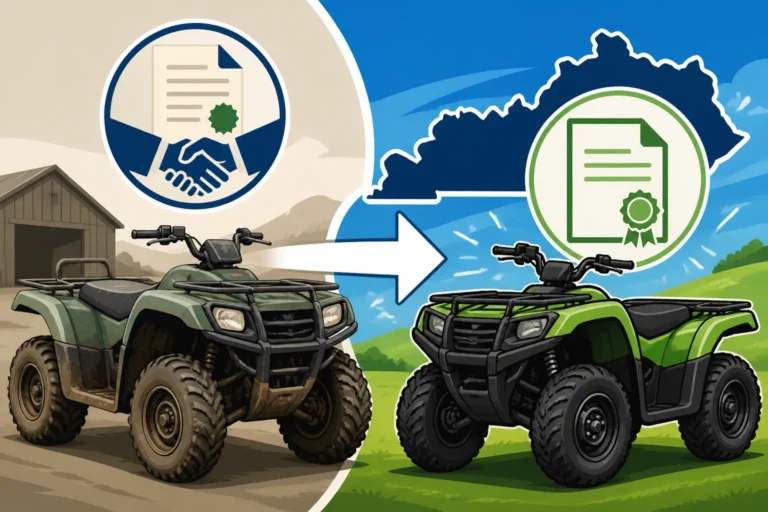
Think of a vehicle title as the official proof of ownership. It’s a legal document issued by the state that identifies you as the rightful owner of a specific ATV, much like the deed to a house or the title to your car. This piece of paper contains crucial information: the vehicle identification number (VIN), make, model, year, and the owner's name. It’s absolutely essential for buying, selling, or transferring ownership of an ATV in Kentucky. Without a title, proving you own the machine can be a real headache, making it difficult to sell it later or even get it back if it's stolen.
Kentucky began requiring titles for ATVs and UTVs purchased new or transferred after July 15, 2010. This was a significant change aimed at reducing theft and making transactions more transparent. So, if you're looking at a machine bought after that date, it must have a title. If you're buying, you'll need that title signed over to you. If you’re the seller, you’ll need to sign it over to the buyer. This process happens at your local County Clerk's office. It confirms your legal rights to the machine, preventing future disputes or issues. For a deep dive into this, check out [Why Kentucky Titles Machines Bought After July 2010].
Why "Registration" is a Different Animal (and Why Kentucky Skips It for ATVs)
Now, let's talk about registration. In most states, and for most on-road vehicles, registration involves paying an annual fee to the state, receiving license plates or decals, and in return, you're granted permission to operate that vehicle on public roads. It's how the state tracks vehicles for taxation, enforcement, and public safety. When you register a car, you get a tag and sticker for your plate; it’s an annual process.
For ATVs in Kentucky, this kind of general registration simply does not exist. The state doesn't issue annual tags, stickers, or license plates for ATVs meant for off-road use. Why? Because, by default, Kentucky considers ATVs to be off-road machines, not designed or intended for public road use. Therefore, there's no need for a system to track their movement on public highways, beyond simply establishing ownership through titling. This means no yearly renewal fees, no state-issued decals for your fender, and no requirement to prove insurance for general off-road riding to the state (though individual trail parks might require it, and you should always have it for your own protection!). This lack of registration often causes confusion, as riders expect the same process they go through for their cars or even motorcycles.
Kentucky's Legal Framework: An Off-Road Mindset
Kentucky's laws concerning ATVs are rooted in a clear philosophy: these machines are primarily for off-road use. This underlying principle shapes everything from how they're defined to what paperwork you need (or don't need).
The Statute's View of ATVs: Not for Pavement
Kentucky's legal definition of an ATV usually describes it as a motorized vehicle designed for off-highway use, having low-pressure tires, a straddle seat, and handlebars. This definition immediately sets them apart from typical on-road vehicles. Because of this classification, the default stance of Kentucky law is that ATVs are not permitted on public roads. This isn't just a suggestion; it's a legal reality that riders often struggle with. You can't just hop on your quad and ride it down a county road to your neighbor's house, at least not without meeting very specific, limited exceptions.
These exceptions are few and far between. For instance, Kentucky law allows for brief, ninety-degree crossings of two-lane public roads, usually limited to 0.2 miles, to get from one private property to another. [Kentucky's 0.2-Mile Crossing Rule] There's also a specific exception for farm use, allowing ATVs to be operated on public roads for agricultural purposes, with no mileage cap on that particular use. [Kentucky's Farm Exception With No Mileage Cap] But these are highly specific scenarios and don't equate to general road legality. The core message from the state legislature is simple: ATVs belong off the pavement. This underlying legal framework is why a statewide registration system for road use doesn't exist for ATVs – because they're not supposed to be there in the first place. You can learn more about this by reading [Why Kentucky Roads Are Closed by Default].
No Statewide Registration for Off-Road Use Either
Beyond the road use issue, many states that do register ATVs often do so to fund and manage state-wide trail systems or to grant access to public lands. They might issue annual stickers or permits that are recognized across various state-managed trails. Think of it as a fishing license for your ATV.
Kentucky, however, does not have such a statewide registration program for off-road use. There's no single state decal you buy that grants you access to all public ATV trails in Kentucky. [Why Kentucky Has No Decal to Display] Instead, access to designated off-road riding areas, like Black Mountain Off-Road Adventure Area or Leatherwood Off-Road Park, is typically managed by the individual park or land manager. This means you'll purchase permits directly from these parks, and those permits are usually only valid for that specific riding area. The state itself doesn't act as a central permitting or registration authority for general off-road access. This decentralized approach can sometimes be a surprise to riders expecting a more unified system, but it's consistent with Kentucky's focus on private land ownership and localized recreation management. Check out [Why Trail Permits Come From Parks, Not the State] for more context.
The Practical Implications of No Registration
So, what does this "no registration" policy actually mean for you, the ATV owner in Kentucky? It brings both certain conveniences and responsibilities that are important to understand.
No Annual Fees or Stickers for Most Riders
One of the most immediate and appreciated implications of Kentucky's no-registration policy for ATVs is the absence of annual fees and the hassle of renewing stickers. Unlike your car, where you have to remember to pay your county clerk every year for new tags, your off-road ATV doesn't require this ongoing expense or administrative task. This can be a welcome relief for riders who just want to enjoy their machines without extra bureaucracy and costs. You buy your ATV, you get your title (if applicable), and you're essentially set on the state paperwork front for as long as you own it, barring any transfers or duplicate title needs.
It's important to clarify, however, that "no registration" doesn't mean "no costs." You'll still pay a titling fee when you first title your machine, and you'll certainly pay sales tax on the purchase price unless an exemption applies. [What a Kentucky ATV Title Costs] [Kentucky ATV Sales Tax at Titling] These are one-time costs associated with establishing legal ownership, not ongoing fees for road access or state tracking. For the vast majority of ATV owners who keep their machines exclusively off public roads, this distinction means a simpler, less expensive ownership experience from a state-mandated fee perspective.
Ownership Documentation and What You Still Need
Even though you won't be carrying a registration card or displaying a state-issued decal on your ATV, having solid proof of ownership is absolutely critical. Your ATV's title is the primary document that establishes you as the legal owner. It's essentially your ATV's birth certificate and deed rolled into one. When you sell the machine, you'll transfer this title. If your ATV is ever stolen, the title is what you'll use to prove to law enforcement and your insurance company that it's yours.
Beyond the title, especially when buying or selling, a comprehensive bill of sale is incredibly important. Even for machines that predate Kentucky's titling law (those bought before July 2010), a solid bill of sale is often the only proof of ownership you'll have. A well-drafted bill of sale, which you can find resources for from services like LawDepot, clearly documents the transaction, including buyer and seller information, the ATV's details (VIN, make, model), and the purchase price. This helps prevent disputes and provides a paper trail. [A Kentucky Bill of Sale for an ATV] If you're ever stopped while riding on an allowable public road segment (like a 0.2-mile crossing) or even leaving a trail park, an officer might ask for proof of ownership. While they won't expect a registration, they will expect to see documentation like your title. Without it, you could face questions about the machine's origin or even potential fines for [Riding Without a Title in Kentucky]. Always keep your title in a safe place, and carry a copy or have easy access to it when you ride.
The Confusing Case of "Street Legal" UTVs and SPVs
This is where a lot of the confusion about "registration" comes in, especially for UTV owners. While traditional ATVs don't have a path to general road registration in Kentucky, a specific category of vehicles, primarily UTVs, can qualify for a limited form of road legality as Special Purpose Vehicles (SPVs).
The Rise of Special Purpose Vehicles (SPVs)
Over the last decade or so, UTVs (or side-by-sides) have exploded in popularity. These machines are often larger, more stable, and more capable of carrying passengers and cargo than traditional ATVs, blurring the lines between recreational vehicle and utilitarian workhorse. Many UTV owners wanted the ability to legally operate their machines on public roads, at least for short distances or specific purposes, such as driving to a trailhead or a local store in a small town. Recognizing this growing demand, Kentucky enacted legislation to allow certain UTVs to be designated as "Special Purpose Vehicles" (SPVs). [Kentucky's 2025 Special Purpose Vehicle Law]
It's absolutely crucial to understand that this SPV designation is not a blanket registration for all ATVs and UTVs. It's a very specific pathway for qualifying UTVs to gain limited road access, under stringent conditions. A traditional ATV (the kind you straddle) will generally not qualify for SPV status. The SPV law is specifically designed for machines that more closely resemble a small car or utility vehicle, rather than a quad. This legislative effort attempts to bridge the gap between purely off-road recreation and the practical needs of UTV owners, but it comes with a distinct set of rules and requirements. For more details on what qualifies, check out [Kentucky Street Legal UTV Requirements].
SPV Registration: A Different Category Altogether
If your UTV meets Kentucky's definition of an SPV, you can go through a process that involves a kind of "registration" for road use. However, it's a completely separate process from titling and is distinct from how cars are registered. To obtain SPV status, your UTV must undergo a safety inspection by a certified inspector. This inspection verifies that the machine has specific safety equipment, such as headlights, taillights, brake lights, turn signals, mirrors, a horn, a windshield, and seat belts, among other things. [Kentucky SPV Equipment List] This is a serious undertaking; it's not just a quick glance. [The $25 Kentucky Inspection]
Once it passes inspection, you then apply for an SPV plate at your County Clerk's office. This plate is an annual registration, and it comes with annual fees and requires you to carry liability insurance comparable to what's required for a motorcycle. [Motorcycle-Level Insurance for a Kentucky SPV] The biggest catch? Even with an SPV plate, you can only operate your UTV on public roads in cities or counties that have specifically "opted in" to the SPV program. [Kentucky Cities That Opted Into Street Riding] Many local governments have chosen not to, or have placed further restrictions on where and how SPVs can operate within their jurisdiction. So, while it feels like a form of registration, it's highly conditional and limited, and it absolutely does not apply to ATVs. This distinction is vital to avoid fines and legal trouble.
Navigating Ownership: Your Kentucky ATV Title
Since Kentucky doesn't register ATVs, your title becomes the single most important piece of documentation you'll hold for your machine. It’s what legally establishes your claim, and understanding how to get and manage it is crucial.
The Titling Process: Your Trip to the County Clerk
When you purchase an ATV in Kentucky, whether new from a dealer or used from a private seller, the process of officially making it yours revolves entirely around the title. This isn't something you can do online or by mail from a state agency; you'll be making a trip to your local County Clerk's office. This office handles all vehicle titling and transfers for residents of that specific county, including ATVs. [Titling at a Kentucky County Clerk]
To title an ATV, you'll generally need a few key documents. If you bought it new from a dealer, you'll likely have a Manufacturer's Certificate of Origin (MCO). If you bought it used, you'll need the previous owner's signed-over title. You'll also need a completed Kentucky Form TC 96-182, the Application for Kentucky Certificate of Title/Registration. This form collects all the necessary information about you and your ATV. [Kentucky Form TC 96-182 Explained] The VIN, or Vehicle Identification Number, will be central to this process. Kentucky law requires a seventeen-character VIN for titling, which is standard for most newer machines. [Kentucky's Seventeen-Character VIN Rule] Once you have your documents in order, you'll present them, pay the titling fee and any applicable sales tax, and your clerk will process the transfer. Remember, Kentucky has a strict [Kentucky's Fifteen-Day Titling Deadline] from the date of purchase to complete this transfer, so don't procrastinate!
What to Do If You Don't Have a Title (Older Machines, Lost Titles)
It's not uncommon for Kentucky ATV owners to find themselves without a title, especially if they own an older machine or have simply lost their original document. This can be a source of major frustration, but there are usually pathways to resolve it.
If your ATV was purchased new or transferred before July 15, 2010, Kentucky law generally did not require it to be titled. [Machines Bought Before July 2010 in Kentucky] In such cases, your primary proof of ownership would be a bill of sale. If you're planning to sell such an older machine, providing a clear, detailed bill of sale is paramount. For this, resources like LawDepot can be invaluable for generating a legally sound document. If you've lost your original title for a machine that was previously titled, you'll need to apply for a duplicate title at your County Clerk's office. This process is usually straightforward, requiring you to fill out an application and pay a small fee. [Replacing a Lost Kentucky ATV Title] However, if you bought an ATV from a state that doesn't issue titles for ATVs, and you want to title it in Kentucky, you'll typically need to present a bill of sale along with any other available ownership documents, such as a prior registration from that state. [Using a Bill of Sale From a Non-Titling State] The County Clerk's office is always your best resource for specific guidance on these more complex situations.
Why This System (Mostly) Works for Kentucky Riders
While the lack of statewide registration can seem confusing to newcomers, Kentucky's approach to ATVs and UTVs actually aligns well with the state's geography, culture, and the way most people use these machines.
Focus on Off-Road Recreation and Property Rights
Kentucky is a state with a rich history of outdoor recreation, vast stretches of rural and wooded land, and a strong emphasis on private property rights. The majority of ATV and UTV riding in Kentucky happens either on private land or within dedicated off-road parks that operate on leased or owned land. For these common scenarios, a statewide registration system designed primarily for road use or state-managed trail systems simply isn't necessary.
When you're riding on your own property, or on a friend's land with permission, the state doesn't need to track your vehicle's movements. Similarly, established trail parks like Black Mountain and Leatherwood have their own permit systems to manage access, maintain trails, and ensure safety. These parks generate revenue through their permits, which goes directly back into maintaining their specific trail networks. This decentralized system often feels more organic to Kentucky's landscape, where riders can often access trails near their homes or travel to large, privately-managed parks, rather than relying on a vast network of state-run trails. It supports a model where the local entities and private landowners manage the riding experience, not a broad state bureaucracy for off-road use.
Less Bureaucracy for the Core ATV Experience
For the casual off-road rider, or the farmer using an ATV for chores, Kentucky's titling-only approach (for ATVs) significantly reduces bureaucracy. Imagine having to renew a registration for your farm quad every year, just to move hay or check fences on your own land. By foregoing statewide registration, Kentucky streamlines the ownership process for the vast majority of ATV users who use their machines purely for their intended off-road purpose.
This means less paperwork, fewer annual fees, and a generally more direct path from purchase to riding. The focus remains on establishing clear ownership through the title, which is paramount for legal protection against theft and for legitimate sales. For those who do want to venture onto public roads with a UTV, the SPV program, while more complex, offers a specific, intentional pathway. This two-tiered system (titling for ATVs, titling + optional SPV registration for UTVs) tries to balance the desire for minimal regulation for off-road fun with a structured approach for limited on-road utility, without burdening every single ATV owner with unnecessary requirements. It's a system designed to primarily support off-road activities without imposing broad, highway-focused regulations.
Common Misconceptions and What to Watch Out For
Despite Kentucky's clear laws, the lack of a registration requirement often leads to misunderstandings that can land riders in trouble. It's vital to separate fact from fiction.
The "No Papers, No Problem" Myth
One of the most dangerous myths circulating among ATV riders is that because Kentucky doesn't require registration for ATVs, you don't really need any paperwork. This couldn't be further from the truth and can lead to serious legal complications. While you won't get a registration sticker, your ATV still requires a title (if it was bought after July 2010 or previously titled) as proof of ownership. This title is not just a formality; it's your legal claim to the machine.
Without a title or a proper bill of sale, proving your ownership becomes incredibly difficult. Imagine your ATV is stolen. If you can't produce a title or a robust bill of sale (which a service like LawDepot can help you create), law enforcement will have a much harder time recovering it for you, and your insurance company might deny your claim. Similarly, trying to sell an ATV without proper paperwork is a huge red flag for potential buyers and often leads to scams or drastically reduced prices. If you're considering buying an ATV advertised with "no title," proceed with extreme caution and understand the risks. [Should You Buy a Quad Advertised With No Title?] It might seem like a bargain, but the headache of trying to establish legal ownership later can far outweigh any initial savings. Always demand proper documentation, even if it's "just" a bill of sale for an older machine.
Thinking an ATV is the Same as an SPV
Another significant misconception, particularly since the introduction of the Special Purpose Vehicle (SPV) designation, is confusing a traditional ATV with an SPV. Many riders mistakenly believe that if some off-road vehicles can be "street legal" in Kentucky, then their ATV can too. This is fundamentally incorrect and can lead to tickets, fines, and even vehicle impoundment.
Kentucky law defines ATVs and SPVs as distinct categories. As we've discussed, traditional ATVs, which you straddle and steer with handlebars, generally do not meet the criteria for SPV conversion. They lack the necessary safety equipment (like full roll cages, seatbelts, windshields, and often robust braking systems and lighting) to pass an SPV inspection. Even if you somehow managed to modify an ATV to appear to have some of these features, it's highly unlikely it would pass a certified inspection or be legally recognized as an SPV. The SPV designation is specifically for UTVs or side-by-sides that can be equipped to meet stringent safety standards. Attempting to ride your ATV on public roads, even in a city that allows SPVs, without it legally being an SPV, is a violation of the law. [Kentucky Rules for ATVs on Public Roads] It's crucial to understand the very narrow scope of the SPV program and that it does not open the door for general ATV road use.
Kentucky ATV Documentation at a Glance
To summarize the key distinctions and requirements:
| Feature | Traditional ATV in Kentucky | Special Purpose Vehicle (SPV) in Kentucky | Automobile in Kentucky |
|---|---|---|---|
| Titling | Required if purchased after July 15, 2010 (at County Clerk) | Required (at County Clerk) | Required (at County Clerk) |
| Registration | NOT required for general off-road use | REQUIRED for limited public road use (annual plate from Clerk) | REQUIRED for public road use (annual plate from Clerk) |
| Annual Fees | No annual registration fees | Annual SPV plate fees | Annual registration fees |
| Decals/Plates | No state-issued decals or plates for off-road use | Special SPV license plate required for road use | Standard license plate and annual sticker |
| Road Use | Generally PROHIBITED, very limited exceptions (e.g., 0.2-mile crossing, farm use) | Limited to participating cities/counties, specific rules apply | Generally permitted on all public roads |
| Insurance | Not state-mandated for off-road use (highly recommended) | REQUIRED (motorcycle-level liability) for road use | REQUIRED (minimum liability) for road use |
| Inspection | Not required | REQUIRED for SPV designation (annual safety inspection) | Not generally required for private vehicle registration |
| Primary Proof of Ownership | Title (or bill of sale for older machines) | Title | Title |
Disclaimer
This article is for general informational purposes only and does not constitute professional advice. Laws, prices and regulations vary by location and change over time. Consult a qualified professional for guidance on your specific situation.