Teaching a Young Rider in Kentucky
Teaching a child to ride can feel like balancing two concerns: giving them room to learn and keeping every part of the ride controlled. In Kentucky, start with the machine’s age label and the rules for the place you plan to ride. Then build skills gradually, with close supervision, suitable protective gear and a clear plan for when the young rider is ready to move on.
Check age, machine fit and Kentucky rules first
Before teaching throttle control, check that the child is eligible to operate that particular machine and can physically manage it. A small rider on an oversized ATV may struggle to reach the controls, steer through a turn or stop smoothly. Confidence does not make up for a poor fit.
Kentucky’s rules make the manufacturer’s age recommendation important. Read the label on the machine and its manual, and treat the recommended age as a boundary, not a challenge to work around. Do not remove or alter the label to make a machine appear suitable for a younger child. For more on the legal framework, see Kentucky Minimum Age to Ride an ATV and Reading a Manufacturer’s Age Label.
A youth ATV is not automatically appropriate just because it is smaller than an adult model. Check the manufacturer’s guidance for the exact model, including any instructions about rider age, passenger use and operating conditions. If the label is missing or unreadable, contact the manufacturer or dealer for model-specific guidance rather than guessing.
Kentucky rules can also depend on where the child rides. Requirements that apply on public property may not be identical to a private-landowner’s rules or a trail park’s conditions of entry. The child’s age, supervision and required safety gear all matter. Review Kentucky Rules for a Rider Under 16 and [Kentucky Supervision Rules for Young Riders] before choosing a riding site.
A parent or responsible adult should also decide whether the child is ready, even when the machine’s label and the location’s rules allow the ride. That decision is about ability and judgment, not just age. A child who cannot comfortably reach the brake, understand a stop signal or stay focused through a short practice session needs more time before riding independently.
A quick readiness check
Before the first ride, confirm that the child can:
- Reach and operate the controls while seated in the normal riding position.
- Understand and repeat basic instructions, including how to stop immediately.
- Keep both hands on the handlebars and feet in the intended position.
- Follow a simple route without drifting toward hazards.
- Stay calm when the machine makes noise, vibrates or feels different over uneven ground.
- Tell an adult when they feel tired, nervous or unsure.
These are practical checks, not a substitute for the machine’s instructions or Kentucky law. If any answer is no, adjust the plan: choose a safer practice area, use a more suitable machine, shorten the session or wait.
Choose a practice place and understand permits
A child’s first ride should happen somewhere controlled, flat and free of traffic, steep drop-offs, deep water, blind corners and unexpected obstacles. The best practice area is not necessarily the most exciting one. It is a place where an adult can see the rider clearly and the young rider can concentrate on the controls without having to react to other trail users.
On private land, get the landowner’s permission and agree on where riding is allowed. Do not assume that a family connection, open gate or old track means a child has permission to ride there. Review [Kentucky Rules for Riding Private Property] and Kentucky Landowner Permission Requirements when access is not your own.
Trail parks and public riding areas have their own conditions. Kentucky does not have one statewide trail permit that automatically covers every riding location. A park may require a site-specific permit, restrict certain machines or set its own age and supervision conditions. A permit is permission to use a particular place under its rules; it does not override machine age recommendations or make a child ready to ride.
Before loading up, check the rules for the exact destination and the specific trail system. Do You Need a Permit for Kentucky Trails? explains why the answer varies by location, while Why One Park’s Permit Does Not Travel covers the limits of assuming that one permit works elsewhere. A permit from one park should not be treated as a pass for a different park or public riding area.
| Practice location | What to confirm before teaching | What to keep in mind |
|---|---|---|
| Private land | Landowner permission, boundaries and any site rules | Permission for the land does not remove the need to follow age and machine guidance |
| Trail park | Permit, operating rules, youth requirements and allowed machine types | Rules can differ between parks and may change |
| Public riding area | The agency or site’s current access and safety rules | A park or land-management pass may be separate from other permits |
| Road or roadside | Whether riding is allowed at all, plus applicable legal requirements | A road is not a suitable practice area for a young beginner |
Do not use an access permit as a safety credential. A child can have permission to enter a riding area and still need more practice before tackling its trails. Likewise, an adult’s experience at a park does not guarantee that a route is appropriate for a new rider. Ask about beginner routes and current conditions, and choose a place with room to turn around if the child becomes overwhelmed.
If you plan to ride across state lines, do not assume another state accepts a Kentucky permit or follows Kentucky’s age and supervision rules. Check the destination’s requirements directly. Permits and safety rules are not automatically reciprocal.
Prepare the rider and machine before starting
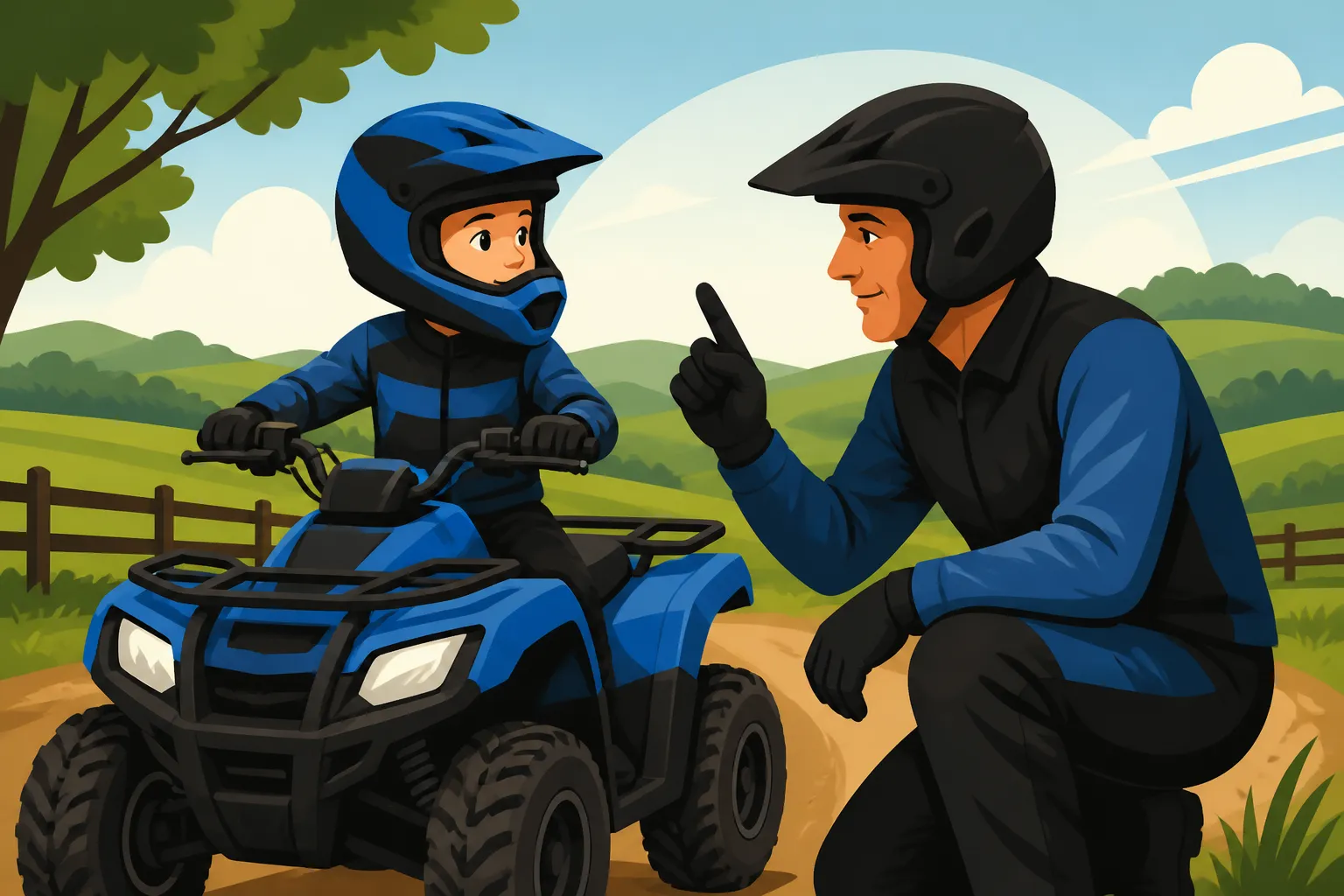
Preparation should be calm and repeatable. Explain what the child will do, show the controls while the machine is off, and agree on a simple way to communicate. For example, decide how the adult will signal “stop,” where the child should wait and what to do if they lose sight of the adult. Keep instructions short enough for the child to remember under stress.
Fit protective gear
A properly fitted helmet is essential. It should be designed for motorized off-road riding, sit level, fasten securely and stay in place when the child moves their head. A helmet that is too large can shift or obstruct vision; a loose chin strap can undermine the fit. If the helmet has taken a hard impact or is damaged, follow its manufacturer’s replacement guidance.
Add eye protection, gloves, long sleeves, long pants and sturdy over-the-ankle footwear. The goal is to protect against debris, scrapes, heat and contact with the machine, without clothing that can snag on controls or moving parts. Avoid loose drawstrings and dangling accessories. Check that the child can see, turn their head and operate the controls while wearing all gear.
For a UTV, use the vehicle’s intended seating positions and safety equipment. The child should sit in a seat designed for a passenger or operator, with the seat belt fitted as instructed. Do not carry a child on someone’s lap, in a cargo area or in a seat not intended for passengers. Keep hands and arms inside the vehicle, and explain that a cage is not a reason to unbuckle or lean out.
Inspect the machine together
A brief inspection teaches the child that riding starts before the engine does. Check tires, brakes, steering, throttle return, controls, lights where relevant, and any guards or restraints specified by the manufacturer. Look for leaks, loose parts or damage. If something does not work correctly, do not use the machine until it is fixed.
Set the machine up according to its manual. Do not make changes to engine output or controls based on guesswork. If a manufacturer provides a speed-limiting feature or other youth-specific setup instructions, follow those directions. An adult should confirm that the machine is functioning as intended before the child gets on.
Keep the first session short. Fatigue and frustration make it harder to listen and react. Plan a break before the child asks for one, and stop immediately if they become upset, distracted, cold, overheated or uncomfortable. A child who is eager to keep going may still be tired enough to make poor decisions.
Agree on supervision and signals
An adult should be close enough to intervene and should remain focused on the child, not on another rider, a phone or a separate task. Keep the practice area within clear sight. Set simple boundaries, such as where the child may ride and where they must stop.
If the adult is riding another machine, distance and terrain can make supervision less effective. For a beginner, standing nearby is usually easier than trying to teach while riding alongside. Avoid a group ride as the first lesson: other riders add noise, pressure and unpredictable movement.
The legal meaning of supervision can depend on the setting and applicable rule. Do not assume that being somewhere on the same property automatically satisfies every requirement. Check [Kentucky Supervision Rules for Young Riders] and the rules for the specific riding area.
Teach control in small, deliberate steps
A useful first lesson is deliberately uneventful. The goal is not distance or speed; it is learning to start, move slowly, steer, stop and follow instructions. Add one skill at a time. If the child struggles, return to an easier step rather than urging them to push through.
- Walk around the machine. Point out the throttle, brake, ignition, gear selector and any shutoff control. Explain which controls the child may use and what the adult will handle.
- Practice getting on and off. Show the correct position and how to mount or dismount with the machine stopped. For a UTV, practice entering and exiting without climbing on the cage or standing in a seat.
- Review stop signals. Use one clear word or hand signal. Ask the child to repeat what they will do when they hear or see it.
- Start and stop at walking pace. Choose a flat open area. Let the child move only a short distance, then stop. Repeat until they can stop smoothly and consistently.
- Practice gentle turns. Begin with wide, slow turns in both directions. Make sure the child looks where they intend to go and does not accelerate abruptly.
- Use a simple route. Add a few widely spaced markers or landmarks. Keep the route short and visible, with no obstacles that force sudden steering.
- Review before adding anything new. Ask the child what went well and what felt difficult. Repeat the basic skills until they are comfortable rather than treating one successful attempt as proof of readiness.
Do not begin with hills, deep mud, water crossings, side slopes, tight wooded trails or riding close behind another vehicle. Those conditions demand quick choices and leave little room for correction. A young rider needs basic control before learning to handle terrain that can shift, hide hazards or change the machine’s balance.
An adult should also avoid riding so close that dust, noise or pressure distracts the child. Give enough space for safe stopping, but stay close enough to supervise. If the child is expected to follow, keep the route simple and agree on a stop point before moving.
Teach stopping before speed
Children often focus on making the machine move. Give stopping equal attention. The rider should know which control to use, how firmly to apply it and what to do if the machine does not slow as expected. Practice stopping from a very slow speed in a clear area before introducing longer distances.
Do not teach by shouting directions after the child is already moving. Explain the exercise first, demonstrate it if appropriate, then let the child try. If they do not respond to a signal, stop the exercise and review the signal before continuing. Never turn a practice session into a test of whether the child can react to a surprise.
Teach terrain judgment, not just technique
A young rider should learn that turning around is a good decision. Point out soft ground, loose gravel, ruts, blind corners and slopes from a safe place. Ask the child what they notice and whether the route looks suitable. That helps build judgment without putting them in a situation they cannot manage.
Explain that conditions change. A trail that was manageable earlier may become slick after rain, and a puddle can conceal a hole or debris. If visibility is poor or the route is crowded, choose another time or location. For a new rider, skipping a difficult section is a sign of sound judgment, not failure.
Move from practice area to trail only when ready
A child who can operate the machine in an open field may not be ready for a trail. Trails add other riders, changing surfaces, limited sightlines, noise and pressure to keep moving. Readiness should be based on repeated, consistent control, not one good lap or an adult’s desire to continue the trip.
Before a first trail ride, look for signs that the child can:
- Start, turn and stop smoothly without repeated reminders.
- Keep a safe distance from other people and machines.
- Follow the agreed route and stop signal.
- Stay focused through a short session and communicate discomfort.
- Recognize when a route is too difficult and accept turning back.
- Wear the required gear correctly throughout the ride.
Choose a beginner-appropriate route with an easy exit. Ask the park staff or site operator about current conditions and youth rules, and do not rely only on a map or a trail rating. A trail can feel different with mud, traffic, weather or a crowded weekend. If the child becomes tired or anxious, end the ride rather than trying to finish a planned loop.
For a UTV, explain that the driver’s responsibilities include controlling speed, watching the route and keeping passengers secure. A child who is old enough and eligible to drive a UTV still needs to demonstrate judgment and control. A child who is only a passenger needs to understand the seat belt, staying seated and keeping hands inside the vehicle.
Keep the adult’s expectations realistic. A young rider may need frequent stops, a shorter route or an early return. Avoid letting friends’ pace set the lesson. If the child falls behind, becomes upset or stops responding to instructions, stop in a safe place and reassess.
Kentucky does not require every rider to hold a universal ATV safety certificate, but a recognized safety course can still be useful, especially before moving to a more powerful machine or busier trail. A course does not replace supervision, the manufacturer’s age guidance or a park’s rules. See Does Kentucky Require an ATV Safety Course? for the distinction between a statewide course requirement and good preparation.
Keep a simple record of what the child has practiced and what still needs work. Note the machine, conditions, skills practiced and any problems. That makes it easier to choose the next lesson without mistaking familiarity with one machine or one field for readiness everywhere.
Frequently Asked Questions
What is the youngest age a child can ride an ATV in Kentucky?
There is not a single age answer that works for every machine and riding location. Check the manufacturer’s age recommendation and the rules that apply where the child will ride. The child must also be able to control the machine safely. See Kentucky Minimum Age to Ride an ATV for more detail.
Does Kentucky require an ATV safety course for children?
Kentucky does not require a universal safety certificate for every ATV rider. A course can still be a sensible way to teach operating skills and safety habits. A trail park or event may have its own conditions, so check those separately.
Can a young rider practice on private land without a trail permit?
A trail permit may not apply to private land, but the rider still needs the landowner’s permission and must follow applicable law and the machine’s age guidance. Confirm who controls the land and where riding is allowed before starting.
Does a Kentucky trail permit work at every riding park?
No. Permits and access rules are generally location-specific. Check the requirements for each trail system before you travel, and do not assume a permit from one park covers another.
Disclaimer
This article is for general informational purposes only and does not constitute professional advice. Laws, prices and regulations vary by location and change over time. Consult a qualified professional for guidance on your specific situation.