Kentucky Parental Supervision Rules Explained
Kentucky parents often have to sort out three different questions at once: whether a young rider may operate a machine, whether an adult must supervise, and whether a particular trail or rental operator allows the ride. The practical answer depends on the rider’s age, the machine’s manufacturer label and where it will be used. Here’s how to check those pieces before unloading.
The basic rule: supervision and age guidance both matter
Kentucky’s rules for young ATV riders are not a single blanket permission that a parent can grant. A parent’s approval does not replace the requirements that apply to the rider, machine and riding location. In particular, treat direct adult supervision and the manufacturer’s age recommendation as separate checks.
For riders under 16, Kentucky’s supervision rule is a central part of the analysis. An adult’s involvement should be real and immediate, not just permission given before the ride. Separately, a machine’s age recommendation matters: a child should not be placed on a machine that the manufacturer says is intended for an older rider simply because an adult is nearby.
These checks work together. A young rider who is supervised may still be on a machine that is not appropriate for their age. A machine bearing an age recommendation that fits the rider does not, by itself, satisfy a supervision rule or a trail operator’s requirements. See Kentucky Rules for Riders Under 16 for the broader age-related rules.
A useful way to think about it is:
- Supervision asks who is watching and able to intervene.
- The age label asks whether the machine is intended for that rider’s age group.
- The riding location asks whether the activity is allowed there and under what conditions.
The details can be different for an ATV and a side-by-side. A child who is a passenger rather than the operator is not automatically exempt from all requirements, and the machine’s seating and passenger rules matter too. A child’s age, size, ability to reach and use the controls, and the manufacturer’s instructions should all be considered before deciding that a ride is suitable.
This is also why “my child has ridden before” is not a complete answer. Previous experience does not change the machine’s age guidance, make an adult’s supervision more direct, or override a park’s rules. If you are checking whether a child can ride a particular unit, look at the unit’s label and owner’s manual, then confirm the rules for the specific land or facility.
What direct parental supervision should look like
“Direct supervision” should be treated as active oversight. The adult needs to be in a position to see the young rider, understand what is happening and respond quickly if the rider loses control, approaches a hazard or needs help. Merely being somewhere on the property—or reachable by phone—does not provide that kind of oversight.
The exact circumstances vary. A parent riding nearby on a separate machine may be able to keep a rider in view on a broad, familiar route. That arrangement may not be adequate on a crowded trail, around blind corners, in steep or rocky terrain, or when the child is moving out of sight. A supervising adult should choose a route and pace that make effective supervision possible.
A practical supervision plan includes:
- Staying close enough to observe the young rider rather than relying on occasional check-ins.
- Keeping the rider within sight whenever the terrain and conditions allow.
- Choosing a route suited to the child’s ability and the machine, not merely to the adult’s experience.
- Giving clear instructions about stopping, following distance and what to do if separated.
- Avoiding conditions that make it hard to communicate or intervene, such as poor visibility, heavy dust or a crowded trail.
- Stopping the ride if the child becomes tired, frightened, distracted or unable to manage the machine safely.
For a more detailed discussion of what “direct” supervision means in a trail setting, see What Direct Parental Supervision Actually Means on a Trail. The key is not to turn the phrase into a loophole. If the adult cannot observe the rider and act promptly, the setup is not a sensible interpretation of close supervision.
Supervision also involves more than riding behind a child and assuming everything is fine. Before starting, the adult should check that the rider understands the controls, knows how to stop, can reach the controls while seated, and can follow basic instructions. If the child cannot reliably stop or steer the machine, the problem is not solved by a parent being present.
The route matters as much as the adult’s position. A quiet, open area with clear sightlines presents a different supervision challenge from a narrow trail with sharp turns, steep grades or other riders approaching from the opposite direction. Adults should reduce speed and complexity when a child is learning, and should not let a faster or more experienced group set the pace.
Supervision is not a substitute for protective equipment or safe operating practices. It does not make an unsuitable machine suitable, and it does not authorize riding where the land manager or operator prohibits it. For rules about passengers, review Kentucky Rules for a Passenger on an ATV before carrying a child on a machine.
Read the machine’s age label before choosing a ride
The manufacturer’s age recommendation is an important part of deciding whether a child should operate a particular ATV. Check the warning label on the machine and consult its owner’s manual. Do not rely on a seller’s description, a friend’s estimate or the child’s height alone. The age recommendation is tied to the manufacturer’s assessment of the machine, and it may reflect its power, weight, controls and intended use.
Do not assume every machine has the same age guidance. Two ATVs that look similar can have different specifications and recommendations. A side-by-side can also have different operating and passenger considerations from a small youth ATV. Check the exact model rather than applying an age rule remembered from another machine.
The right process is straightforward:
- Find the manufacturer’s warning label and read the age recommendation.
- Confirm the model and instructions in the owner’s manual.
- Compare the rider’s age with the recommendation, rather than relying on physical size or experience.
- Check the rider’s ability to reach and operate all controls while seated in the proper position.
- Confirm the supervision and location rules before riding.
If the label is missing, damaged or unreadable, do not treat that as permission to ignore it. Look for the manual or contact the manufacturer or dealer to identify the model and its recommendation. Avoid removing or altering a warning label. A missing label can make it harder to establish the intended age group and can create a safety and compliance problem.
For help interpreting the label, see Reading a Manufacturer’s Age Label. The safest approach is to treat the stated age recommendation as a real limit, not a rough suggestion that can be waived by a parent. A child being tall for their age or having ridden another machine does not change what the manufacturer recommends for this one.
Fit is another useful safety check, but it does not replace the age label. A child should be able to sit properly, reach the controls and use them without stretching or shifting into an unstable position. If the child’s hands or feet cannot comfortably operate the controls, or the child cannot manage the machine’s weight, that is a strong reason not to ride it.
Parents sometimes ask whether there is one youngest age at which any child can ride an ATV in Kentucky. A single number cannot answer that safely across all machines and locations. The manufacturer’s recommendation, the direct-supervision rule and the specific site’s requirements all need to be considered together. A machine labeled for an older age group is not made appropriate for a younger child just because a parent is present.
Kentucky does not generally require every ATV rider to hold a statewide rider certificate as a condition of riding. That does not mean training is pointless or that a park, rental business, event organizer or land manager cannot set its own conditions. A course can help a child learn controls, trail signals and safe habits, but completion of a course does not override a machine’s age recommendation. See Kentucky ATV Safety Course Requirements for the distinction between statewide requirements and other rules that may apply.
Location and operator rules can add requirements
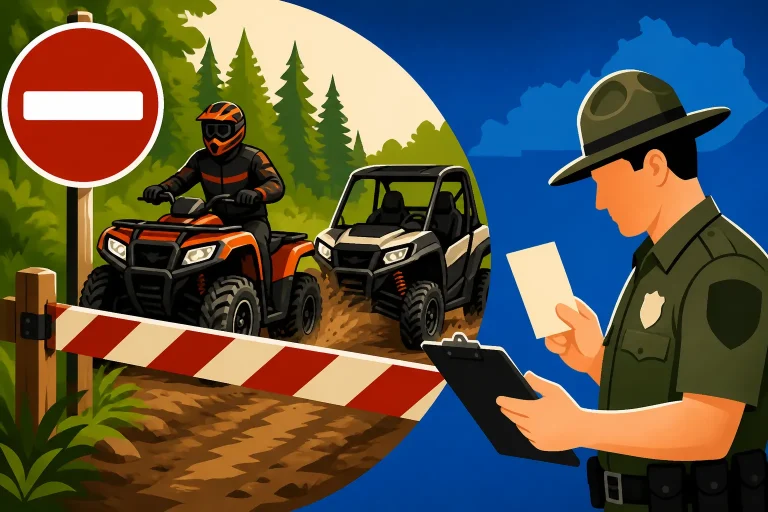
The supervision question does not end when the family reaches a trailhead. A park, public land manager, rental business or event organizer may have additional rules for minors. Those rules can cover minimum age, passenger use, adult-to-child oversight, permitted machine types, safety gear, riding areas or waivers. Check the rules for the place you plan to visit before you haul the machine.
A trail permit is permission to use a particular riding area under its conditions. It is not a general authorization for a child to operate any machine, and it does not replace Kentucky’s requirements. Likewise, an out-of-state permit or certificate should not be assumed to satisfy the local operator’s rules. For additional context on riding under 16 at trail locations, see Kentucky Trail Rules for Riders Under 16.
Private property is not automatically an exception to every safety or legal concern. Permission from the landowner matters, but it does not make an age-inappropriate machine a good choice or eliminate the need for close supervision. Get clear permission for the specific land and route, and check whether the property is subject to additional rules. See [Kentucky Rules for Riding Private Property] and Kentucky Landowner Permission Rules.
Public roads require particular caution. The fact that an adult is supervising a child does not make an ATV or UTV road use legal. Kentucky’s road rules and exceptions are separate from the rules for riding on a trail or private ground. Do not use a road shoulder, public road or roadside crossing as a shortcut based only on parental permission; first confirm that the particular operation is lawful. Kentucky Rules for ATVs on Public Roads explains that separate issue.
Rental operators can have stricter conditions than the general rules. A rental business may set age limits for drivers and passengers, require a particular adult to sign paperwork, or limit which machines minors may use. Do not assume the child can operate a rental just because the family has permission to ride at the park. Check the rental company’s requirements before booking, and read Kentucky Rules for a Rented Machine if a rental is part of the plan.
The same caution applies to organized rides and events. An organizer may require additional supervision, safety equipment or written permission, and could set age restrictions for its course. Ask the organizer directly rather than relying on a rule from another venue. If the event takes place on land managed by someone else, both the event conditions and the land manager’s rules may apply.
A parent’s pre-ride checklist
A short check before each ride can prevent confusion at the gate and help avoid putting a child in a situation they are not ready to handle. The decision should be based on the specific child, machine, route and conditions—not on a general idea that “kids can ride ATVs.”
Before leaving home, confirm:
- The rider’s age: Identify whether the under-16 supervision rule applies.
- The machine’s recommendation: Read the age label and manual for the exact model.
- The rider’s fit and control: Make sure the child can sit correctly and reach and operate the controls.
- The adult’s role: Decide who is supervising and how that person will maintain effective oversight.
- The location’s rules: Check the park, land manager, rental provider or event requirements.
- The route and conditions: Choose terrain and pace suitable for the child’s ability and the adult’s capacity to supervise.
- Protective equipment: Use properly fitting gear and follow the machine and site instructions.
- A stop plan: Agree on what the rider should do if separated, tired, unsure or faced with an obstacle.
Gear should fit the child, not just match the machine. A helmet that shifts, blocks vision or does not sit securely is a poor choice. When shopping through a retailer such as Amazon, verify the item’s sizing, intended use and safety information from the manufacturer rather than relying on a listing title or customer photos. Try on the helmet and other equipment before the trip when possible.
On the trail, the adult should keep reassessing. Conditions change: dust can obscure the view, weather can make a slope slick, and a child can tire faster than expected. A reasonable plan at the start may stop being reasonable later. Slow down, take a break or end the ride when supervision becomes difficult or the child’s control declines.
If a park or rental counter gives an answer that differs from what you expected, ask which written rule applies and follow the stricter site requirement while there. A family’s interpretation of the statewide rule does not bind a private operator or land manager. When the answer is uncertain, postpone the ride until the requirement is clear rather than testing it with a child on the machine.
A helpful rule of thumb is to make the decision in this order: first check the machine’s age recommendation, then confirm the adult-supervision arrangement, then verify the land and operator rules. If any one of those checks fails, choose another machine, location or activity. A parent’s presence is important, but it cannot make every combination of rider, machine and terrain appropriate.
Frequently Asked Questions
Does a parent’s permission alone allow a child to ride?
No. Permission is not a substitute for applicable supervision rules, the machine’s age recommendation or the rules of the riding location.
Does direct supervision mean an adult can stay at the trailhead?
That is not a sound interpretation. Direct supervision should involve active oversight, with the adult able to observe the rider and respond promptly. A remote or occasional check-in is not equivalent.
Does Kentucky require every young ATV rider to complete a safety course?
Kentucky does not generally require every rider to hold a statewide ATV rider certificate as a condition of riding. A park, rental business or event may still have its own training or participation requirements.
Can a child ride a machine if its age label recommends an older age?
Do not treat adult supervision as permission to disregard the manufacturer’s recommendation. Check the exact model’s label and manual and choose a machine intended for the child’s age group.
Disclaimer
This article is for general informational purposes only and does not constitute professional advice. Laws, prices and regulations vary by location and change over time. Consult a qualified professional for guidance on your specific situation.