Mud After a Week of Mountain Rain
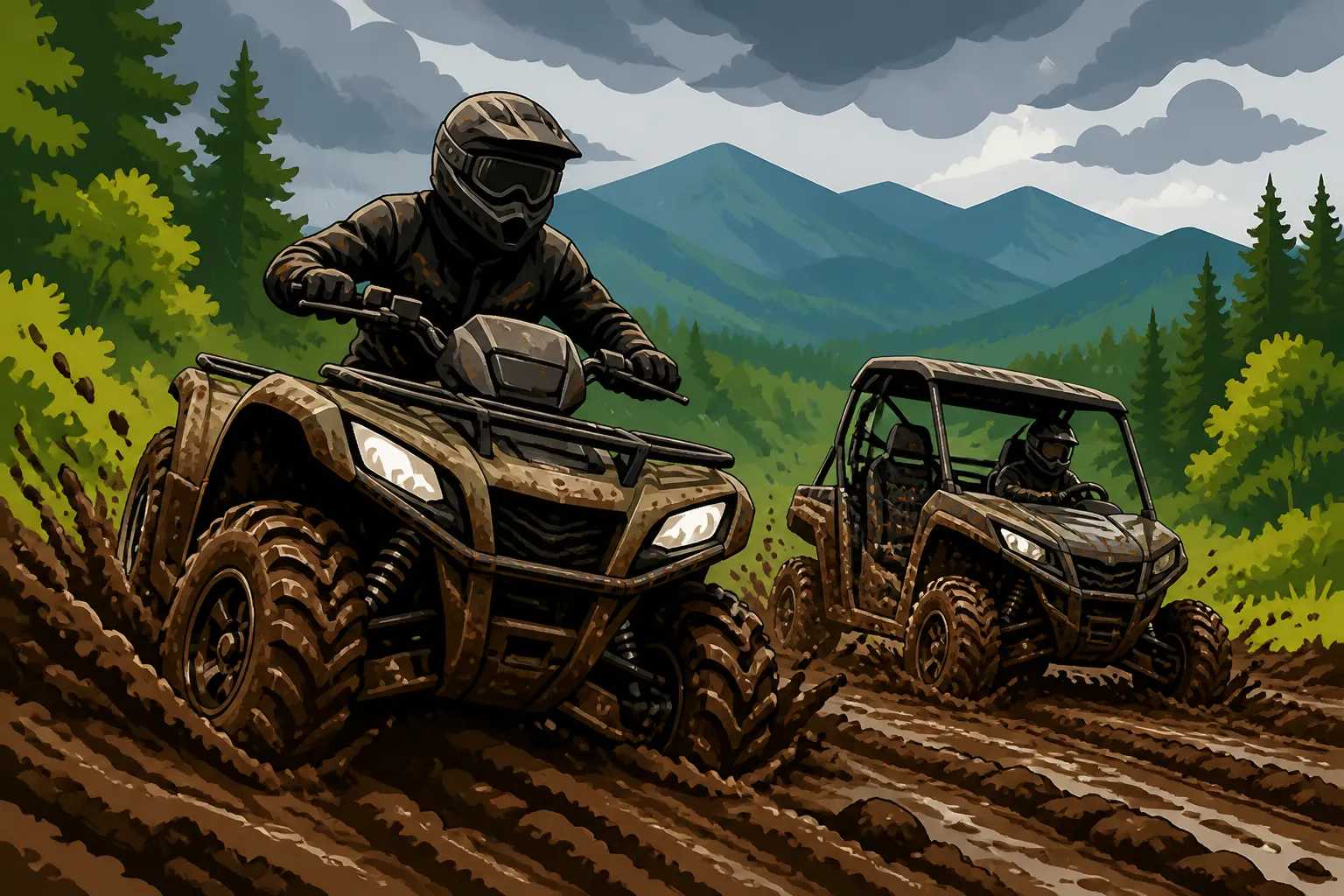
A week of mountain rain can turn a familiar Kentucky trail into a slick, rutted route with hidden rocks, rising creek crossings, and soft shoulders. The hardest part is deciding whether to ride at all. This guide explains how to check conditions, prepare your ATV or UTV, handle mud more safely, and know when turning around is the smartest call.
Decide Whether the Trail Is Ready
Check the park, not just the forecast
A sunny morning does not necessarily mean a trail has dried out. In eastern Kentucky, steep slopes, shaded hollers, creek bottoms, and old mining roads can hold water long after rain stops. One section may feel firm while the next is slick clay or a washed-out bench. A forecast tells you what may be coming; it cannot tell you what a particular trail looks like right now.
Before loading up, check the trail park’s official notices and contact the operator if conditions are unclear. Ask specifically about the route or area you plan to ride, not just whether the park is “open.” A park may be operating while some trails are closed, restricted, or too wet for safe passage. Review [Kentucky Trail Conditions Before You Ride] and [Kentucky Trail Closures to Check First] as part of your pre-trip routine.
If you’re considering Turkey Bay, take wet-ground closures seriously. Saturated soil can rut easily, and ruts may worsen with every pass. That is one reason [Why Turkey Bay Closes on Saturated Ground] is a useful topic to understand before you travel. Conditions and operating decisions can change, so confirm directly with the recreation area rather than relying on an old social media post or a trail report from a different weekend.
Look for more than standing water
A puddle is easy to spot. The more concerning signs can be less obvious: water flowing across a trail, fresh gravel or soil deposited over the route, a soft edge where the trail meets a drop, or a creek that is higher and faster than it was on your last visit. Rain can also expose rocks, deepen existing ruts, and weaken the edge of a narrow trail.
Use this quick check before committing to a ride:
| What you find | Why it matters | Sensible response |
|---|---|---|
| Water is flowing across the trail | The depth and footing may be hard to judge | Stop and assess from a safe location; do not enter if you cannot see a safe exit |
| A creek is noticeably higher or moving quickly | Water levels can rise further upstream, and crossings can hide hazards | Skip the crossing and choose a safe alternate route |
| Fresh mud covers the trail edge | The ground may be unstable near a slope or drop | Keep away from the edge and turn around if the trail is too narrow |
| Deep new ruts or exposed rocks | The route may be difficult to steer through without damage or loss of control | Slow down and avoid the section if you cannot pass without forcing the machine |
| A posted closure or blocked route | Riding may damage the trail or put you in an unsafe area | Respect the closure and follow the park’s directions |
A map can help you plan, but it is not a substitute for current trail information. If you use onX Offroad to review a route, treat it as a planning aid rather than confirmation that the route is open or passable. Download or save what you need before entering areas with poor reception, and check the park’s own notices for closures.
Prepare Your ATV or UTV for Wet Trails
Check the machine before you leave
Mud adds strain to a machine and can hide problems you might notice on dry ground. Before the trip, check tire pressure and condition, brakes, steering, throttle response, lights, and the condition of any winch or recovery gear you expect to use. Make sure the battery is secure and that key electrical connections are protected as the manufacturer recommends. If you have not inspected the machine recently, a rainy-weekend ride is a poor time to discover a loose component on a remote trail.
Tire choice matters, but aggressive tread is not a magic fix. A tire that works well in one kind of Kentucky mud may feel unpredictable on slick rock, roots, or a hard-packed trail. Review [Tire Choice for Kentucky Rock and Mud] with your machine, riding style, and the terrain you expect to encounter in mind. Avoid changing tire pressure or equipment based on a generic tip without checking the machine’s guidance and understanding the trade-offs.
Bring a basic recovery kit suited to your vehicle and experience. Depending on the ride, that may include a properly rated recovery strap, gloves, a shovel, and a winch with appropriate accessories. Know how to use each item before you need it. A strap is not a safe recovery plan by itself: riders need to understand suitable attachment points, keep people clear of tensioned equipment, and follow the machine and recovery-gear manufacturers’ instructions.
Pack for delays and limited communication
A muddy route can take longer than expected, even when no one gets stuck. Pack water, food, weather-appropriate layers, a first-aid kit, and a charged phone. Tell someone where you intend to ride and when you expect to be back. If your group separates, agree in advance on a meeting point and what to do if someone has to turn around.
Cell service can be unreliable in mountain hollers. Before you leave, make sure each rider understands the planned route and has a way to navigate if phones lose signal. A tool such as onX Offroad can help with route planning, but do not assume a phone’s map will provide live trail status or work without preparation. Save the information you may need ahead of time, and carry a backup navigation method appropriate to your trip.
Ride Muddy Kentucky Trails With Care
Slow down and choose a line deliberately
On wet ground, small control inputs matter. Sudden acceleration can spin the tires and dig a rut; abrupt braking can make a machine slide. Keep a steady pace that lets you react, leave space between machines, and avoid following so closely that another rider’s mud spray blocks your view. If you cannot see the ground clearly, slow down or stop somewhere safe.
Choose a line you can assess rather than charging into the deepest-looking section. Mud can hide rocks, branches, holes, and abrupt changes in depth. If a puddle’s bottom is not visible, do not assume it is shallow. Avoid riding around an obstacle by cutting a new path through vegetation or over a soft shoulder. That can widen the trail, damage the land, or take you closer to an unstable edge.
If a route becomes too difficult, turn around before the machine is committed to a steep or narrow section. On a side-by-side, remember that the vehicle’s width can make a muddy bench or tight turn especially challenging. A route that was manageable in dry weather may not offer a safe passing or turning space when the ground is slick.
Treat creeks, slopes, and narrow benches as separate hazards
A creek crossing deserves its own decision, not a casual extension of the trail. Water depth, speed, bottom conditions, and the shape of the exit all matter. Rain upstream may affect a crossing even if the sky above you is clear. Do not enter moving water if you cannot judge the depth and footing or identify a safe way out. A flooded or fast-moving crossing is a reason to turn back, not to test the machine.
Mountain trails can also narrow along slopes and old benches. Wet soil may crumble or slide under tires, especially where water has run across the trail. Keep away from soft edges and avoid passing another machine in a place where neither vehicle has firm room. For more on the risks of riding in a narrow valley after rain, see [Flash Flooding in a Narrow Valley]. You can also review [Kentucky Trail Etiquette on Narrow Benches] before riding in a group.
If a route is blocked, do not bypass the blockage by cutting through unmarked land. Stay on authorized trails and respect posted closures. [Kentucky Riding After Heavy Rain] offers related guidance on how wet conditions can change a ride; the practical takeaway is to adjust the plan to the ground you actually encounter, rather than pushing through because the route looked easy on a map.
Know When to Turn Around and What to Do Afterward
Use clear turn-back rules
It helps to agree on turn-back rules before anyone is tired, muddy, or eager to finish the loop. For example, your group might decide to stop if a creek is moving quickly, a trail edge looks unstable, a machine begins to slide unpredictably, or a section requires repeated attempts to climb. Those are not signs that a rider needs to try harder. They are information about the conditions.
A sensible group ride also gives the least experienced rider a real say in whether to continue. If one person is uncomfortable with a crossing or slope, pause and discuss another route. Nobody benefits from pressure to keep going, especially when the trail is remote and a recovery would be difficult. If you are riding alone, use an even more conservative threshold: a problem that would be manageable with a group can become much more serious without help nearby.
If a park closes a route or the ground is too wet, do not try to recreate the ride somewhere unauthorized. Check for another permitted area, postpone the trip, or choose a non-riding activity nearby. [Where to Ride When a Kentucky Park Closes Wet] can help you think through alternatives, but confirm that any destination you choose is open and allows the type of riding you plan.
Clean and inspect the machine after the ride
Mud left on the machine can hide damage and make maintenance harder. After the ride, rinse mud away without forcing water into electrical connectors, bearings, seals, or other sensitive areas. Follow the manufacturer’s cleaning guidance, especially if using a pressure washer. Let the machine dry, then check for packed debris around the radiator, brakes, suspension, and drivetrain.
Look over the tires for cuts or lodged debris, inspect the underside for damage, and pay attention to changes in steering, braking, or unusual noises. If the machine was deeply submerged, ran hot, or took a hard impact, do not assume that washing it makes everything fine. Follow the owner’s manual and arrange a qualified inspection if needed.
Finally, think about the trail as well as your machine. Staying on marked routes, avoiding repeated wheelspin, and honoring wet-weather closures helps prevent damage that can take a long time to repair. When a trail has had a week of mountain rain, the most responsible ride may be a shorter route—or no ride at all. That can be frustrating after hauling your machine to the mountains, but it is better than risking a rollover, damaging the trail, or turning a weekend outing into a recovery job.
Disclaimer
This article is for general informational purposes only and does not constitute professional advice. Laws, prices and regulations vary by location and change over time. Consult a qualified professional for guidance on your specific situation.