Coal Benches and Steep Climbs
Coal-country ATV trails in eastern Kentucky can turn from a broad gravel bench into a narrow shelf road or a steep, loose climb in a short distance. That change catches riders off guard, especially after rain or when traffic is coming the other way. This guide explains how to read the terrain, choose a sensible line, prepare your machine, and ride coal benches and climbs with more confidence.
What makes coal-country trails challenging
A bench road is not always an easy road
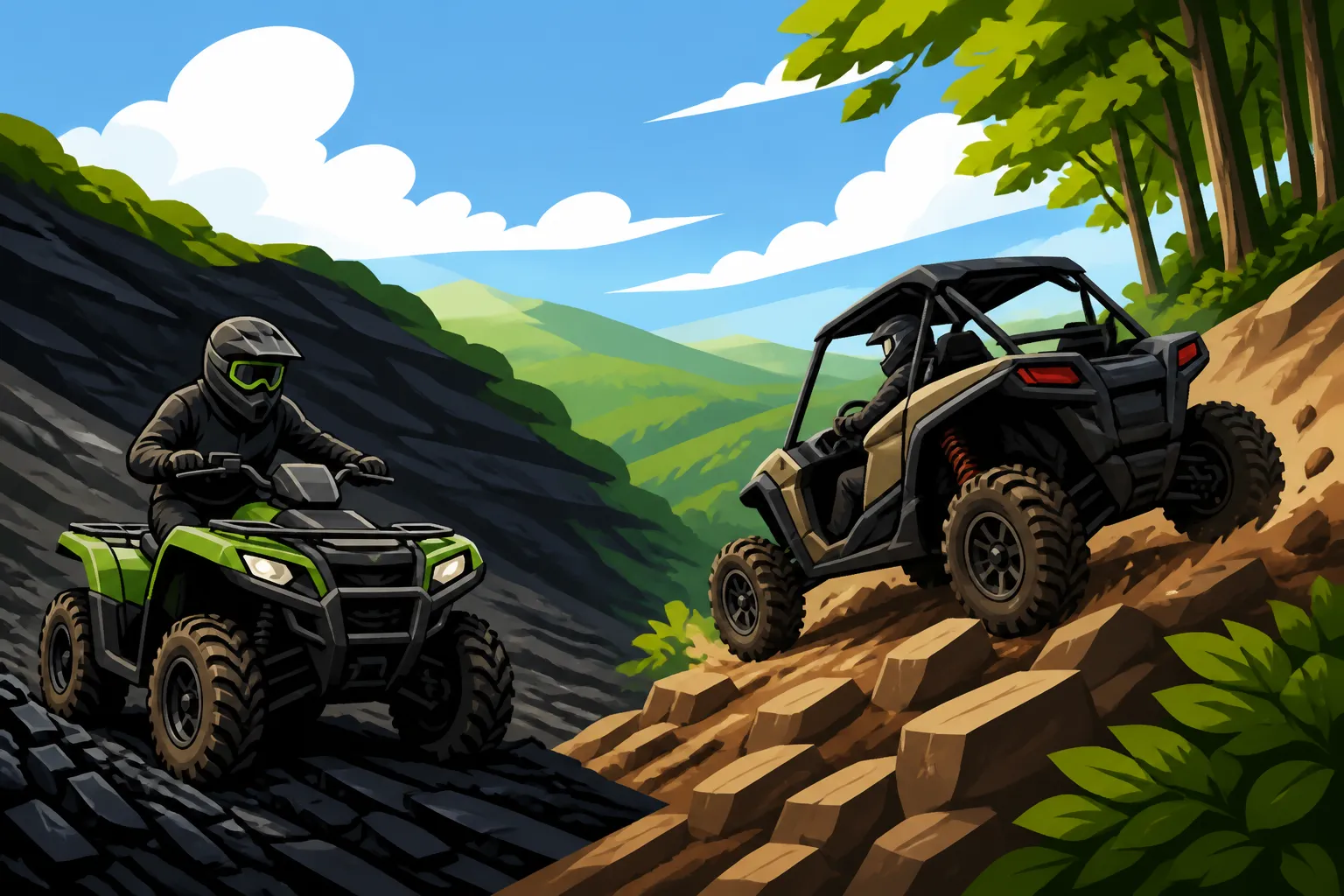
A coal bench is a road cut across a hillside, often following the mountain’s contour. It may look relatively level from a distance, but the ground can slope toward the downhill edge, and the usable riding surface may be narrower than it appears. Loose stone, ruts, washouts, and drainage channels can make a bench feel very different from a wide forest road.
That’s why it helps to look beyond the road’s apparent flatness. Notice the slope across the trail, the condition of the outside edge, and whether water has carved a rut down the center. A wide, firm bench with clear sightlines is a different proposition from a narrow shelf with a soft edge and a blind bend. If you cannot see enough of the route to judge what is ahead, slow down rather than assuming the trail stays consistent.
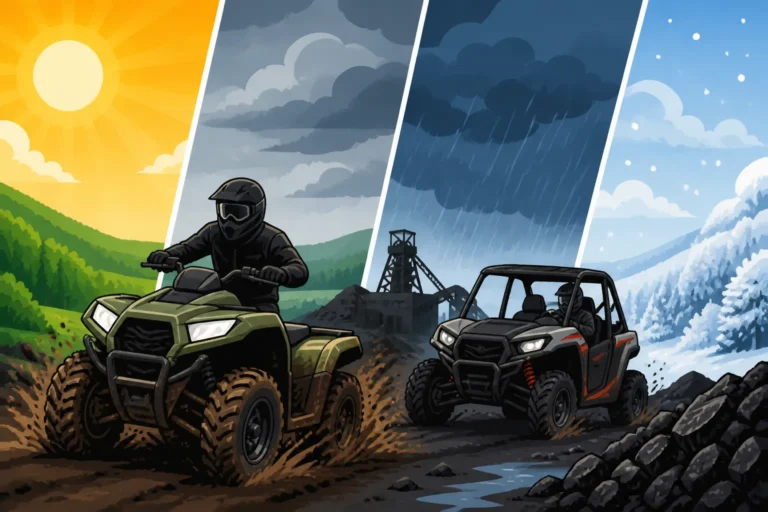
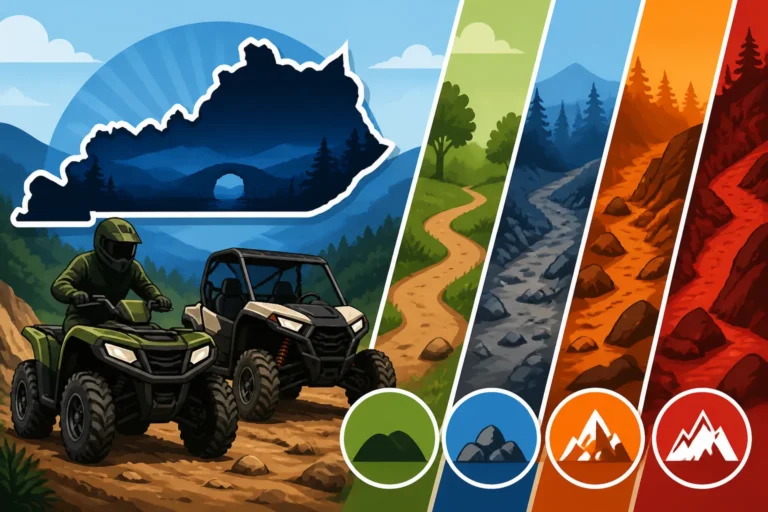
Coal-country roads also change with use and weather. A route that felt straightforward on a dry day can become slick after rain, while loose rock may shift under a tire on a climb. Read up on local conditions and route character before choosing a ride, including [Kentucky Trail Difficulty Ratings] and [Kentucky Trail Conditions Before You Ride].
Steep climbs ask for judgment, not just throttle
A steep climb can look manageable from the bottom and become intimidating once the slope steepens, the surface gets loose, or the line narrows. Before committing, stop in a safe place and assess the whole section. Look for embedded rock, deep ruts, sharp ledges, standing water, and a stable area where you could pause without blocking the trail. If you cannot identify a reasonable route up, turning around may be the best decision.
Riders often get into trouble by charging at a climb without enough time to choose a line. Too much speed can make steering difficult; too little momentum on loose ground can leave a machine spinning or stalled. The right approach depends on the machine, the rider, the surface, and the slope. Use smooth, controlled inputs, avoid abrupt changes in direction, and do not follow another rider so closely that you have no room to react.
If a hill is beyond your comfort level, don’t let the group’s enthusiasm make the choice for you. Ask an experienced rider to look at it with you, or choose a marked alternate route if one is available. A trail ride is not a test of who can force a machine up the hardest line. For route ideas in the region, explore [Kentucky's Coal Country Trail Systems] and [Black Mountain Off-Road Adventure Area in Kentucky], then check the riding area’s own information before you travel.
Plan for the route before you unload
Check the riding area, route, and weather
Coal-country riding areas can include steep grades, narrow benches, mine-road remnants, and changing trail conditions. The name of a park or trail system does not tell you whether every route is suitable for your machine or experience. Look at the riding area’s current map and rules, confirm that the routes you plan to use are open to your type of vehicle, and check for closures or weather-related restrictions before setting out.
Rain deserves particular attention. Water can make clay slick, expose loose rock, fill ruts, and weaken the outer edge of a bench. A low-looking drainage crossing can also change quickly after heavy rainfall. If conditions have deteriorated, shorten the ride or choose a less exposed route rather than trying to keep to a fixed itinerary. For more planning help, see [Kentucky Trail Closures to Check First] and [Kentucky Riding After Heavy Rain].
Think through the ride as a series of decisions, not a single destination. Where can the group turn around? Are there intersections where riders could get separated? Does the route have places to stop safely without blocking traffic? If the terrain becomes more difficult than expected, is there a practical way back? A little planning can prevent a minor delay from becoming a stressful recovery.
Carry a map and know how to use it
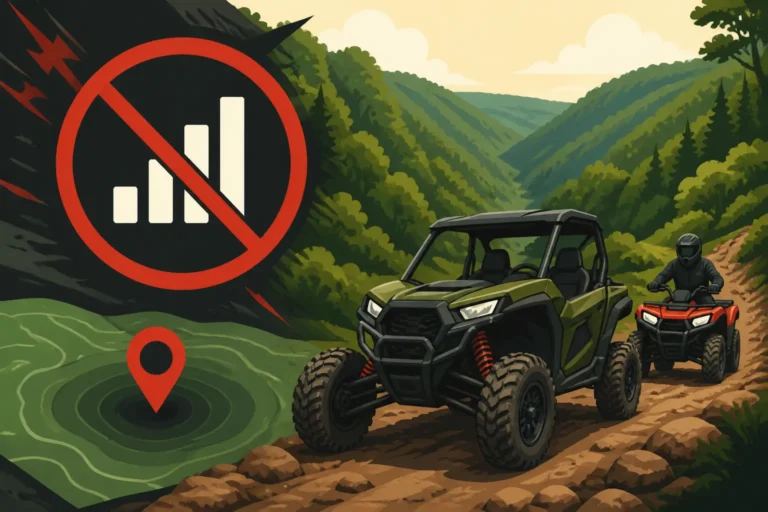
A map is most useful when you consult it before you are tired, cold, or uncertain about a junction. Review the route at the staging area, note recognizable trail intersections, and agree on what the group will do if riders lose sight of one another. Do not assume that a phone will have reliable service throughout a mountain hollow or along a remote bench road.
A digital mapping tool such as onX Offroad can help riders view routes and keep track of their position when planning a ride. Learn how to use the map before leaving the trailhead, and prepare for weak or missing signal if the app or device offers an offline map option. A phone map is a helpful aid, not a substitute for following posted signs, respecting closures, and carrying out the riding area’s rules.
It is also wise to keep the group’s navigation simple. Pick a lead rider who knows the route, have another rider bring up the rear, and agree that nobody leaves an intersection until the group is together. If the route is unfamiliar, mark a conservative turnaround point instead of continuing just because the trail remains open. [Kentucky Trail Maps Worth Carrying] offers more ideas for planning and navigating a ride.
Ride benches and climbs with control
Use a deliberate approach on narrow benches
On a bench road, give yourself time to see and respond. Reduce speed before a blind corner, keep a steady line, and avoid sudden steering that could carry a tire toward a soft shoulder. If the downhill side is exposed or the road is especially narrow, make space for other riders to pass at a spot with enough room rather than trying to squeeze past at a bend.
When you meet another machine, communicate calmly and look for a safe place to yield. Don’t assume the rider coming toward you has seen your group, particularly around dust, vegetation, or a blind curve. If one rider moves to a turnout, wait until everyone has passed before proceeding. On a narrow route, patience is a safety skill.
Do not ride along the outside edge simply because it looks like the shortest line. The edge may be undercut or softened by water, and loose material can slide under a tire. Stay on the established riding surface, avoid creating new tracks, and follow any signs or barriers. For practical guidance on sharing tight routes, read [Kentucky Trail Etiquette on Narrow Benches].
Choose a climb only when you can ride it safely
Before starting uphill, check that the route is clear and that the riders ahead have enough space to complete the section. Keep a gap so you are not forced to stop directly behind a machine on a steep grade. If the climb is blind, wait until you know the path is clear rather than following another rider’s dust or tire marks without seeing the terrain.
Use a line you can maintain, not one that looks impressive from below. Avoid sudden throttle or braking inputs, and do not turn sharply across a steep slope unless you are confident the terrain and machine allow it. If your machine begins to lose traction, spinning the tires harder may dig a hole and make the situation worse. A controlled pause, a safer line, or a retreat may be preferable to forcing the climb.
A group should agree in advance on how to handle a stalled or struggling rider. Keep bystanders and waiting machines clear of the slope, and do not stand directly below a machine that could slide backward. Recovery work belongs to people who understand the machine, terrain, and equipment involved. A winch or tow strap can create serious hazards when attached or used incorrectly, so avoid improvised recovery attempts.
| Trail situation | What to assess | Safer choice |
|---|---|---|
| Narrow bench with a blind bend | Visibility, road width, edge condition, and oncoming traffic | Slow before the bend and wait for a safe passing area |
| Loose or wet climb | Traction, ruts, slope, and a safe place to stop | Choose a manageable line or turn back if uncertain |
| Fresh rain or visible washout | Mud, drainage channels, soft shoulders, and closures | Recheck conditions and avoid damaged or restricted routes |
| Unfamiliar junction | Signs, map position, and the group’s agreed route | Stop safely and confirm the route before continuing |
| Rider stalled on a grade | Machine position, people nearby, and recovery risks | Keep others clear and use only a suitable, controlled recovery plan |
Prepare your group and machine for mountain terrain
Match the ride to the least experienced rider
A route that feels routine to one rider may be a serious challenge for someone new to steep terrain. Before the ride, talk honestly about everyone’s experience, machine type, and comfort with narrow roads and climbs. Choose a route that gives the least experienced rider room to learn without being pressured to keep pace with a faster group.
Set a pace that allows the group to stay together. Stop at safe, visible locations, not in the middle of a narrow climb or on a blind corner. A lead rider can manage the route while a sweep rider checks that nobody has been left behind. If someone is uncomfortable, take that seriously and adjust the plan.
For families or mixed-experience groups, a shorter ride with a clear turnaround point can be more enjoyable than a long route with several difficult sections. Talk through basic expectations before starting: where to stop, what to do if separated, and how to signal a problem. [Riding With Children at a Kentucky Park] and [Kentucky Trail Rules for Riders Under 16] are useful starting points when younger riders are part of the group.
Check the machine and carry practical essentials
A pre-ride inspection is especially worthwhile when the route includes rocks, steep grades, or remote sections. Check tires for visible damage and appropriate condition, confirm that controls work properly, and make sure the machine is carrying only what it can safely handle. Secure loose cargo so it cannot shift during a climb or snag on brush. Follow your owner’s manual for maintenance and operating guidance.
Bring water, weather-appropriate clothing, basic first-aid supplies, and a way to contact the group if riders become separated. A charged phone is useful, but don’t plan as if it will always have service. If you rely on a digital map, such as onX Offroad, review the route ahead of time and make sure you understand how to access the information you need without depending on a strong connection.
Finally, treat signs, gates, and marked closures as boundaries, not suggestions. Coal-country land may be privately owned, leased, or managed for particular uses. A visible road is not automatically open to recreational riding, and an old mining track is not permission to ride beyond a marked route. Confirm access with the riding area and stay on authorized trails. A cautious route choice, a clear group plan, and a willingness to turn around make steep Kentucky riding far more manageable.
Disclaimer
This article is for general informational purposes only and does not constitute professional advice. Laws, prices and regulations vary by location and change over time. Consult a qualified professional for guidance on your specific situation.