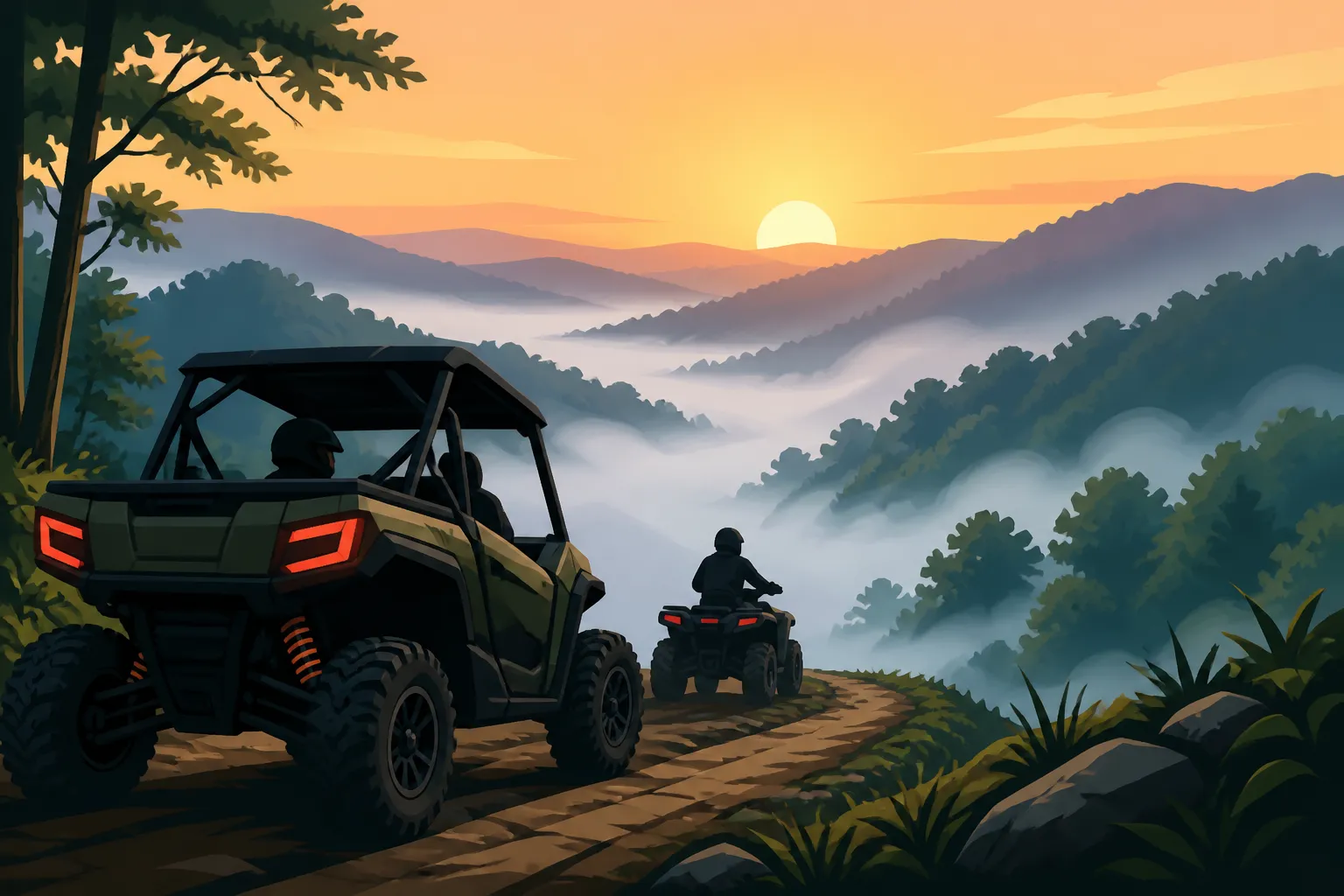
Fog in a Kentucky Holler at Dawn
Fog in a Kentucky holler can turn a familiar road into a short, disorienting tunnel: trees block what little daylight there is, damp air softens the edges of the trail, and a truck may appear around a bend before you hear it. This guide explains how to judge visibility, prepare your ATV or UTV, and decide when it is safer to wait than ride.
Why fog is especially challenging in a Kentucky holler
How terrain changes what you can see
A holler’s steep sides and narrow valley can hold moisture and shade long after the surrounding ridges begin to brighten. Near dawn, fog may sit low over a creek, drift across a gravel lane, or gather where a road dips between wooded slopes. You can ride out of one clear patch and into a nearly opaque pocket in a matter of seconds.
That change matters because familiar landmarks can vanish. A bend you normally recognize by a fence line may look like a straight section, while a creek crossing or washed-out shoulder becomes difficult to distinguish from the road itself. Even at low speed, it takes time to interpret what you are seeing and stop safely.
Fog also muffles sound and makes distance difficult to judge. A coal truck, pickup, or another off-road vehicle may seem farther away than it is. On narrow roads with limited room to pull aside, being unable to see far enough ahead can leave little time to react.
What conditions to check before unloading
Look beyond the parking area. Check visibility along the route you intend to use, especially at low points, creek bottoms, shaded bends, and places where a holler road meets a larger road. Clear conditions at a trailhead do not guarantee clear conditions deeper in the valley.
Ask someone who has recently traveled the route whether fog is sitting in the holler or whether rain has left mud, gravel, or standing water. A local campground host, land manager, or riding partner may know that a particular section stays foggy well after sunrise. You can also review [Kentucky Trail Conditions Before You Ride] before setting out.
Use a simple decision rule: if you cannot see far enough to stop within the visible, clear section of road, do not continue at your usual pace. If you cannot identify the road edge, a safe pull-off, or an approaching vehicle, stop somewhere well out of the travel path and wait for conditions to improve.
Prepare the machine and rider for low visibility
Check lighting and visibility equipment
Before a dawn ride, test the headlights, taillights, brake lights, and any indicators your machine has. Clean the lenses and remove mud, dust, or dried water that can scatter light. A light that looks adequate in a garage may reveal a weak beam once it is aimed through fog and onto a dark, damp road.
Fog reflects light back toward the rider. That is one reason a brighter beam does not always make visibility better: a high, intense beam can create a pale wall that hides the road beyond it. Use the lighting setup the machine is designed for, and avoid staring into glare. For equipment and legal context, see [Kentucky Lighting Requirements for ATVs] and [How to Aim a Headlight for a Holler Road].
Wear high-visibility outerwear where practical, and make sure passengers do not have loose clothing that could snag. Reflective details can help another road user notice you, but they are not a substitute for legal access, working lights, or a clear view. If you have added a windshield or other aftermarket equipment from a brand such as SuperATV, check that it is clean and not creating glare or obstructing your sightline.
Keep the windshield and your own vision clear
A fogged windshield can be as troublesome as fog outside. Temperature differences, damp air, and breath can cloud the inside surface. Before moving, clean it with a product suitable for its material and check that you can see through the full area you rely on. Do not assume that wiping a small patch will be enough once the machine is moving.
If you use a windshield made by SuperATV or another manufacturer, follow its care instructions rather than reaching for an abrasive cloth or an unsuitable cleaner. Scratches and haze can scatter light, especially when headlights shine toward you. Make sure your helmet visor or goggles are also clean and positioned so they do not fog as you breathe.
Bring a dry cloth where it can be reached without leaning out or taking your attention off the trail. If your vision becomes cloudy while moving, slow down and stop at a safe place before cleaning anything. Never try to wipe a windshield, visor, or goggles while steering along a narrow road.
| Before the ride | What to check | Why it matters in fog |
|---|---|---|
| Headlights and rear lights | Confirm they work and lenses are clean | Helps you see and be noticed |
| Windshield, visor, or goggles | Check for haze, scratches, and interior fog | Prevents glare and blurred sightlines |
| Tires and brakes | Look for damage and confirm normal response | Damp gravel and mud can increase stopping difficulty |
| Route access | Confirm the road or trail is open and permitted | Visibility does not make an otherwise closed route legal |
| Weather and local conditions | Ask about fog, rain, and surface damage | A clear trailhead may not reflect conditions farther in |
| Communication plan | Tell someone where you are going and when to expect you | Makes a delay or breakdown easier to respond to |
Ride cautiously when visibility is reduced
Slow down and create more room
In fog, ride at a speed that lets you stop within the distance you can actually see. That may mean traveling much slower than you would on the same road in clear daylight. The right speed depends on the surface, slope, tire condition, load, and how far ahead the fog allows you to see. There is no useful “normal” pace when the road ahead is hidden.
Increase the space between machines. If the rider in front disappears into the fog, the group is too close or moving too quickly for the conditions. Agree on a pace before leaving, keep each rider in sight when possible, and use a safe stopping place to regroup rather than trying to catch up.
Avoid sudden steering and braking on wet gravel or mud. Slow progressively, keep both hands on the controls, and stay alert for ruts, loose rock, branches, and changes in road surface. If the road narrows or visibility drops further, stop in a place where you are not blocking traffic and wait.
Expect other road users and hidden hazards
On a shared or permitted route, assume that a vehicle may be coming from the opposite direction even if you cannot hear it. Keep to the appropriate side of the route, avoid stopping around blind bends, and do not ride down the center of a narrow lane. If a larger vehicle approaches, use a designated or clearly safe pull-off rather than trying to squeeze past on a soft shoulder.
A coal truck or work vehicle can be difficult to see and may need a wide path. Fog makes it harder for its driver to spot a small ATV or UTV, too. Read [Meeting a Coal Truck on a Narrow Road] before traveling in areas where haul or service traffic may be present. If the route feels too narrow to share safely, turn around where you can do so without putting yourself or others at risk.
Remember that fog does not change where you are allowed to ride. Kentucky road access depends on the route and applicable rules; do not assume a county road, utility corridor, or public pavement is open to your machine. Review [Why Kentucky Roads Are Closed by Default] and [Kentucky Rules for Riding a County Road] before planning a road connection. If you are unsure whether a particular road is authorized, do not use it as a shortcut.
Decide when to wait, turn around, or end the ride
Use clear stop-and-go thresholds
A cautious decision is easier if your group agrees on limits before anyone is eager to get moving. Stop if you cannot see the road edge, a safe stopping place, or enough clear distance to halt. Turn around if fog continues to thicken, the route becomes unfamiliar, or you cannot confirm that the road ahead is open and passable.
| Situation | Safer response |
|---|---|
| Fog is light and you can see the full stopping distance | Continue slowly, with extra space between machines |
| Fog thickens around a bend or low spot | Slow before entering; stop if the road ahead is unclear |
| You lose sight of the rider in front | Stop safely and regroup; do not accelerate to catch up |
| You cannot see the road edge or a safe pull-off | Stop away from the travel path and wait |
| A vehicle approaches on a narrow section | Move to a safe pull-off if available; do not force a close pass |
| Fog does not lift or the route becomes uncertain | Turn back or end the ride |
A pause is not a failed ride. If the fog begins to lift, reassess from a safe location rather than assuming the whole route has cleared. Conditions can vary sharply between a ridge and a valley floor. A spotter’s view from the trailhead may not tell you what the next shaded bend looks like.
If your group includes newer riders, children, or passengers, use an even more conservative threshold. Riders may have different experience with wet surfaces, hills, and poor visibility. Agree that anyone can call for a stop without being pressured to keep pace.
Take care if you are already on the road
If visibility suddenly collapses, do not stop in the middle of a bend or at the crest of a hill. Ease off the throttle, signal or communicate with your group if you can do so safely, and move only as far as needed to reach a stable place out of the travel lane. Once stopped, make the machine visible without shining a beam into approaching traffic.
If you are on a narrow route with no safe shoulder, prioritize avoiding an abrupt maneuver into a ditch, creek, or unstable edge. Wait for a safe opening or for visibility to improve. If you cannot determine where the road runs, do not creep forward blindly; a few feet can be enough to put a machine over a drop or into an obstacle hidden by fog.
Keep a phone or other communication device accessible, but do not rely on coverage in a remote holler. Tell someone your planned route and return time before leaving, and stay with your group if a machine develops a problem. For broader riding decisions in poor visibility, [Riding a Mountain Park in Fog] and [Kentucky Rules for Riding After Dark] offer useful related guidance.
Fog at dawn is often a reason to delay, not a challenge to push through. Waiting for daylight and a clearer view can protect you from hazards you cannot see, including other vehicles, road damage, and trail closures. Before riding, check access and local conditions; on the route, keep your speed within your visible stopping distance and turn back when you can no longer judge the road safely.
Disclaimer
This article is for general informational purposes only and does not constitute professional advice. Laws, prices and regulations vary by location and change over time. Consult a qualified professional for guidance on your specific situation.