Using an Out-of-State Registration to Prove Ownership
It's incredibly frustrating when you've finally found that perfect ATV or side-by-side, maybe even driven across state lines to get a great deal, only to hit a wall when you try to get it legally titled in Kentucky. Many folks assume a simple bill of sale is enough, but if your machine comes from a state that doesn't issue titles for off-road vehicles, Kentucky's titling process can feel like a maze. This guide will walk you through how an out-of-state registration, coupled with other crucial documents, can serve as the necessary proof of ownership to get your machine titled in the Bluegrass State.
The Kentucky Titling Predicament for Out-of-State Purchases
Buying an ATV or UTV from another state often presents unique challenges when it comes to titling it here in Kentucky. You might have walked away from the deal feeling great, only to find yourself scratching your head at the county clerk's office because the seller couldn't provide a title in the first place. This situation is far more common than you might think, and it’s a specific hurdle Kentucky buyers frequently encounter.
The Core Challenge: No Title From the Seller's State
The primary issue arises because not every state operates under the same titling laws as Kentucky. While Kentucky mandates titles for most ATVs and UTVs purchased after July 2010, many other states do not issue titles for off-road vehicles at all. They might only require registration for certain uses, or perhaps no official paperwork beyond a bill of sale. Imagine you've just bought a used quad from a private seller in, say, Indiana or Ohio, and they hand you a registration card and a bill of sale, confidently assuring you that's all there is. You might assume this is perfectly normal, only to arrive at your local Kentucky County Clerk's office and be told, "Where's the title?" This can feel like a punch to the gut, leaving you wondering if you've made a terrible mistake or if your dream machine is now just an expensive lawn ornament. The frustration is palpable, as you’ve acted in good faith, only to encounter a bureaucratic roadblock.
Why Kentucky Needs Solid Proof of Ownership
Kentucky's insistence on robust proof of ownership isn't just about making things difficult; it's a vital safeguard. The state's requirement for titling [Why Kentucky Titles Machines Bought After July 2010] is in place to establish a clear chain of ownership, prevent the sale of stolen property, and ensure that sales tax is properly collected. Without a formal title, it becomes much harder to definitively prove that the person selling the machine truly had the legal right to do so. This protects both buyers, like yourself, from unknowingly purchasing a stolen ATV and the state from potential fraud. When you consider the value of these machines and how easily they can be transported, the need for stringent ownership verification becomes clear. The [Kentucky's ATV Title Rule Explained] is designed to bring off-road vehicles into a similar regulatory framework as cars and trucks, even though they aren't meant for public roads. This system helps maintain order and accountability within the ATV and UTV market.
When an Out-of-State Registration Steps Up
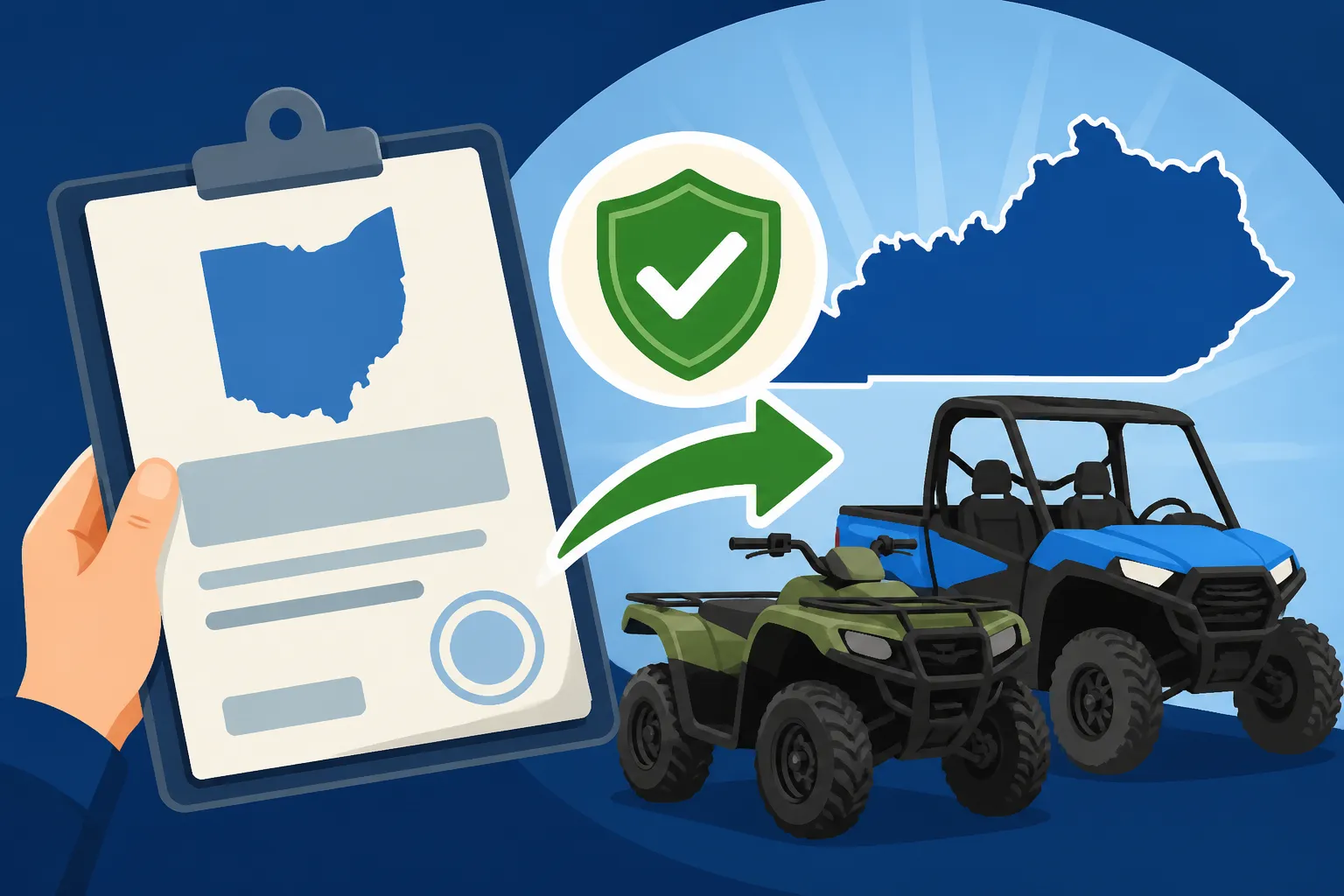
So, you're in a situation where the selling state doesn't issue titles, and all you have is a bill of sale and maybe a previous registration card. Don't despair! While an out-of-state registration isn't a title itself, it can be a crucial piece of the puzzle, especially when combined with other documentation, to help you prove ownership to the Kentucky County Clerk.
What an Out-of-State Registration Proves
Think of an out-of-state registration as a strong secondary indicator of ownership. While it doesn't declare absolute legal title in the same way a Kentucky vehicle title does, it often signifies that the person listed was the legal operator and, importantly, responsible for that machine in their home state. It typically means they paid whatever taxes or fees were required to legally operate it there. This documentation, even if it's just a small card, establishes a connection between the machine and the seller, demonstrating that the seller previously had a recognized legal relationship with the ATV or UTV.
For example, imagine you bought a pristine side-by-side from a private seller in a neighboring state that only registers, not titles, ATVs. The seller presents you with a bill of sale and their current registration card for the machine. This registration card, even though it's not a title, shows their name and address, the machine's VIN, and often details like make, model, and year. To the Kentucky County Clerk, this card, in conjunction with your bill of sale, strongly corroborates that the person who sold you the machine was indeed its recognized owner and operator in their previous state. It helps build a narrative of legitimate ownership, filling the gap left by the absence of a formal title.
Combining Registration with a Bill of Sale
This is where the magic truly happens: leveraging the out-of-state registration alongside a comprehensive bill of sale. A bill of sale is your primary document of transfer, formally stating that ownership has moved from the seller to you. However, if the seller didn't have a title, the bill of sale needs an extra layer of support. That's where the registration comes in.
The bill of sale should be as detailed as possible, including:
- The full names and addresses of both buyer and seller.
- The date of the sale.
- The exact purchase price.
- A clear and complete description of the ATV or UTV, including make, model, year, and especially the full 17-character Vehicle Identification Number (VIN).
- Signatures of both parties.
When you present this detailed bill of sale along with the seller's out-of-state registration, you are providing a powerful combination of evidence. The registration card verifies that the person who signed the bill of sale as the seller was, in fact, the recognized individual associated with that specific machine in their home state. This helps the Kentucky County Clerk verify the legitimacy of the transaction. You might find templates for a robust bill of sale from resources like LawDepot, which can help ensure you capture all the necessary information. Using a professionally drafted bill of sale, perhaps one you adapted from a LawDepot template, provides an added layer of credibility and makes the clerk's job of verifying your ownership much easier. For more details on what's needed, refer to [Kentucky ATV Bill of Sale Requirements].
Here's a quick comparison of ownership proofs:
| Document Type | What It Is | How Kentucky Views It (Without a Title) | Best Use |
|---|---|---|---|
| Out-of-State Title | Primary proof of ownership from another state. | Direct proof, usually accepted for transfer. | Ideal for machines from titling states. |
| Out-of-State Registration | Proof of legal operation/responsibility in another state. | Secondary proof, used to corroborate a bill of sale. | Essential when buying from a non-titling state, combined with BoS. |
| Bill of Sale | Record of transaction between buyer and seller. | Primary evidence of transfer, needs corroboration. | Always necessary, especially if no title is provided. |
| Affidavit of Ownership | Sworn statement of ownership. | Used in specific cases (e.g., lost records, inherited). | For complex situations where other proofs are insufficient. |
This table illustrates how an out-of-state registration fits into the broader picture of proving ownership in Kentucky when a traditional title isn't available from the seller's state.
Preparing Your Documents for the Kentucky County Clerk
When you're dealing with an out-of-state purchase that lacks a traditional title, preparing your documents meticulously is key. The goal is to present a clear, undeniable case for your ownership, leaving no room for doubt or delay at the clerk's counter. This takes a bit more effort than simply handing over a signed title, but it's entirely manageable if you know what the clerk needs to see.
Essential Information the Clerk Needs
The Kentucky County Clerk's office is primarily looking for verifiable facts that confirm the machine's identity and its transfer of ownership to you. The most crucial piece of information, aside from your own identification, is the Vehicle Identification Number (VIN). Kentucky is very strict about the [Kentucky's Seventeen-Character VIN Rule]. Your out-of-state registration and your bill of sale must show the exact same, complete 17-character VIN. Any discrepancy, or a VIN shorter than 17 characters (common on older machines or those from different markets), can halt the process immediately.
Beyond the VIN, the clerk will need:
- Your full legal name and current Kentucky address. This is where your new title will be mailed.
- The seller's full legal name and address. This verifies the previous owner.
- The date of the sale. This is important for calculating any applicable sales tax and for the [Kentucky's Fifteen-Day Titling Deadline] if the purchase occurred recently.
- The purchase price. Again, for sales tax calculations.
- A detailed description of the ATV/UTV. Make, model, year, and color.
The out-of-state registration serves to reinforce these details. If the registration lists the seller's name and the exact VIN of the machine, it strongly corroborates the information on your bill of sale. It acts as an independent verification that the person who sold you the machine was indeed the recognized party associated with it in their home state. This level of consistency across your documents is what builds confidence with the clerk.
The Importance of Accuracy and Completeness
Imagine walking into the clerk's office, excited to finally get your title, only to be turned away because a crucial piece of information is missing or inaccurate. It's a common scenario and one that causes immense frustration. For instance, if the VIN on your bill of sale is off by even one digit, or if the seller's address is incomplete, you'll likely be sent home to gather more information. This isn't the clerk being difficult; it's about adhering to the strict legal requirements for establishing ownership.
Before you even leave your driveway, go over every document with a fine-tooth comb. Check names, addresses, VINs, dates, and prices. Do they all match perfectly across the out-of-state registration and the bill of sale? Are all required signatures present? A small detail, like an omitted middle initial or an unclear date, can lead to significant delays. Using a structured form for your bill of sale, perhaps one you downloaded from a reputable source like LawDepot, can greatly reduce the chances of accidental omissions. These templates often guide you through all the necessary fields, helping you ensure completeness and accuracy. This attention to detail will make your visit to [Titling at a Kentucky County Clerk] much smoother.
What if the Registration is Not in the Seller's Name?
This is a trickier situation, and unfortunately, it does happen. You might buy an ATV from someone who just bought it themselves a week ago and never got around to putting the out-of-state registration in their name. Or perhaps they inherited it, and the registration is still in a deceased relative's name. When the name on the out-of-state registration doesn't match the name of the person who sold you the machine, the clerk will rightfully question the chain of ownership.
In such cases, you need to establish an "unbroken chain" from the person listed on the registration to your seller, and then from your seller to you. This usually means you'll need additional documentation.
- Previous Bill of Sale: If your seller bought it from the person on the registration, they would need to provide their bill of sale showing that transfer.
- Affidavit of Ownership/Inheritance: If the machine was inherited, you might need a copy of a death certificate and an affidavit or probate documents proving the seller's right to inherit and sell the machine.
This can be a challenging and time-consuming process, as it often involves tracking down previous owners or legal documents. It underscores the importance of thoroughly vetting the seller and their documentation before you complete the purchase. Always ask for clear proof that the person selling you the machine has the legal right to do so. This is a critical step in [Proving Kentucky ATV Ownership].
Visiting the Kentucky County Clerk's Office
Once you have all your meticulously prepared documents in hand, the next step is to visit your local Kentucky County Clerk's office. This is where all your hard work comes to fruition, but it's also where you need to be prepared for the final checks and potential questions.
What to Expect at the Counter
When you walk into the County Clerk's office, you'll typically take a number or get in line, just like you would for vehicle registration. When your turn comes, you'll present all your documents to the clerk. This will include:
- Your Kentucky photo ID (which is always required, as detailed in [A Kentucky Photo ID at the Clerk's Counter]).
- The original out-of-state registration from the previous owner.
- Your original, fully completed bill of sale.
- Any supporting documents, like previous bills of sale or affidavits if the chain of ownership was complex.
- A completed [Kentucky Form TC 96-182 Explained], which is the application for a Kentucky certificate of title.
The clerk will carefully review everything, cross-referencing VINs, names, and dates. They'll input the information into their system and calculate any applicable sales tax, which is typically due at the time of titling. Be prepared to answer questions about the purchase, especially regarding the absence of a title from the selling state. A polite and clear explanation, backed by your solid paperwork, will go a long way. This is also when you'll pay the [What a Kentucky ATV Title Costs] and any other associated fees.
Potential Roadblocks and How to Navigate Them
Even with all your preparation, sometimes unexpected issues can arise. Common roadblocks include:
- Minor discrepancies: A tiny typo on the bill of sale that the clerk catches, or a VIN digit that looks smudged.
- Unclear chain of ownership: If the clerk still has doubts about whether the seller truly had the right to sell the machine. This is where your supporting documents (previous bills of sale, affidavits) become critical.
- Out-of-state registration validity: Questions about whether the out-of-state registration is current or truly applies to an ATV/UTV.
If you encounter a roadblock, the best approach is to remain calm and polite. Ask the clerk exactly what information is missing or what needs clarification. They are there to help you, and often, a little clarification or an additional piece of information you might have overlooked can resolve the issue. If you’ve used a comprehensive LawDepot bill of sale template, you're already ahead of the game because it’s likely to be complete and legally sound, which can alleviate many of these concerns. Sometimes, they might ask you to step aside, make a quick phone call to the seller (if possible), or even consult with a supervisor. Patience is your greatest asset here.
The Goal: Receiving Your Kentucky Title
Once the clerk has reviewed and approved your documents, you'll pay all the necessary fees and taxes. They will then process your application. You won't walk out with a physical title in your hand that day; Kentucky titles are typically mailed to you. The clerk will provide you with a temporary receipt that serves as proof of your application. This receipt is important because it shows you've initiated the titling process within the statutory timeframe, which is especially critical if you plan on riding the machine soon. The actual title will arrive in the mail, usually within a few weeks. You can refer to [Kentucky ATV Title Processing Time] for more specific expectations on when your title should arrive. Finally, with that piece of paper, your out-of-state ATV or UTV will be legally recognized and ready for adventures across Kentucky!
Disclaimer
This article is for general informational purposes only and does not constitute professional advice. Laws, prices and regulations vary by location and change over time. Consult a qualified professional for guidance on your specific situation.