Can an Old Three-Wheeler Be Titled in Kentucky?
Many folks across Kentucky have a soft spot for those classic three-wheelers, whether it's an old reliable farmhand or a nostalgic weekend warrior. But when you try to figure out how to make that vintage machine legally yours through a title, you can run into a wall of confusion and frustration. This guide is here to untangle the complexities of titling an old three-wheeler in Kentucky, explaining why some machines can be titled and, more often, why many simply can't.
Kentucky's ATV Definition and the Three-Wheeler Dilemma
Before we can even talk about getting a title for an old three-wheeler in Kentucky, we have to understand what Kentucky law actually considers an ATV. This is where most three-wheelers hit their first, and often insurmountable, hurdle. The legal definitions set the stage for everything that follows, and unfortunately, many beloved three-wheelers simply don't fit the mold that allows for titling.
What Kentucky Defines as an All-Terrain Vehicle
Kentucky Revised Statutes are pretty specific when it comes to defining an all-terrain vehicle for titling purposes. While it might seem like a three-wheeler should naturally fall under the umbrella of "ATV," the precise wording of the law often excludes them. According to Kentucky, an ATV is generally described as a motor vehicle that meets several criteria. Crucially, it must have "four low-pressure tires." It also needs a "straddle seat" for the operator, handlebars for steering, and must be designed for off-road use.
Now, think about your classic three-wheeler. It has a straddle seat, handlebars, and is definitely designed for off-road adventure. But how many tires does it have? Three. This seemingly small detail is the biggest obstacle. The explicit mention of "four low-pressure tires" in the statute for what Kentucky considers an ATV is a direct disqualifier for any three-wheeled machine right out of the gate. This isn't just a minor technicality; it's a fundamental difference in how the machine is classified under the law, impacting everything from titling to registration and even where you can legally ride. You can dive deeper into this specific point by checking out [Four Low-Pressure Tires and a Straddle Seat].
The Impact of Kentucky's Narrow ATV Definition on Three-Wheelers
Because Kentucky's definition of an ATV is quite narrow, it means that even if your three-wheeler is a perfectly functional, off-road capable machine, it doesn't meet the primary requirement for titling in the same way a four-wheeled ATV would. This is the core reason why many older three-wheelers are untitleable in Kentucky. It's not about the age of the machine, or whether it's in good working order, or even how much you paid for it. It's purely about the number of wheels it has.
This distinction can be incredibly frustrating for owners. You might have bought a three-wheeler thinking it was just like any other off-road vehicle, only to find out the state doesn't categorize it that way for titling. It feels like a bureaucratic technicality, but it has real-world consequences for proving ownership and potentially selling the machine down the line. It's a prime example of how specific legal definitions can impact what seems like common sense. For a broader understanding of what the state defines, see [Kentucky's Narrow ATV Definition].
The Hard Truth: Why Most Older Three-Wheelers Can't Be Titled
It's tough to hear, but for the vast majority of older three-wheelers in Kentucky, obtaining a title just isn't possible. This isn't due to neglect or a lack of trying on your part, but rather a combination of specific legal requirements that most three-wheelers simply cannot meet. Understanding these rules is crucial to setting realistic expectations for your vintage machine.
The "Four Low-Pressure Tires" Requirement as a Major Blocker
As we touched upon earlier, the single biggest reason why most three-wheelers cannot be titled in Kentucky stems directly from the legal definition of an ATV itself. The statute requires an ATV to have "four low-pressure tires." If your machine has three, it does not fit this definition. Period.
This isn't a rule that a county clerk can bend or interpret differently. It's black and white in the law. So, if you walk into your local county clerk's office with a classic Honda ATC 200ES and a bill of sale, the first thing they'll notice is the number of wheels. That alone is usually enough for them to politely inform you that the machine doesn't qualify for a Kentucky ATV title, regardless of its age or condition. This can be a huge letdown for folks who have spent time and money restoring one of these iconic machines, only to find out they can't get official documentation for it.
Machines Manufactured Before July 2010 (Unless a Security Interest Forced a Title)
Even if, hypothetically, your three-wheeler somehow defied the laws of physics and had four tires (it doesn't, but bear with me), there's another hurdle for older machines: the July 2010 cutoff. Kentucky law generally requires a title for ATVs that were manufactured after July 15, 2010. This means that if your three-wheeler rolled off the assembly line before that date, it would typically not be eligible for a title unless a specific exception applies.
Most older three-wheelers, like those from the 70s, 80s, and early 90s, fall well before this July 2010 date. So, even if the "four tires" rule didn't exist, the age of the machine would still be a significant barrier to titling. This rule was put in place to standardize ownership documentation for newer machines, but it effectively leaves older ones in a gray area unless they meet the very narrow "security interest" exception we'll discuss shortly. This combination of the "four tire" rule and the "July 2010" cutoff means that nearly every three-wheeler you encounter in Kentucky will be untitleable through the standard process. For more context on this date, see [Why Kentucky Titles Machines Bought After July 2010] and [Machines Bought Before July 2010 in Kentucky].
Let's look at how these rules stack up:
| Feature/Criteria | Modern Four-Wheeled ATV | Old Three-Wheeler | Kentucky Titling Eligibility |
|---|---|---|---|
| Number of Tires | Four | Three | Fails "Four Low-Pressure Tires" rule |
| Straddle Seat | Yes | Yes | Meets criterion |
| Handlebars | Yes | Yes | Meets criterion |
| Designed for Off-Road Use | Yes | Yes | Meets criterion |
| Manufactured After July 2010 | Potentially | Rarely | Fails for most older models |
| Security Interest Ever Attached | Possible | Possible | Only path for older machines |
As you can see, the "Number of Tires" is the immediate deal-breaker for three-wheelers, regardless of age.
Rare Exceptions: When an Old Three-Wheeler Might Have a Title
While the odds are stacked against titling an old three-wheeler in Kentucky, there's one specific scenario where you might find an existing title for one of these machines. This exception doesn't make a previously untitleable machine titleable today, but it acknowledges that some documentation may have been created in the past under different circumstances. It's a long shot, but worth checking if you're trying to prove ownership.
The "Security Interest" Loophole
Before Kentucky implemented its widespread ATV titling laws in July 2010, the primary reason an ATV—or any vehicle, for that matter—would receive a title was if there was a "security interest" attached to it. What does that mean? Basically, if someone bought a three-wheeler with a loan from a bank or other financial institution, that lender would typically require a title to be issued so they could record their lien against the machine. This protected their interest in case the borrower defaulted on the loan.
So, even if your three-wheeler was manufactured in 1988, if it was purchased new (or even used) with financing at some point, a title might have been issued. This title would have been created specifically to allow the lien to be recorded. Once the loan was paid off, the lien would be released, but the title itself would remain. This is the one and only way an older, pre-July 2010 machine (including a three-wheeler, if it somehow was titled despite the wheel count or before the wheel count became a hard rule) could possess an official Kentucky title. It’s a very specific circumstance, and it means that the title wasn’t issued because the state wanted to title all ATVs, but rather because a financial transaction necessitated it. You can learn more about this by reading [When a Security Interest Forced an Older Kentucky Title].
How to Check for an Existing Title
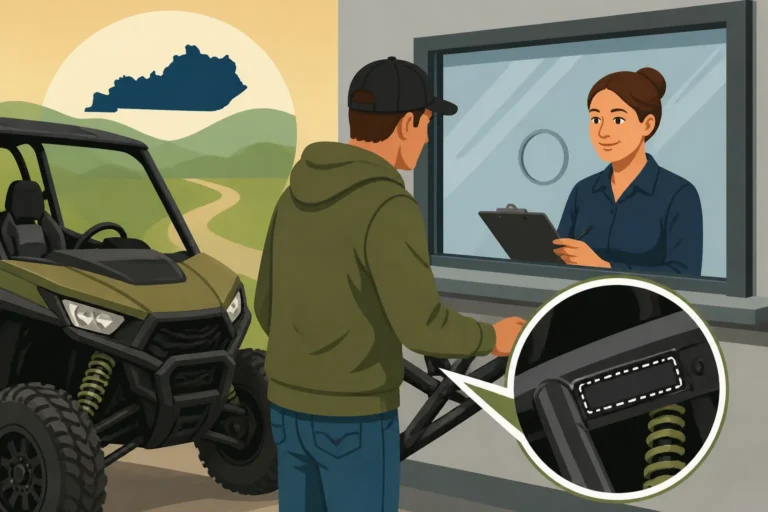
If you've got an old three-wheeler and you're hoping it might fall under this security interest exception, your best bet is to check for an existing title. This process involves the machine's Vehicle Identification Number, or VIN. Every motorized vehicle, including ATVs and three-wheelers, has a unique VIN stamped on its frame. This number is your key to unlocking any titling history.
You would typically take this VIN to your local Kentucky County Clerk's office. They have access to the state's vehicle records and can perform a search based on that VIN. They can tell you if a title was ever issued for that specific machine, and if so, who the last titled owner was and if there are any active liens. If a title was issued because of a security interest, this is where you'd find that information. Be sure to have a clear photo or transcription of the VIN, as county clerks are very particular about accurate numbers. This step is crucial before you get too far into trying to prove ownership through other means. It's also a good idea to check the VIN even if you don't think it has a title, just to ensure the machine isn't reported stolen. This is covered in [Checking a VIN Before a Kentucky Purchase]. Remember, this search won't create a new title for a three-wheeler that doesn't meet current definitions; it only confirms if one exists from previous circumstances.
What to Do When Your Three-Wheeler Can't Be Titled
Finding out your beloved old three-wheeler can't be titled in Kentucky can be a real punch to the gut. It might feel like you don't truly own it, or that you're stuck with a machine that has limited uses. However, not having a title doesn't mean your machine is worthless or useless. It simply means you need to manage your expectations and understand the limitations, particularly regarding proving ownership and where you can legally ride.
Proving Ownership Without a Title
Since a title isn't an option for most three-wheelers, you'll need other forms of documentation to prove that the machine is legitimately yours. This is incredibly important, especially if you ever plan to sell it or if there's ever a question of ownership. The primary document for this is a detailed bill of sale. A strong bill of sale acts as your proof that you legally acquired the machine from a previous owner.
A good bill of sale should include:
- Full names and addresses of both the buyer and the seller.
- Date of sale.
- Detailed description of the three-wheeler: Make, model, year, and most importantly, the full Vehicle Identification Number (VIN).
- Purchase price.
- Signatures of both buyer and seller. While Kentucky doesn't always require a bill of sale to be notarized for ATV transfers, having it notarized adds an extra layer of legal weight and can prevent disputes down the road.
If you don't have a formal bill of sale, or if you're concerned about creating one that holds up, consider using a reputable template service. LawDepot, for example, offers various legal document templates, including bills of sale, that you can customize to fit your specific needs for an ATV or a three-wheeler. Using a structured template can ensure you don't miss any critical details. Always keep your bill of sale in a safe place, as it's your primary proof of ownership. For more detailed information, check out [A Kentucky Bill of Sale for an ATV]. If you bought your machine from a state that doesn't title ATVs, their bill of sale might also be your best bet, as discussed in [Using a Bill of Sale From a Non-Titling State].
Limitations for Riding and Selling Untitled Three-Wheelers
An untitled three-wheeler comes with significant limitations, particularly concerning where you can legally operate it.
- Riding: Without a title, your three-wheeler is essentially confined to private property. You cannot legally ride it on public roads, highways, or most public trail systems in Kentucky. Kentucky law is very clear that ATVs (and by extension, any off-road machine that could be titled but isn't) are generally prohibited from public roads. Since your three-wheeler doesn't even qualify for a title, it definitely doesn't qualify for any special road-use exceptions that might exist for street-legal UTVs or other specialized vehicles. Using it on public land or roads risks fines, impoundment, and legal trouble. Always ensure you have explicit permission if riding on someone else's private land.
- Selling: Selling an untitled three-wheeler can be more challenging. Potential buyers might be hesitant without an official state document proving ownership. You'll likely need to provide your comprehensive bill of sale, and the buyer will also need to understand that they, too, will be unable to title the machine. This can reduce the machine's market value and limit your pool of potential buyers to those who plan to use it strictly on private land. Be transparent with any buyer about the machine's untitleable status to avoid future disputes.
- Insurance: While not legally required for off-road use, getting insurance for an untitled three-wheeler might be difficult or more expensive than for a titled ATV. Some insurance companies may offer coverage, but you'll likely need to verify ownership through your bill of sale and understand the policy's limitations regarding public use.
In essence, while an untitled three-wheeler can still be a fantastic machine for work on your farm or recreational riding on your own property, its legal scope of use and ease of transfer are severely restricted. Understanding these limitations upfront will save you headaches and potential legal issues down the road.
Disclaimer
This article is for general informational purposes only and does not constitute professional advice. Laws, prices and regulations vary by location and change over time. Consult a qualified professional for guidance on your specific situation.