Kentucky ATV Title Transfer
Transferring an ATV title in Kentucky can feel like navigating a maze, especially if you're not familiar with the state's specific rules. Many folks get tripped up by the deadlines, the paperwork, or simply knowing where to go. This comprehensive guide will walk you through every step of a Kentucky ATV title transfer, ensuring you avoid common pitfalls and get your machine legally registered without a hitch.
Understanding Kentucky's Titling Basics for ATVs
Before you dive into the specifics of a title transfer, it's really helpful to understand Kentucky's overall philosophy when it comes to titling ATVs. It's not always straightforward, and knowing the "why" can make the "how" a lot clearer.
Why Kentucky Titles ATVs and When They Don't
Kentucky has a very specific line drawn in the sand when it comes to ATV titles: July 15, 2010. If your ATV was bought new after this date, it absolutely needs a title. This is a critical piece of information because it directly impacts whether the machine you're buying even has a title to transfer in the first place. You can find more detail on this specific cutoff in [Why Kentucky Titles Machines Bought After July 2010]. Imagine buying a quad, excited to hit the trails, only to find out it was never titled because it pre-dates this rule, and now you're wondering how to prove ownership. It’s a common headache.
For machines purchased new before July 15, 2010, the situation is different. Generally, these older ATVs were not issued titles unless there was a specific reason, like a lienholder requiring one. This means if you're looking at an older machine, say a well-loved Honda Foreman from 2008, it might genuinely not have a title. Don't immediately assume the seller is trying to pull a fast one. Understanding this historical context is crucial when you're looking at a used ATV. We've got a whole article dedicated to [Machines Bought Before July 2010 in Kentucky] that can clear up any lingering questions about these older machines.
The Importance of a Clean Title Transfer
A clean title transfer isn't just about following the law; it's about protecting yourself as a buyer and ensuring you truly own your machine free and clear. Without a proper transfer, you could run into all sorts of trouble down the line. What if the previous owner still has a lien against it? What if the machine was reported stolen? A properly transferred title is your legal proof of ownership. It means no nasty surprises when you go to sell it yourself, or God forbid, if it's involved in an accident.
When you purchase an ATV, that signed-over title is what seals the deal. It transitions legal ownership from the seller to you. Without it, you might be driving around a machine you technically don't own, and that can lead to significant legal complications if you're ever stopped or questioned. It's worth taking the time to do it right. Many people ask, [Do You Need a Title for an ATV in Kentucky?], and the answer is usually a resounding "yes" for newer machines.
The Step-by-Step Process for Transferring a Kentucky ATV Title
Alright, let's get down to brass tacks. You've found your dream machine, the price is right, and you're ready to make it yours. Here's exactly what you need to do to get that title transferred into your name in Kentucky.
Gathering Your Essential Documents
Before you even think about heading to the County Clerk's office, you need to make sure you have all your ducks in a row. Missing even one piece of paper can send you right back home, wasting precious time.
First and foremost, you need the original, signed-over title from the seller. This isn't just any piece of paper; it's the official document from the Kentucky Transportation Cabinet that designates ownership. The seller must sign it over to you in the designated spots. Make sure their signature matches the name on the title, and check for any alterations or white-out, which could raise red flags. A guide on [A Signed-Over Title for a Kentucky Purchase] elaborates on what to look for.
Next up is Form TC 96-182, the Application for Kentucky Certificate of Title/Registration. This is a critical form, and you'll fill out your portion as the new owner. It's where you provide your information, the machine's details, and confirm the sale. You can usually download this from the Kentucky Transportation Cabinet website or pick one up at your local County Clerk's office. Don't worry, we've broken down [Kentucky Form TC 96-182 Explained] in detail to help you navigate it.
You'll also need a bill of sale. While the signed-over title is primary, a bill of sale clearly documents the transaction, including the purchase price, date, and signatures of both buyer and seller. This is especially useful for tax purposes and as an extra layer of proof. You can find excellent, legally sound bill of sale templates from reputable sources like LawDepot, which can help you create a customized document that covers all the necessary bases for your specific transaction. Having a good bill of sale, like one you'd create through LawDepot, can prevent arguments later. Check out [A Kentucky Bill of Sale for an ATV] for more information.
Finally, bring your valid photo ID. This is non-negotiable, as the County Clerk will need to verify your identity. A Kentucky driver's license or state-issued ID is perfect. They want to make sure the person claiming ownership is actually you. [A Kentucky Photo ID at the Clerk's Counter] covers what to bring.
Completing the Paperwork Accurately
Accuracy is key when it comes to government paperwork. A tiny mistake can mean rejection and a delay in getting your title.
When filling out Form TC 96-182, be meticulous. Make sure all fields are completed, especially the VIN, purchase price, and your personal information. If you're buying the ATV with another person, both names need to be listed correctly, and both of you might need to be present at the Clerk's office. It's easy to overlook a box or misspell a name under pressure, but those small errors can be a big problem. Our article on [Filling Out TC 96-182 in Kentucky] provides a step-by-step walkthrough to ensure you get it right the first time.
The seller's signature on the title is arguably the most important part of the entire transfer. Ensure they sign in the correct spot, usually indicating they are transferring ownership. If there are multiple owners listed on the title, all owners must sign it over. Don't accept a title that looks incomplete or has corrections that haven't been properly initialed. It's better to address these issues with the seller before you leave their presence.
Double-check the Vehicle Identification Number (VIN) on the title against the actual VIN on the ATV's frame. These numbers absolutely must match. Kentucky is very strict about VINs, requiring a seventeen-character VIN for titling most machines. If there's a discrepancy, or if the VIN is shorter than expected (which can happen with older or imported machines), you might face difficulties. For comprehensive information, see [Kentucky's Seventeen-Character VIN Rule].
Visiting Your County Clerk's Office
With all your documents in hand and paperwork meticulously filled out, it's time for the final step: a visit to your local Kentucky County Clerk's office. This is where the magic happens and your ATV officially becomes yours.
It's important to note that ATV titling in Kentucky is handled at the county level, not by a state central office. Each of Kentucky's 120 county clerks processes these transactions. So, you'll visit the clerk in the county where you reside. The article [Why a County Clerk and Not a State Office] sheds more light on this local approach. This means if you live in Harlan County, you go to the Harlan County Clerk, not Frankfort.
There's a crucial deadline to keep in mind: you generally have fifteen days from the date of purchase to transfer the title. Missing this deadline can result in penalties, so don't procrastinate! Many new owners get excited about riding and forget this important administrative step, only to face fines later. Get it done quickly. You can learn more about this strict timeframe in [Kentucky's Fifteen-Day Titling Deadline].
When you arrive at the Clerk's office, you'll present your completed Form TC 96-182, the signed-over original title, your bill of sale, and your photo ID. You'll also pay the necessary fees and any applicable sales tax. The fees typically include a titling fee, a transfer fee, and Kentucky's 6% sales tax on the purchase price (or the ATV's fair market value, if different). The exact cost can vary slightly, so it's always a good idea to call ahead to your specific County Clerk's office for current figures. For an idea of typical costs, check out [Kentucky ATV Title Cost]. They'll process your application, and you'll typically receive your new title in the mail within a few weeks.
Special Considerations for ATV Title Transfers
While the standard process covers most scenarios, sometimes life throws a curveball. Here are some special situations you might encounter and how to handle them.
Handling Out-of-State Purchases
Buying an ATV from a neighboring state like Tennessee or Ohio can be a great way to find a deal, but it adds a layer of complexity to the title transfer. Each state has its own titling laws, and they don't always align with Kentucky's.
If you're buying an ATV from a state that does not issue titles for ATVs (which many states don't), you'll need a different set of documents. Typically, a notarized bill of sale and perhaps the previous owner's registration from that state will be required. This is a common situation that can cause confusion. LawDepot can be an invaluable resource here, providing customizable bill of sale templates that meet legal standards, even when dealing with varied state requirements. Our guide on [Using a Bill of Sale From a Non-Titling State] offers specific advice for this scenario.
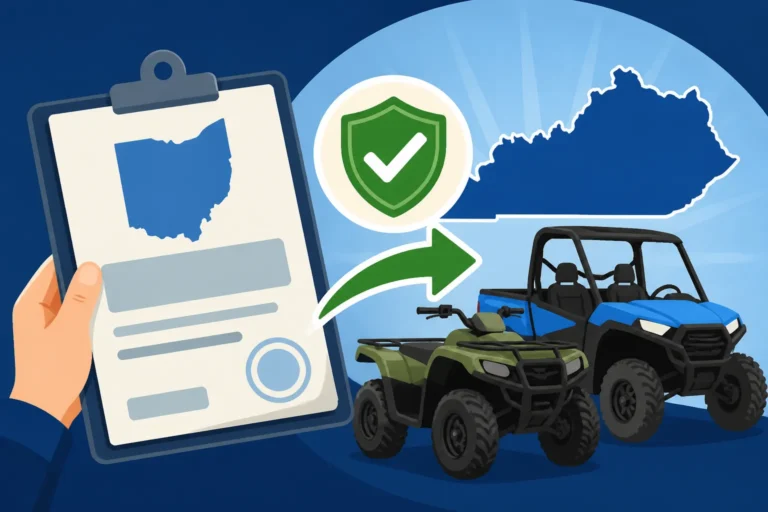
If the ATV comes from a state that does title ATVs, then you'll generally need the original, properly signed-over title from that state. Kentucky will accept this out-of-state title as proof of ownership for your transfer. However, always confirm with your County Clerk what specific documentation they require, as they might have particular forms or procedures for interstate transfers. You'll find more insights into this in [Buying an Out-of-State Machine for Kentucky].
Transferring a Title with a Lien
Discovering an ATV has a lien against it can be a real headache, but it's not always a deal-breaker. A lien means there's an outstanding debt on the machine, and until that debt is paid off, the lienholder (often a bank or finance company) technically has a claim to the ATV.
Before you can transfer the title into your name, that lien must be satisfied and released. This usually involves the seller paying off the balance of their loan. Once the loan is paid, the lienholder will issue a lien release document. This document, often an official letter or a signed-off section of the title itself, proves the debt has been cleared. Without this release, the County Clerk will not transfer the title to you. It's a critical step that often holds up transfers. For more in-depth information, refer to [Releasing a Lien on a Kentucky Title].
If you're buying a machine with an existing lien, insist that the seller handles the lien release before you finalize the purchase and certainly before you attempt to transfer the title. Never assume the seller will "take care of it later." Make it a condition of your sale. This protects your investment. You can learn more about navigating this complex situation in [Titling a Machine With a Lien in Kentucky].
Lost Titles, Inherited Machines, or Gifts
Sometimes, the original title isn't readily available for various reasons, or the transfer isn't a straightforward sale.
If the seller has lost the original title, they cannot simply write you a new one or sign a copy. They must apply for a duplicate title in their name first. Once they receive the duplicate, they can then sign it over to you. This adds an extra step and waiting period to the process, so be prepared for a delay. You can find detailed steps on [Replacing a Lost Kentucky ATV Title] if you ever find yourself in this situation.
For inherited machines, the process involves proving your right to the ATV through legal documents like a will, letters of administration, or an affidavit of descent, depending on the circumstances of the estate. You'll typically need to present these documents to the County Clerk along with Form TC 96-182 to get the title transferred into your name. It's not a simple transfer and requires documentation of the inheritance. Our guide [Titling an Inherited Machine in Kentucky] provides a fuller explanation.
If an ATV is being gifted to you, you still need to go through the title transfer process. While you won't pay sales tax (as there's no purchase price), you'll still need the original signed-over title, Form TC 96-182, and a gift affidavit or a bill of sale stating it's a gift. Again, using a platform like LawDepot to create a formal gift agreement can streamline this, making it clear to the Clerk that no money changed hands. This helps avoid questions about sales tax. The process is similar to a regular sale, just without the monetary transaction. For details on the necessary paperwork for a gifted quad, see [Paperwork for a Gifted Quad].
Common Pitfalls and How to Avoid Them
Even with the best intentions, things can go wrong during a title transfer. Knowing the most common issues can help you steer clear of them.
The Perils of an Unsigned or Incomplete Title
This is perhaps the biggest and most frequent pitfall. An unsigned title, a title with an incorrect name, or one that has been altered (like white-out over a previous buyer's name) will be rejected by the County Clerk. They are very particular about the integrity of official documents. Think of it like this: if the document isn't perfectly clear and unblemished, it raises questions about chain of ownership.
If you encounter this, your only recourse is to go back to the seller and have them correct the issue. If the seller is no longer available or unwilling to cooperate, you could be stuck with an ATV you can't legally title. This is why inspecting the title thoroughly at the time of purchase is absolutely paramount. Don't leave the seller's presence until you are 100% sure the title is correctly signed over and free of errors. It's a pain to chase someone down weeks later.
Missing the Fifteen-Day Deadline
We've mentioned it before, but it bears repeating: the fifteen-day deadline for transferring a title in Kentucky is a serious one. Many people underestimate how quickly those two weeks fly by, especially if they're busy or encounter unexpected delays.
If you miss the deadline, you will likely face a penalty. This typically comes in the form of a late fee added to your titling costs. While not usually exorbitant, it's an unnecessary expense that's easily avoided with a bit of planning. The state puts this deadline in place to ensure timely recording of ownership and collection of sales tax. Don't give them a reason to add extra charges to your bill. For a deeper dive into the implications, look up [Kentucky ATV Title Deadline].
Plan to visit the County Clerk's office as soon as possible after purchasing your ATV, ideally within the first few days. Don't wait until day 14! This gives you a buffer in case you realize you're missing a document or encounter an unforeseen closure at the Clerk's office.
Verifying Ownership and VINs Before You Buy
This step happens before any money changes hands, but it's crucial for a smooth title transfer. Always, always, always verify the seller's ownership and the ATV's VIN before you commit to a purchase.
First, check the VIN on the ATV itself against the VIN on the title. Are they an exact match? A mismatch is a huge red flag and could indicate a stolen machine or a fraudulent title. Never buy an ATV if these numbers don't align. It's a quick check that can save you a world of hurt. You can even do a VIN check through various online services (some free, some paid) to see if the ATV has been reported stolen or has any other issues. Learn more about this crucial check in [Checking a VIN Before a Kentucky Purchase].
Also, verify that the seller's name on their photo ID matches the name on the title. If they aren't the registered owner, they legally can't sell you the ATV or sign over the title. Be wary of sellers who say they're selling it "for a friend" or offer a title that isn't in their name. These situations are ripe for scams. Using a formal bill of sale, perhaps generated through a service like LawDepot, can also help establish clear terms and confirm identities, adding another layer of security to your private transaction. Take the time to do your due diligence; it's always worth it.
| Document Type | Private Sale (Kentucky Title) | Out-of-State (No Title Issued) | Inherited Machine | Gifted Machine |
|---|---|---|---|---|
| Original Signed Title | Required | Not Applicable | Not Applicable | Required |
| Form TC 96-182 | Required | Required | Required | Required |
| Bill of Sale | Recommended | Required | Not Applicable | Recommended (Gift Affidavit) |
| Photo ID | Required | Required | Required | Required |
| Lien Release | If Applicable | If Applicable | If Applicable | If Applicable |
| Proof of Inheritance | Not Applicable | Not Applicable | Required (e.g., Will) | Not Applicable |
Disclaimer
This article is for general informational purposes only and does not constitute professional advice. Laws, prices and regulations vary by location and change over time. Consult a qualified professional for guidance on your specific situation.