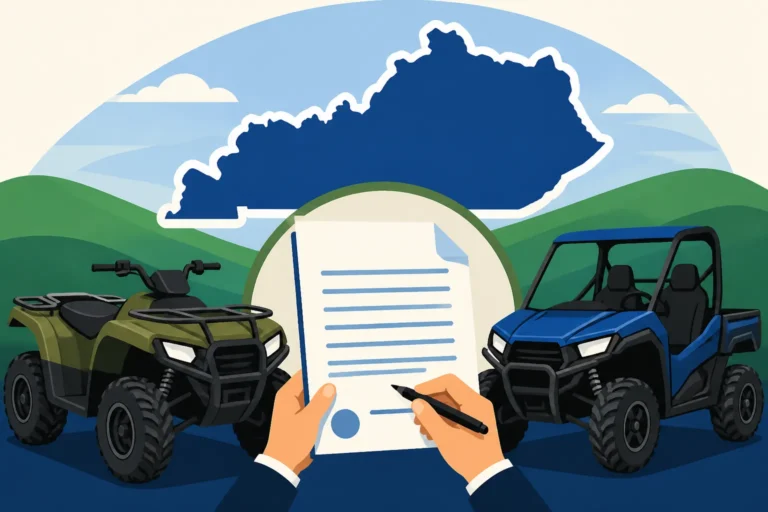
What Kentucky Counts as an ATV
Oh, the wild world of off-road vehicles in Kentucky! You’ve finally saved up, done your research, and found that perfect machine you've been dreaming of, maybe a roaring quad for the trails or a trusty side-by-side for farm work and family adventures. But then comes the moment you realize something isn't quite clear: what exactly does Kentucky consider an ATV? This isn't just a casual question; getting this wrong can lead to headaches at the county clerk’s office, issues with road use, and even unexpected fines. This comprehensive guide is here to untangle Kentucky’s specific definition of an All-Terrain Vehicle, helping you understand how your machine fits into the legal landscape and what that means for titling, riding, and everything in between.
The Core Definition: What Kentucky Law Says
When you're dealing with the legal system, precision is key. What you might casually call an "ATV" out on the trails or around the farm might not be what the Commonwealth of Kentucky defines as one. And believe me, that distinction matters immensely when you're trying to title your machine or figure out where you can legally ride it. The law isn’t always as flexible as our everyday language, and nowhere is this more apparent than with off-road vehicles.
The legal definition is the foundation upon which all other rules about ownership, titling, and use are built. Without understanding this core concept, you're essentially trying to navigate a maze blindfolded. Many folks assume that if it's got four wheels and goes off-road, it's an ATV. But as you'll soon discover, Kentucky has a very particular set of criteria that must be met, and those criteria often leave out a lot of popular machines you'd commonly associate with off-road recreation. It's not about what feels like an ATV; it's about what the statute explicitly states.
Four Low-Pressure Tires and a Straddle Seat
Kentucky Revised Statute (KRS) 189.010(1) lays out the official definition for an ATV, and it hinges on two very specific physical characteristics. First, an ATV must be a motor vehicle designed to travel on four low-pressure tires. This isn't just about having four tires; it's about the type of tire. Low-pressure tires are typically large, soft, and designed to spread the weight of the vehicle over a larger surface area, enhancing traction and flotation on varied terrains like mud, sand, or loose gravel. They're what give an ATV its characteristic "balloon tire" look. If your machine has six wheels, or if its tires are high-pressure like those on a car or truck, it immediately falls outside this part of the definition. This is a common point of confusion for many riders, especially with the proliferation of different types of off-road vehicles on the market today.
Secondly, and this is where many popular machines are excluded, the statute specifies that an ATV must be designed for an operator to ride straddle-type. Think of how you ride a motorcycle or a horse – you sit with one leg on either side, straddling the machine. This seating position is fundamental to the traditional ATV design, where the rider shifts their weight to steer and control the vehicle. If your machine has bucket seats, bench seating, or requires you to sit in it rather than on it, then it does not meet this critical component of Kentucky's ATV definition. This single detail is often the biggest hurdle for owners of side-by-sides, which we’ll delve into more deeply shortly. It's frustrating because, to the average person, a side-by-side feels like a bigger, safer ATV, but legally, it's a completely different animal.
Engine Size and Weight: Beyond the Basics
Interestingly, Kentucky's statutory definition of an ATV does not include any specific limits or requirements regarding engine size, horsepower, or the overall weight of the machine. You won't find language in KRS 189.010(1) that says an ATV must be under a certain CC, or weigh less than a certain amount. This can be a bit counter-intuitive because many people, especially those familiar with off-road regulations in other states or even manufacturer classifications, often associate engine size with vehicle type. For example, some states might classify smaller youth models differently, or impose restrictions based on cubic centimeters.
However, in Kentucky, as long as a machine meets the "four low-pressure tires" and "straddle seat" criteria, its engine size (whether it’s a 90cc youth model or a powerful 1000cc sport quad) doesn't change its classification as an ATV for titling purposes. The same goes for weight; a heavier utility quad is still an ATV if it meets the core definition. This simplicity can be a double-edged sword: it means less confusion about power outputs, but it also means that powerful, heavy machines are still lumped into the same category as lighter, less powerful ones, which can feel odd when considering safety or performance on trails. The focus remains squarely on those two key physical characteristics, not the mechanics under the hood.
Why This Definition Matters for Titling
Understanding this precise definition isn't just academic; it has very real, practical implications, especially when it comes to getting your machine titled. In Kentucky, most ATVs bought after July 15, 2010, are required to be titled, and this process happens at your local county clerk's office. If your machine doesn't fit the state's official definition of an ATV, you're going to hit a roadblock when you try to submit your paperwork. The clerk isn't going to care what you call it; they're going to compare your machine against the legal criteria. For example, if you bring in documentation for a side-by-side, which has bucket seats, they simply cannot process it as an ATV title. You might be interested in reading [Titling an ATV in Kentucky] for more details on the process.
This discrepancy often leaves owners of non-ATV off-road vehicles in a peculiar legal limbo regarding ownership proof. They might have a bill of sale, but without a title, it can be harder to prove ownership for insurance, resale, or even recovery if stolen. The system is designed to title ATVs as defined, not every type of off-road vehicle. This is why it’s so critical to know if your machine truly is an "ATV" in the eyes of Kentucky law before you even head to the clerk’s office or, ideally, before you even buy the machine. It saves you immense frustration and potential heartache down the line.
Side-by-Sides: The Kentucky Conundrum
Ah, the side-by-side. These machines have exploded in popularity, offering more seating, storage, and often a greater sense of stability than a traditional ATV. They're fantastic for everything from hauling gear on a farm to exploring vast trail systems with a passenger or two. However, their very design—what makes them so appealing—is precisely what creates a legal quandary in Kentucky. Many folks assume a side-by-side is just a bigger ATV, but legally, that's often not the case at all. This distinction isn't just a nuance; it's a fundamental difference that affects everything from how you prove ownership to where you can ride.
When you walk into a dealership or browse online classifieds, you'll see "ATV" and "UTV" (Utility Task Vehicle, often used interchangeably with side-by-side) categories, but the law operates on its own terms. The frustration for many side-by-side owners stems from the disconnect between common understanding and statutory language. You’ve invested good money in a powerful off-road machine, only to find it doesn’t quite fit neatly into the state’s pre-existing categories for motor vehicles. It feels like the law hasn't quite caught up with the evolution of off-road technology, leaving many owners feeling confused and unsupported.
Why a Side-by-Side Sits Awkwardly in Kentucky Law
The fundamental reason a side-by-side (often called a UTV or SxS) doesn't typically qualify as an ATV under Kentucky law boils down to those two critical criteria we just discussed: tire type and seating. While most side-by-sides do indeed ride on four low-pressure tires, a few might have higher-pressure tires depending on their specific design or modifications, which would immediately disqualify them. But the real sticking point for nearly all side-by-sides is the seating arrangement.
Side-by-sides are designed with bucket seats or a bench seat, allowing the operator and passengers to sit side-by-side (hence the name) within a protective roll cage, much like a small car. The operator typically controls the vehicle with a steering wheel and foot pedals, rather than handlebars. This is in direct contrast to the "straddle-type" seating required for an ATV. Because of this, even if a side-by-side looks and feels like an off-road vehicle, it simply doesn't meet the core definition for an ATV in Kentucky. This legal distinction, while perhaps seeming minor, is monumental when it comes to official documentation and classification. You might want to refer to [Why a Side-by-Side Sits Awkwardly in Kentucky Law] for more discussion on this specific issue.
Practical Implications for UTV Owners
So, if your side-by-side isn't legally an ATV, what does that mean for you as an owner in Kentucky? The biggest implication is typically related to titling and registration. Since it doesn't fit the ATV definition, it historically couldn't be titled as an ATV. This meant that many side-by-side owners only had a bill of sale to prove ownership, which, while better than nothing, isn't as robust or universally recognized as a state-issued title. Reselling a machine without a title can be more challenging, and proving ownership after theft or loss can also become a more complicated process.
Beyond ownership documentation, the classification impacts road use. Since they aren't ATVs, and they don't fit into other traditional vehicle categories like cars or trucks, side-by-sides historically had very limited legal access to public roads in Kentucky. Trail access is usually less affected as most private or park trail systems define "off-road vehicle" more broadly. However, understanding this classification is crucial for anyone planning to use their UTV for anything beyond private property or designated trail parks. This legal ambiguity has been a source of significant frustration for side-by-side owners across the Commonwealth, who often feel their useful and increasingly common vehicles are overlooked by state law.
The Rise of "Special Purpose Vehicles"
Recognizing the growing popularity of side-by-sides and similar off-road vehicles that didn't fit the traditional ATV or car definitions, Kentucky lawmakers began to address this gap. The result was the creation of a new classification: the "Special Purpose Vehicle," or SPV. This designation was Kentucky's legislative attempt to provide a legal framework for titling, registering, and in some very specific circumstances, operating vehicles like side-by-sides on public roads. It's a testament to the fact that the off-road landscape is constantly evolving, and sometimes the law has to play catch-up.
An SPV is a broader category that can include many machines that wouldn't qualify as ATVs, specifically those with non-straddle seating and steering wheels. This means that if you own a side-by-side, it's far more likely to be classified as an SPV than an ATV. This classification allows for a specific titling and registration process, distinct from ATVs, and opens up the possibility of limited road use under strict conditions. While this doesn't make a side-by-side a street-legal car, it does give owners a clearer path for official recognition of their vehicle. For more detailed information, you should look into [Kentucky's 2025 Special Purpose Vehicle Law], as these regulations have evolved to better accommodate these machines.
Machines That Don't Quite Fit the Mold
The world of off-road vehicles is incredibly diverse. Beyond the classic ATV and the increasingly popular side-by-side, there's a whole host of other machines that capture our imagination and serve various purposes. From pint-sized youth quads designed for the littlest riders to vintage three-wheelers that harken back to an earlier era, and even cutting-edge electric models, these vehicles present their own unique challenges when trying to shoehorn them into Kentucky's precise legal definitions. It's easy to assume that if it's got an engine and goes off-road, it's all the same, but the devil, as they say, is in the details, and the law cares about those details.
Understanding how these "other" machines are classified is vital. It impacts whether they need a title, where they can be ridden, and what safety regulations might apply. The blanket term "ATV" just doesn't cover everything, and misclassifying your machine can lead to administrative headaches or even legal trouble. It requires a bit of detective work to determine where your specific off-road vehicle lands in the eyes of the Commonwealth.
Youth Machines: Size and Power Considerations
Youth ATVs are specifically designed for younger riders, typically featuring smaller engines, lower top speeds, and a more compact frame. When it comes to Kentucky’s definition, a youth ATV can indeed qualify as an ATV, provided it meets the core criteria: four low-pressure tires and a straddle-type seat. The fact that it's smaller or less powerful doesn't change its fundamental classification as an ATV for titling purposes, unlike how some other states might differentiate them. So, if your child's quad has those two key elements, it's an ATV in Kentucky's eyes.
However, while it might be an ATV for titling, specific rules often apply to who can ride these machines and where. Kentucky law places emphasis on manufacturer-recommended age limits, and there are strict supervision rules for riders under 16. So, while the titling process might be straightforward if it fits the physical definition, the operational rules for youth machines add another layer of complexity that parents absolutely need to understand. If you're looking to title one of these for a younger rider, [Titling a Youth Machine in Kentucky] would be a helpful resource.
Three-Wheelers and Older Quads
Step back in time a bit, and you’ll remember the iconic three-wheelers. These machines were incredibly popular decades ago but were largely phased out due to safety concerns. In Kentucky, an older three-wheeler cannot be legally classified as an ATV because, by definition, an ATV must have four low-pressure tires. The "three-wheeler" aspect immediately disqualifies it. This means that if you're holding onto a vintage three-wheeler, or perhaps bought one at an estate sale, you won't be able to title it as an ATV in Kentucky. This is a common frustration for collectors or those who inherited older machines.
Similarly, even older four-wheeled ATVs, especially those purchased before Kentucky's titling law for ATVs took effect in July 2010, might face their own unique challenges. While they might meet the physical definition of an ATV, the historical context of their purchase can impact their titling status. Many machines bought before that date were never required to be titled, and proving ownership today can be tricky without the original paperwork. However, if an older quad does meet the physical definition, and you have sufficient proof of ownership, titling might still be possible. For those curious about the legal status of very old machines, [Can an Old Three-Wheeler Be Titled in Kentucky?] offers more insights.
Electric ATVs: A Modern Twist
As technology advances, so does the range of off-road vehicles available. Electric ATVs are becoming increasingly popular, offering quieter operation, instant torque, and zero emissions. From a legal standpoint in Kentucky, whether an electric machine qualifies as an ATV depends entirely on its physical characteristics, not its power source. If an electric vehicle is designed with four low-pressure tires and a straddle-type seat, then it falls squarely within Kentucky's definition of an ATV for titling purposes. The fact that it runs on a battery rather than gasoline is irrelevant to its classification.
This means that owners of electric ATVs should follow the same titling procedures as those with gasoline-powered models, provided their machine meets the criteria. This is good news for the environmentally conscious rider, as it ensures their modern machine isn't left in a legal gray area just because it lacks a gas tank. The primary concern remains the physical design features, not the propulsion system. It's another example of how the specific wording of the statute guides classification, rather than assumptions based on modern innovations.
Why the Definition Impacts Your Paperwork
Understanding Kentucky's precise definition of an ATV isn't just theoretical; it directly affects the practical process of getting your machine titled and ensuring you have legitimate proof of ownership. Paperwork, as tedious as it can be, is the official record of your ownership, and if that paperwork doesn't align with the state's definitions, you're going to face complications. Imagine spending your hard-earned money on a machine, only to find out you can't get the proper documentation because of a misunderstanding about its classification. It's a common and incredibly frustrating scenario that many Kentuckians encounter.
The county clerk's office, where you handle titling, operates under strict guidelines set forth by state law. They aren't there to interpret your intent or personal understanding; they're there to apply the statutes as written. This means that every piece of information on your application, and every characteristic of your machine, will be cross-referenced against those legal definitions. Getting it right from the start saves you countless hours of back-and-forth, potential rejections, and the stress of dealing with incomplete or incorrect documentation.
The Titling Dilemma: When a Machine Isn't an ATV
This is where many off-road enthusiasts run into trouble. You show up at the county clerk's office, ready to title your shiny new (or new-to-you) machine, only to be told it doesn't qualify as an ATV. Why? Because it doesn't meet the "four low-pressure tires and straddle-type seat" criteria. Perhaps it's a side-by-side with bucket seats, or maybe a unique off-road vehicle with more than four wheels. Whatever the reason, if it deviates from that precise definition, the clerk's office simply cannot issue you an ATV title. They are bound by law.
This dilemma leaves owners in a challenging position. Without an ATV title, proving formal ownership becomes harder. It can complicate insurance claims, deter potential buyers if you decide to sell, and might even be an issue if your machine is ever stolen and you need to demonstrate ownership for recovery. It's not that your machine isn't legitimate; it's that Kentucky law hasn't historically created a universal titling category for all off-road vehicles. This situation often leads to a lot of confusion and can feel like a bureaucratic dead end for those who haven't encountered it before.
Form TC 96-182: Understanding What It Asks For
When you go to title an ATV in Kentucky, you'll be dealing with Kentucky Transportation Cabinet Form TC 96-182, which is the Application for Kentucky Certificate of Title/Registration. This form is central to the titling process, and its sections are designed to capture information that directly relates to Kentucky's legal definitions. For example, it asks for the Vehicle Identification Number (VIN), information about the seller, the purchase price (for sales tax calculation), and details about the vehicle itself. The information you provide on this form must align with the vehicle's classification. You can find more specific guidance on [Kentucky Form TC 96-182 Explained].
If you're trying to title a side-by-side using this form, you'll quickly see the disconnect. The form is geared towards "vehicles" that fit within existing categories, and if your machine doesn't squarely fit the ATV definition, or isn't a "Special Purpose Vehicle" (which has its own distinct process), then the application might be rejected. This is why having accurate documentation from the moment of purchase is paramount. Knowing the legal definition helps you anticipate which forms you'll need and what information will be scrutinized by the clerk's office.
Ensuring Your Documentation Matches the Law
To avoid all the headaches mentioned above, it's crucial to ensure your ownership documentation aligns perfectly with Kentucky's ATV definition. This starts the moment you consider purchasing a machine. If you're buying a true ATV (four low-pressure tires, straddle seat), make sure your bill of sale explicitly identifies it as such and includes the VIN. For private sales, a robust bill of sale is your best friend. Services like LawDepot can provide customizable bill of sale templates that help ensure all necessary legal information is included, protecting both buyer and seller. This foundational document will be critical when you present your case at the county clerk's window.
If you're buying a side-by-side, understand that its titling path will likely be through the SPV designation, not the ATV route. So, ensure your paperwork reflects that understanding. Regardless of the machine type, always verify the VIN on the paperwork matches the VIN on the physical vehicle. Any discrepancy can cause an immediate rejection of your titling application. By doing your homework and using reliable resources for your paperwork, you significantly smooth out the process of getting your off-road vehicle legally recognized in Kentucky. For details on what should be on a bill of sale, check out [A Kentucky Bill of Sale for an ATV].
Road Use and the ATV Definition
This is perhaps one of the most contentious and misunderstood aspects of ATV ownership in Kentucky. The allure of riding your ATV from your home directly to the trail, or using it for quick errands, is strong. However, Kentucky law is very clear, and often quite restrictive, about where ATVs can and cannot be operated, especially on public roads. The definition of what constitutes an ATV plays a huge role here, because different types of off-road vehicles (like SPVs) have different, albeit still limited, rules for road access. Ignoring these rules can lead to significant fines, confiscation of your machine, or even serious accidents.
It’s easy to get frustrated when you see people in other states riding their machines on the shoulder or crossing roads freely. But Kentucky has chosen a very specific, conservative approach to this issue, primarily due to safety concerns and the inherent design limitations of ATVs for road environments. Your machine's legal classification directly dictates whether it falls under these strict road-use prohibitions or if it might qualify for one of the very narrow exceptions. Don't assume; know the law.
Why Kentucky Roads Are Closed by Default
For traditional ATVs (those meeting the four low-pressure tires and straddle seat definition), Kentucky law explicitly prohibits their operation on public roads and highways. This is the default rule, and it’s a big one. The reasoning behind this widespread prohibition is rooted in safety. ATVs are designed for off-road terrain, not paved surfaces. Their low-pressure tires provide excellent traction on dirt, mud, and rocks, but they can be unstable and offer poor handling characteristics on asphalt, especially at higher speeds or during sharp turns. The straddle seating, coupled with the high center of gravity, also makes them prone to rollovers in on-road situations.
Furthermore, ATVs generally lack safety features common to street-legal vehicles, such as turn signals, rearview mirrors, proper lighting for night operation, and robust suspension systems designed for sustained road travel. The state legislature has, for the most part, deemed the risks associated with mixing ATVs and traditional road traffic too high. This means that if you own a true ATV, you should generally plan to trailer it to designated off-road areas. To understand more about the general prohibition, see [Why Kentucky Roads Are Closed by Default].
Limited Exceptions for Farm or Emergency Work
While the default rule is a blanket prohibition, Kentucky law does provide a few, very narrow exceptions where an ATV might legally operate on a public road. These exceptions are highly specific and are tied to the purpose of the operation, rather than general recreational use. The most common exception is for farm purposes. An ATV may be operated on a public road for "agricultural purposes" if it's being used for bona fide farm work, traveling between fields, or accessing agricultural properties. This exception typically applies when the ATV is being used as a piece of farm equipment rather than a recreational vehicle. However, even with this exception, riders must typically cross the road at a 90-degree angle, take the shortest route possible, and only ride during daylight hours.
Other exceptions might include use by authorized emergency or utility personnel, or for certain road maintenance activities. These are not open invitations for casual road use. It’s crucial to understand that these exceptions are not a loophole for recreational riding; they are specific, limited allowances for essential work. Misinterpreting these exceptions can lead to severe penalties. For a deeper dive into the farm exception, [Kentucky's Farm Exception With No Mileage Cap] is a valuable read.
SPVs vs. ATVs: Different Rules for Different Roads
This is where the distinction between a traditionally defined ATV and a "Special Purpose Vehicle" (SPV) becomes critically important for road use. As mentioned, side-by-sides often fall under the SPV classification. In an effort to address the needs of UTV owners, Kentucky has developed a separate set of rules for SPVs, which can, under very specific conditions, allow for limited road access. This is a significant difference from the general prohibition on ATVs.
SPV road use is not universal across the state. It typically requires an inspection to ensure the vehicle meets specific safety equipment requirements (like turn signals, headlights, taillights, mirrors, and a speedometer), proof of insurance, and an annual registration with a special license plate. Furthermore, individual cities and counties must opt-in to allow SPVs on their roads, and even then, there are often restrictions on speed limits (e.g., roads capped at 45 mph) and which roads can be used. So, an SPV might be legal on some roads in one county but completely prohibited just across the county line. This makes it vital for SPV owners to check local ordinances carefully. An ATV, even if inspected, cannot qualify for this SPV road use. The distinct legal categories mean entirely different sets of rules apply.
The Role of Your County Clerk
When it comes to making your ATV ownership official, your local county clerk's office is your primary point of contact in Kentucky. They are the frontline administrators of the state's titling and registration laws. While this might sound straightforward, the reality can sometimes be a bit more complex, especially when dealing with definitions that might not always align with common understanding. The clerks and their deputies are there to apply the law as written, and their interpretation of "what Kentucky counts as an ATV" is the one that ultimately matters for your paperwork.
Navigating the county clerk's office can feel daunting, but understanding their role and what they're looking for can make the process much smoother. They aren't trying to make your life difficult; they're simply adhering to the statutes. Being prepared and understanding the legal definitions before you walk through their door will save you a lot of time and potential frustration.
Interpreting the Definition at the Counter
The deputies at your local county clerk's office are responsible for reviewing your application and supporting documents to ensure they meet state requirements. This includes verifying that the machine you're trying to title actually fits Kentucky's legal definition of an ATV. They look for those key physical characteristics: four low-pressure tires and a straddle-type seat. If, for instance, you present paperwork for a side-by-side that clearly has bench seating, they will not be able to process it as an ATV title. Their hands are tied by the law.
This means that individual clerks don't have the discretion to bend the rules or make exceptions based on your personal interpretation. While there might be minor variations in how different counties approach specific nuances, the core definition is applied consistently. It's not uncommon for someone to bring in a photo or even the machine itself for the clerk to visually confirm its characteristics. If there's any ambiguity, the clerk will err on the side of caution and reject the application until you can provide clear proof of its classification. This process underscores why knowing [Titling at a Kentucky County Clerk] is so important.
What to Bring When in Doubt
If you're unsure whether your machine perfectly aligns with Kentucky's ATV definition, it's always better to over-prepare when visiting the county clerk's office. Beyond the standard required documents like a properly signed-over title (if applicable), a bill of sale, and proof of identification, consider bringing additional supporting evidence. This might include:
- Manufacturer's Specifications: If you have the owner's manual or a spec sheet from the manufacturer that clearly states the vehicle type (e.g., "ATV") and lists features like tire type and seating, bring it.
- Photos of the Machine: Clear, well-lit photos showing the entire machine, especially focusing on the tires and the seating arrangement, can be very helpful for the clerk to visually confirm the definition.
- Proof of Purchase History: Any previous titles, registrations (from non-titling states), or bills of sale that track the machine's history can provide context.
- VIN Verification: Ensure your VIN is clean and clear on the machine itself and matches all paperwork.
Remember, the goal is to leave no room for doubt about your machine's classification. The more clear and comprehensive your documentation, the smoother the process will be. If your purchase paperwork is robust, for example, a bill of sale prepared using a reliable template from LawDepot, it can clearly establish the type of vehicle being sold, supporting your case at the counter.
Seeking Clarity Before You Buy
The absolute best time to clarify how Kentucky counts an ATV is before you make the purchase. This proactive approach can save you immeasurable grief and financial loss down the road. If you're looking at a used machine, especially from a private seller, and you're unsure if it meets Kentucky's ATV definition or if it can even be titled, do your due diligence. Don't rely solely on the seller's assurances.
You can often call your local county clerk's office, describe the machine, and ask about its likely classification and titling requirements. Provide them with the VIN if you have it. They might not be able to give you a definitive "yes" or "no" over the phone without seeing the machine or its paperwork, but they can guide you on what information they'll need. Always check the VIN against known databases for theft or outstanding liens before committing to a purchase; [Checking a VIN Before a Kentucky Purchase] is an excellent resource for this. Walking away from a problematic purchase, even if it seems like a great deal, is far less costly than dealing with an untitled or unclassifiable machine later.
Common Misconceptions and How to Avoid Them
In the fast-paced world of off-roading, where new machines and regulations seem to pop up constantly, it's incredibly easy for misconceptions to take root. Many riders, understandably, apply their general knowledge or experiences from other states to Kentucky, leading to misunderstandings about what the state actually considers an ATV. These assumptions, however well-intentioned, can lead to real problems, from fines for illegal road use to the frustrating inability to title your beloved machine. My goal here is to shine a light on these common pitfalls so you can navigate the Kentucky ATV landscape with confidence and clarity.
The key to avoiding these issues lies in a simple mantra: "don't assume, verify." Kentucky has its own specific set of laws, and while they might overlap with other states in some areas, the nuances are what often trip people up. Whether it's the casual labeling of all off-road vehicles as "quads" or relying solely on a dealer's marketing materials, these shortcuts can lead you down the wrong path.
"It's Just a Quad": Why Assumptions Are Risky
One of the most pervasive misconceptions is the tendency to lump all off-road vehicles into the general category of "quad" or "ATV." While colloquially understandable, legally, this is where a lot of confusion begins. As we've thoroughly explored, Kentucky's definition of an ATV is very precise: four low-pressure tires and a straddle-type seat. If your machine deviates from this, even slightly, it is not an ATV in the eyes of the law, regardless of what you might call it in conversation or what it looks like.
This assumption becomes risky when you go to title a machine that doesn't fit the definition (like a side-by-side) or when you assume that because it's an "ATV" it might have certain road privileges. These assumptions can lead to rejected titling applications at the county clerk's office, or worse, tickets for operating a non-street-legal vehicle on public roads. Always remember that the legal definition is king. Before you make any decisions about titling, riding, or selling, confirm that your machine truly meets the statutory definition of an ATV in Kentucky, or understand its correct classification (e.g., SPV) and its corresponding rules.
The Dealer vs. Private Seller Perspective
When you're acquiring an off-road vehicle, whether it's new from a dealership or used from a private seller, the level of knowledge and guidance you receive can vary significantly. Generally, authorized dealerships that specialize in ATVs and UTVs are more likely to be up-to-date on Kentucky's classifications and titling requirements. They deal with these regulations daily, process paperwork, and often have staff trained on the intricacies of state law regarding the sale and titling of different vehicle types. They understand the difference between an ATV and an SPV and can guide you through the correct paperwork.
Private sellers, on the other hand, might have limited knowledge or, in some cases, incorrect information about their machine's legal classification. They might genuinely believe their side-by-side is an "ATV" because that's what they've always called it. They might not be aware of the specific titling requirements for machines purchased after July 2010 or the different rules for SPVs. This isn't always intentional deception; it's often simply a lack of specialized knowledge. As a buyer, this means you need to be extra vigilant when purchasing from a private party. Don't just take their word for it; verify the machine's classification and titling status yourself.
Protecting Yourself as a Buyer or Seller
Whether you're buying or selling an off-road vehicle in Kentucky, understanding the state's ATV definition is crucial for protecting your interests.
As a Buyer:
- Verify Classification: Before handing over any money, verify that the machine's physical characteristics align with the Kentucky definition of an ATV (four low-pressure tires, straddle seat) if that's what you intend to title it as. If it's a side-by-side, understand it will likely be an SPV.
- Check Paperwork: Ensure you're getting the correct paperwork for the machine's actual classification. For an ATV, this means a properly signed-over Kentucky title if it was bought after July 2010. If the seller claims it doesn't need a title, be wary and verify why.
- Use a Solid Bill of Sale: Always get a comprehensive bill of sale, even if a title is being transferred. Services like LawDepot offer excellent templates that you can customize to include all necessary details, such as the VIN, purchase price, date, and clear identification of the vehicle type. This document is your proof of purchase and helps ensure a smooth titling process. It’s also important if you need to prove ownership later, particularly if the machine was purchased prior to titling requirements.
- VIN Check: Run a VIN check to ensure the machine isn't stolen or doesn't have any outstanding liens.
As a Seller:
- Be Accurate: Clearly and accurately represent your machine's classification to potential buyers. Don't call a side-by-side an "ATV" if it doesn't meet Kentucky's definition.
- Provide Proper Documentation: Have all necessary titling documents (original title, bill of sale) ready. Understand the process for [Selling an ATV in Kentucky] and guide your buyer through what they'll need.
- Secure Bill of Sale: Provide a detailed bill of sale that clearly identifies the vehicle and the terms of sale. This protects you from future disputes about the sale or the machine's condition. Again, a LawDepot template can be invaluable here.
By taking these steps, you can avoid frustrating surprises and ensure a smooth, legally compliant transaction, whether you’re welcoming a new machine into your life or passing one on to its next adventure.
Kentucky Off-Road Vehicle Comparison: ATV vs. SPV
To help clarify the distinctions we've discussed, here's a table summarizing the key differences between a traditional ATV (as defined by Kentucky law) and a Special Purpose Vehicle (SPV), which often includes side-by-sides. This should make it easier to determine where your machine likely falls.
| Feature | Kentucky Defined ATV | Kentucky Special Purpose Vehicle (SPV) |
|---|---|---|
| Tire Type | Four low-pressure tires (mandatory) | Typically four low-pressure tires |
| Seating | Straddle-type seat (mandatory) | Bucket seats or bench seating |
| Steering | Handlebars | Steering wheel |
| Required Title | Yes, if bought after July 15, 2010 | Yes, as an SPV |
| Road Use | Generally prohibited on public roads | Limited road use possible if county opts-in and vehicle is inspected/registered |
| Safety Gear | Helmet often required (depends on age, location) | Helmet often required (depends on age, location) |
| Typical Machines | Quad, four-wheeler | Side-by-side, UTV, some golf carts |
Disclaimer
This article is for general informational purposes only and does not constitute professional advice. Laws, prices and regulations vary by location and change over time. Consult a qualified professional for guidance on your specific situation.