Kentucky’s Fifteen-Day Titling Deadline
You've just bought your dream ATV or UTV, and you're itching to hit the trails around Black Mountain or Turkey Bay. But before you can really enjoy it, there's that nagging thought in the back of your mind: Kentucky's fifteen-day titling deadline. It can feel like a real buzzkill, adding stress to what should be an exciting time. This guide is here to break down exactly what this deadline means, how to meet it, and what happens if life throws a curveball and you miss it, ensuring you navigate the process without a headache.
Understanding the Fifteen-Day Rule in Kentucky
That fifteen-day clock isn't just some arbitrary number plucked out of thin air; it's a specific requirement from the state of Kentucky that governs how quickly you, as the new owner of an ATV or UTV, need to get your machine's title officially transferred into your name. For many folks, buying an ATV is about freedom and adventure, so the idea of a strict deadline can feel a bit restrictive. But understanding this rule is the first step to a smooth process.
What the Deadline Actually Means
Simply put, the fifteen-day rule means you have exactly 15 calendar days from the date you purchase your ATV or UTV to submit all the necessary paperwork to your local County Clerk's office to apply for a new title. This isn't 15 business days; weekends and holidays are included in that count, so the clock can tick down faster than you might expect, especially if you buy your machine right before a long holiday weekend.
The moment you sign on the dotted line, or the seller hands you the keys and the signed-over title, that timer starts. It's a quick turnaround, and it really emphasizes the state's desire to keep a clear, current record of vehicle ownership. This rule is a core part of the overall process for [Titling an ATV in Kentucky], and it's there to ensure that every machine has a clear paper trail from one owner to the next.
Why This Rule Exists for ATVs and UTVs
You might wonder why Kentucky, a state known for its rugged individualism, would impose such a tight deadline on something as personal as an ATV purchase. The truth is, this rule serves a few important purposes. First and foremost, it's about establishing clear ownership and preventing fraud. When there's a quick transfer of title, it's harder for stolen machines to be resold or for ownership to become murky, which can be a real problem with vehicles that often change hands privately.
Secondly, it ensures the timely collection of sales tax. Every time an ATV or UTV changes hands in Kentucky, sales tax is due on the purchase price. By requiring titling within fifteen days, the state ensures that these taxes are collected promptly. Prior to July 2010, many ATVs weren't even titled in Kentucky, leading to a much less regulated system. This deadline, along with the titling requirement itself, was a significant shift to bring ATVs and UTVs more in line with other titled vehicles like cars and trucks, creating a more accountable system for everyone involved.
The Consequences of Missing the Window
Nobody wants to deal with extra fees, and unfortunately, that's often the main consequence of missing Kentucky's fifteen-day titling deadline. If you show up at the County Clerk's office on day 16 or later, you'll almost certainly be hit with a late titling fee. This isn't just a minor administrative charge; these penalties are designed to be a deterrent, and they can add up, especially if you let weeks or months go by. The specific amount can vary, but it’s always more than you would have paid by simply meeting the deadline.
Beyond the financial penalty, missing the deadline can create a real headache down the road. An untitled machine in your possession means that, in the eyes of the law, you haven't fully established your ownership. This can cause major issues if your machine is stolen, making it incredibly difficult to prove it's yours or to file an insurance claim. Speaking of insurance, some companies may even hesitate to provide full coverage for a machine that isn't properly titled in your name. While you might be able to get liability, comprehensive coverage for theft or damage often hinges on having that legal proof of ownership. And should you get caught riding without proper documentation, you might face [Kentucky Fines for an Untitled ATV], adding insult to injury.
The Starting Gun: When the Clock Begins Ticking
Knowing when those fifteen days actually start is probably the most critical piece of information. It's not when you first look at the machine, or when you shake hands on a verbal agreement. There's a very specific point in time that the state considers the official start of your titling clock, and understanding this can save you a lot of stress.
The Day of Purchase vs. Other Interpretations
For Kentucky's fifteen-day titling deadline, the clock officially begins on the date the transaction is finalized and you take legal ownership of the ATV or UTV. This is almost always the date reflected on your bill of sale or the date the previous owner signed over the title to you. It's not a fuzzy interpretation; it's a concrete date on a document.
For example, if you buy an ATV on a Saturday, January 1st, then Sunday the 2nd counts as day one, Monday the 3rd as day two, and so on. Your deadline would be Saturday, January 15th. This means that if you're planning to buy a machine, especially from a private seller, and know you'll be out of town or busy for a few days immediately after, you need to factor that into your timeline. Don't let anyone try to backdate a bill of sale or title if that's not the actual purchase date; stick to the truth, as that's what the County Clerk will be looking for.
Buying from a Kentucky Dealer vs. Private Seller
The starting point of the clock is generally the same whether you're buying from a licensed dealer or a private individual, but the process leading up to it can feel a little different.
When you purchase from a reputable Kentucky dealer, they often handle a good portion of the initial paperwork for you. They'll typically provide you with a temporary buyer's form or a temporary tag and will clearly state the date of sale on your purchase agreement. They're usually well-versed in the titling requirements and will help ensure the initial documentation is correct. They might even guide you on the next steps, making the process feel less intimidating.
However, buying from a private seller requires you to be much more diligent. This is where getting a clearly dated bill of sale becomes absolutely crucial, even if it's a simple, handwritten one. Without a specific date, the County Clerk might defer to the date the title was last assigned or signed over, which could potentially shorten your window if the seller waited a bit to sign it. This is why having [A Kentucky Bill of Sale for an ATV] filled out and signed at the time of purchase is so important. Make sure the seller properly signs over the original title to you immediately upon sale – this is your most vital piece of proof.
Out-of-State Purchases and Your Kentucky Deadline
This is a common area of confusion for Kentuckians, especially those living near state borders like with Tennessee, Ohio, or West Virginia. The fifteen-day rule still applies from the date of purchase, even if you bought your ATV or UTV in another state. The moment you finalize that purchase and bring the machine back to Kentucky, your clock starts ticking.
The primary challenge with out-of-state purchases isn't the deadline itself, but often the paperwork. Different states have different titling and registration requirements. You'll need valid proof of ownership from that state, which could be a clean title, a bill of sale, or even a registration document if the state doesn't issue titles for ATVs. You'll then need to bring all that documentation, along with your Kentucky-specific forms, to your local County Clerk's office. Don't delay just because the machine came from out of state; the deadline is firm for Kentucky residents titling their machines here, regardless of where they bought them.
Gathering Your Paperwork: What You'll Need
Successfully navigating the fifteen-day titling deadline hinges almost entirely on having all your ducks in a row when it comes to paperwork. One missing signature, one incorrect VIN, or one overlooked form can send you right back home, potentially eating up precious days from your deadline. It's a frustrating setback, but easily avoidable with careful preparation.
The Critical Role of Form TC 96-182
This form is your official application for a Kentucky Certificate of Title/Registration, and it's absolutely non-negotiable for titling your ATV or UTV. Think of it as the foundational document upon which your entire titling process rests. It's where you provide all your personal details, specific information about the machine (make, model, VIN, purchase price), and affirm that everything you're submitting is truthful.
Accurately filling out [Kentucky Form TC 96-182 Explained] is paramount. Any errors or omissions can lead to immediate rejection of your application by the County Clerk. They're looking for precise information that matches your supporting documents. You can usually find this form available for download on your specific County Clerk's website or the Kentucky Transportation Cabinet's site, or you can pick up a physical copy at the clerk's office. Taking the time to fill it out neatly and completely before you even head to the courthouse will save you a lot of time and potential frustration.
Proof of Ownership: The Signed-Over Title
For most used ATV or UTV purchases, the single most important document you'll bring to the County Clerk's office is the original title, properly signed over to you by the previous owner. If you're buying a brand-new machine, you'll instead be working with a Manufacturer's Statement of Origin (MSO), which serves as the initial proof of ownership before the first title is issued.
For a used machine, ensure the seller has correctly completed all sections of the title transfer. This includes their signature, their printed name, the date of sale, and often the odometer reading (though ATVs and UTVs are typically exempt from odometer disclosure requirements, it's good practice to ensure all fields are handled). The crucial part is that the original title must be properly assigned to you. Without [A Signed-Over Title for a Kentucky Purchase], or if it's incomplete or altered, the clerk will not be able to process your title transfer. If there was a lien on the machine, make absolutely sure the lien has been properly released and is noted on the title, or you'll need a separate lien release document.
Supporting Documents: ID and Bill of Sale
While the TC 96-182 and the properly assigned title are your core documents, you'll also need a few other items to ensure a smooth transaction. First, always bring your valid Kentucky photo ID or driver's license. The County Clerk needs to verify your identity as the person applying for the title, and this is the standard way they do it. Don't forget it, or your trip will be a bust!
Secondly, a bill of sale is highly recommended, even if you have a perfectly signed title. While not always strictly required if the title is flawlessly executed, a bill of sale provides a clear, separate record of the transaction. It's especially useful for documenting the purchase price (which the clerk will use to calculate sales tax) and the exact date of sale, which confirms your compliance with the fifteen-day deadline. For private transactions, a simple, clear bill of sale can prevent future disputes. You can even use resources like LawDepot to generate a professional-looking [A Kentucky Bill of Sale for an ATV] that includes all the necessary details, giving both buyer and seller peace of mind. It’s an extra layer of protection and clarity that can speed things up at the counter.
Navigating the County Clerk's Office
You've got your new machine, your paperwork is in order (hopefully!), and the clock is ticking. Your next stop is the County Clerk's office. For many, this trip can feel like a daunting visit to a government bureaucracy, but knowing what to expect can ease a lot of that anxiety. It's where the rubber meets the road for your titling process.
Why the Clerk's Office is Your Destination
In Kentucky, unlike some other states, you don't head to a state-level department of motor vehicles or transportation office to title your ATV or UTV. Instead, this task is handled at the local level by your County Clerk's office. This is a point of confusion for some, but it's important to remember that all vehicle titling and registration in Kentucky is decentralized to the county level. So, if you live in Harlan County, you'll go to the Harlan County Clerk. If you're in Fayette County, it's the Fayette County Clerk.
The reason for this setup is rooted in Kentucky's administrative structure. The County Clerk's office is designated as the official agent for the Kentucky Transportation Cabinet for these specific tasks. This means they are responsible for reviewing your documents, ensuring compliance with state law, collecting the appropriate taxes and fees, and ultimately processing your application for a new title. It's where the official transfer of ownership and the financial aspects of the transaction, such as sales tax, are handled. This is why [Titling at a Kentucky County Clerk] is the official procedure.
What to Expect During Your Visit
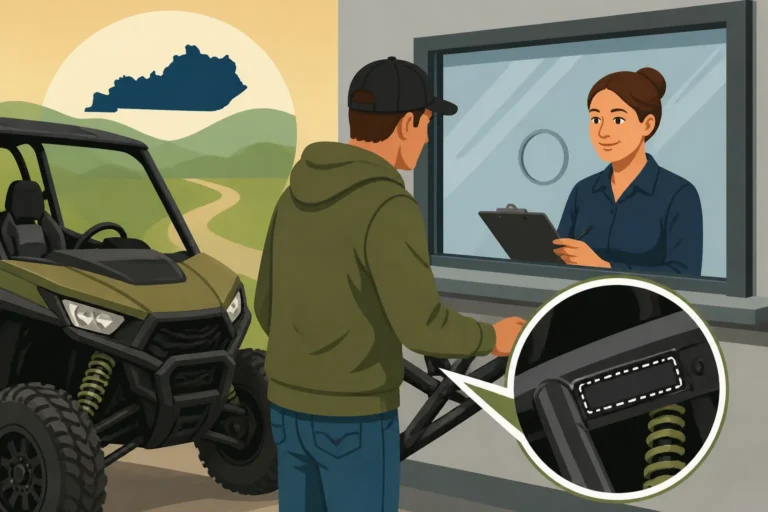
When you walk into the County Clerk's office, be prepared for a bit of a wait, especially if you go during peak hours (lunchtime or just before closing are often busy). It's wise to bring all your neatly organized documents, a good book or podcast, and your patience. Once your number is called or it's your turn at the counter, a clerk will meticulously review your paperwork. They'll check your completed TC 96-182, scrutinize the signed-over title for any discrepancies, verify your photo ID, and cross-reference the VIN to ensure it matches everything. Don't be surprised if they also physically check the VIN on your machine if you've trailered it to the office, though often they rely on your declaration.
The clerk will then calculate the sales tax you owe (based on the purchase price or the machine's NADA value, whichever is higher) and all applicable titling fees. These fees are part of [What a Kentucky ATV Title Costs]. You'll pay these amounts, and typically, you'll be given a receipt and temporary documentation confirming your application is in process. The new, official title will then be mailed to you within a few weeks, though [Kentucky ATV Title Processing Time] can sometimes vary.
Avoiding Common Pitfalls at the Counter
Dealing with government offices can be frustrating enough without self-inflicted wounds. To ensure your visit to the County Clerk is as smooth as possible and you avoid being sent home, be mindful of these common pitfalls:
- Incomplete or Incorrect Forms: This is perhaps the biggest culprit. Double-check every single line on your TC 96-182. Is your name spelled correctly? Is the VIN accurate? Are all required signatures present? A missing signature, even a minor typo, can be grounds for rejection.
- Mismatched VINs: The Vehicle Identification Number (VIN) on your title must exactly match the VIN on your machine and on your TC 96-182 form. Kentucky has a strict [Kentucky's Seventeen-Character VIN Rule], and any discrepancy will halt the process.
- No Valid Photo ID: Seriously, don't forget your driver's license or state-issued ID. Without it, the clerk cannot verify your identity, and they won't proceed.
- Issues with the Signed-Over Title: If the seller didn't properly sign over the title, if there's an unreleased lien, or if the title itself appears altered or damaged, you're going to have a problem. The clerk needs a clean, properly executed original title. They generally won't accept a photo or a copy.
- Lack of Payment: Make sure you have the correct form of payment (cash, check, or card—call ahead to confirm what your specific county accepts) for the sales tax and titling fees.
By being meticulous with your paperwork and prepared for your visit, you can make your trip to the County Clerk a one-and-done success, keeping you well within that fifteen-day window.
Dealing with Delays: What If You Can't Make It?
Life happens. Maybe you had an unexpected family emergency, or you got sick, or a critical piece of paperwork got held up. It's easy to look at that fifteen-day deadline and feel a wave of anxiety if you realize you might not make it. The reality is that extensions are rarely granted, and penalties are almost always applied.
Legitimate Reasons for Extension (and why they're rare)
It's natural to hope for a little grace if you have a truly legitimate reason for missing the titling deadline. Perhaps a sudden illness landed you in the hospital, or you had to travel unexpectedly for a critical family matter. In such extreme and well-documented circumstances, a County Clerk might consider offering some leeway, but this is incredibly rare and entirely at their discretion. There's no state-mandated "grace period" or formal extension process for the fifteen-day rule.
The general expectation is that you, as the buyer, are aware of the deadline and plan accordingly. The system isn't designed with automatic waivers for personal circumstances, no matter how understandable they might be. Therefore, while you can always politely explain your situation, don't go into the County Clerk's office expecting an automatic pass. The safest bet is to always treat the deadline as firm and non-negotiable.
The Reality of Penalties and Fees
When you miss the fifteen-day titling deadline in Kentucky, the most immediate and tangible consequence is a late fee. This isn't a "maybe" situation; it's a "definitely" situation. The state assesses these penalties to incentivize timely compliance and ensure that sales taxes are remitted promptly. The late fee is typically an additional charge on top of the standard titling fees and sales tax you would have paid anyway.
The amount of the late fee can vary depending on how long past the deadline you are. It might be a flat rate, or it could be calculated as a percentage that increases the longer you delay. For instance, if you wait 30 days, the fee might be one amount, but if you wait 60 or 90 days, it could be higher. These penalties are not arbitrary; they are prescribed by state statute, and the County Clerks are obligated to collect them. It's an unfortunate but unavoidable reality of missing the window, and it's a stark reminder of [What a Kentucky ATV Title Costs] when you add in late fees.
What to Do If You're Already Past the Deadline
First and foremost: don't panic, but absolutely do not delay further. If you've realized you're past the fifteen-day mark, the best course of action is to go to your County Clerk's office as soon as humanly possible. Every additional day you wait can potentially increase the penalties or complicate your situation.
Gather all your paperwork diligently, just as you would if you were on time. The process for titling is the same, regardless of how late you are, but you'll need to be prepared to pay the additional late fees. There's no special "late titling" form; you'll still fill out the standard TC 96-182 and present your signed-over title and ID. Be honest with the clerk about the date of purchase. It's almost always better to address the issue proactively rather than waiting for a problem to arise (like trying to sell an untitled machine, or worse, getting a citation for an unregistered vehicle). The sooner you rectify it, the less expensive and stressful it's likely to be.
Special Scenarios and the Fifteen-Day Rule
While the fifteen-day titling deadline is generally straightforward for a typical purchase, there are a few scenarios that can introduce complexity. Inheriting a machine, dealing with an existing lien, or trying to title a very old ATV all have their own quirks that interact with (or sometimes supersede) the standard titling clock.
Inherited Machines and the Clock
When you inherit an ATV or UTV, the fifteen-day clock doesn't necessarily start ticking the day the previous owner passes away. Instead, for [Titling an Inherited Machine in Kentucky], the clock usually begins when the machine is officially transferred to your name as part of the estate settlement process. This often means from the date the will is probated, an affidavit of descent is filed, or the executor formally assigns the vehicle to you.
This can be a more involved process than a standard purchase. You'll likely need additional documentation, such as a certified copy of the death certificate, a copy of the will (if applicable), and perhaps a court order or an affidavit from the executor of the estate authorizing the transfer. Because estates can take time to settle, it's crucial to communicate with your County Clerk's office early in this process to understand precisely what documentation they require and when they consider the "transfer date" to have occurred. Don't wait until the last minute; gather all probate and estate documents well in advance.
Machines with Existing Liens
Buying an ATV or UTV that still has an outstanding lien on its title can definitely complicate your ability to meet the fifteen-day deadline. In Kentucky, a title cannot be cleanly transferred into your name if there's an active lien listed on it. That lien must be released first.
Ideally, if you're buying a used machine, the seller should have already taken care of [Releasing a Lien on a Kentucky Title] before the sale. They should be able to provide you with the title showing the lien released, or a separate lien release document from the bank or financial institution. If the lien is still active at the time of purchase, you'll be in a tricky situation. The fifteen-day clock still technically starts from your purchase date, but you won't be able to title the machine until that lien is cleared. This can lead to delays that push you past the deadline, incurring late fees. Always ensure the lien is released before you hand over payment and finalize the sale, or at the very least, have a clear, documented plan with the seller to get the release immediately.
New Purchases vs. Older, Untitled Machines
The fifteen-day titling rule primarily applies to transactions where a titled ATV or UTV is changing hands, or a new machine is receiving its first title. However, Kentucky has a category of older machines, particularly those purchased before July 2010 when titling wasn't always mandatory, that might not have a title at all.
If you're buying a new machine or a relatively recent used one, the fifteen-day clock is definitely your concern. But if you've acquired a very old ATV that has genuinely never been titled in Kentucky, the fifteen-day rule as a transfer deadline isn't your primary worry. Instead, your challenge will be to establish original ownership and meet the requirements for obtaining a first-time title. This often involves a different process that might include presenting a historical bill of sale, an affidavit of ownership, or potentially a bond if proof is scant.
It's important to understand the distinction: the fifteen-day rule is about transferring an existing title. If you're dealing with [Older Machines That Cannot Be Titled in Kentucky], or have never been titled, you're looking at a different set of hurdles. While the County Clerk's office is still your destination ([Why a County Clerk and Not a State Office]), the specific path to get that first title will be unique and might not involve a fifteen-day deadline in the same way a transfer does.
Tips for a Smooth Titling Process
Successfully navigating the titling process within Kentucky's fifteen-day deadline doesn't have to be a race against the clock or a source of major stress. With a little foresight and preparation, you can make your trip to the County Clerk's office efficient and hassle-free. It's all about being proactive and organized.
Preparing for Your Visit
Preparation is your best friend when it comes to any bureaucratic task, and titling an ATV or UTV is no exception. Before you even think about leaving the house, create a checklist of everything you need:
- Original, Properly Signed-Over Title (or MSO for new machines): This is paramount. Double-check all signatures and dates.
- Completed Kentucky Form TC 96-182: Fill it out neatly and completely at home to avoid errors under pressure at the counter.
- Valid Kentucky Photo ID/Driver's License: Don't forget it!
- Bill of Sale: Even if you have the title, this provides crucial date and price information.
- Proof of Sales Tax Paid (if applicable): For instance, if a dealer already collected it.
- Method of Payment: For [What a Kentucky ATV Title Costs] plus sales tax and any other fees. Call your County Clerk's office to confirm accepted payment types.
It's also a good idea to call your specific County Clerk's office beforehand. Confirm their operating hours, ask about any specific local requirements, and inquire about average wait times. Making copies of all your documents for your personal records before you submit the originals is also a smart move.
Utilizing Online Resources and Forms
In this digital age, many of the resources you need to title your ATV or UTV are readily available online, which can be a huge time-saver. Most Kentucky County Clerk websites, as well as the Kentucky Transportation Cabinet's official site, offer downloadable versions of crucial forms like the TC 96-182.
Printing these forms and filling them out at home allows you to take your time, ensure accuracy, and avoid making mistakes under the watchful eye of a busy clerk. This not only streamlines your visit but also reduces the chance of rejection due to incomplete paperwork.
Furthermore, for private sales, especially if you're the seller, utilizing an online platform to create a formal bill of sale can be incredibly helpful. Services like LawDepot allow you to generate a clear, legally sound [A Kentucky Bill of Sale for an ATV] that includes all the necessary details: buyer and seller information, the machine's VIN, purchase price, and the exact date of sale. This level of detail helps prevent disputes, ensures all required information is captured for the titling process, and makes the County Clerk's job easier when reviewing your application. It’s a small step that can make a big difference in avoiding hiccups.
Record Keeping and Follow-Up
Once you've submitted your application and paid your fees, your work isn't quite done. Good record keeping and knowing when to follow up are essential. Always keep all receipts, copies of your submitted forms, and any temporary documentation the clerk provides you. This creates a paper trail for your records and serves as proof that you submitted your application within the deadline.
Make a note of the date you submitted your application. While [Kentucky ATV Title Processing Time] can vary, most new titles are mailed to you within a few weeks. If a reasonable amount of time passes (say, four to six weeks) and you haven't received your new title in the mail, don't hesitate to follow up with your County Clerk's office. They can check the status of your application. Until you have that new title in hand, those receipts and copies are your best proof that the process is underway. Remember, keep your official title in a safe place at home, not on the machine itself, to protect it from loss or damage while riding. If you ever need to replace a lost title, the process to get a [Replacing a Lost Kentucky ATV Title] is another step you want to avoid if possible.
The Broader Picture: Why Timely Titling Matters Beyond Fines
While avoiding late fees and immediate legal hassles are certainly strong motivators for meeting the fifteen-day titling deadline, the importance of timely titling extends far beyond these immediate concerns. Properly titling your ATV or UTV is a fundamental step in establishing and protecting your investment, and it has significant long-term implications for your ownership experience.
Establishing Clear Ownership
At its core, getting your ATV or UTV titled in your name is the ultimate legal proof that you own the machine. Without a title that clearly lists you as the owner, your claim to the machine can be ambiguous at best. Imagine this scenario: your ATV is stolen from your garage or a trailer. If you haven't transferred the title into your name, proving to law enforcement and your insurance company that the machine legally belongs to you becomes an uphill battle, if not an impossible one.
A properly titled machine provides an undeniable paper trail that protects you from future disputes or claims. It's not just about proving you bought it; it's about the state officially recognizing you as the legal proprietor. This clarity is crucial for everything from ensuring you can legally operate it to successfully selling it down the road.
Insurance Implications
Most insurance companies are very particular about what they'll cover, and clear proof of ownership is almost always a prerequisite for comprehensive coverage. While you might be able to secure basic liability insurance for an untitled machine, obtaining full coverage—which protects against theft, accidental damage, or other unforeseen events—often hinges on having that state-issued title in your name.
Think about it: an insurance company is taking on financial risk for your asset. If you can't definitively prove you own that asset, why would they assume that risk? Delaying or neglecting to title your machine could leave you severely underinsured or completely unprotected if something goes wrong. A stolen machine, a major accident on the trail, or even a fire in your garage could result in a significant financial loss that your insurance company might refuse to cover because you hadn't completed the legal transfer of ownership.
Resale Value and Future Transactions
Someday, you might decide to upgrade your ATV or UTV, or simply sell it for other reasons. When that day comes, having a clean, current title in your name will make the selling process dramatically smoother and often result in a higher sale price. Buyers, especially informed ones, are incredibly wary of purchasing machines without proper titles. An untitled ATV or UTV, or one with an outdated title, immediately raises red flags. Potential buyers will worry about potential legal issues, hidden liens, or the headache they will face trying to title it themselves.
An untitled machine will almost certainly fetch a lower price on the secondary market because of the added risk and complication for the buyer. It makes the transaction feel less legitimate and secure. By properly titling your machine within the fifteen-day deadline, you're not just complying with the law; you're making an investment in your machine's future resale value and ensuring a quick, legitimate, and stress-free transaction when it's time for its next adventure.
| Scenario | Within 15 Days | After 15 Days (Delayed) |
|---|---|---|
| Fees & Penalties | Standard titling fees + sales tax | Standard fees + sales tax + late penalties |
| Proof of Ownership | Clear, immediate legal ownership | Ambiguous until title is processed |
| Insurance Coverage | Easier to obtain full coverage | Potentially limited or delayed coverage |
| Resale Value | Higher, smoother transaction | Lower, harder to sell |
| Legal Standing | Protected against disputes | Vulnerable to ownership claims |
| Peace of Mind | Enjoy your ride, paperwork done | Worry about fines, incomplete paperwork |
Disclaimer
This article is for general informational purposes only and does not constitute professional advice. Laws, prices and regulations vary by location and change over time. Consult a qualified professional for guidance on your specific situation.