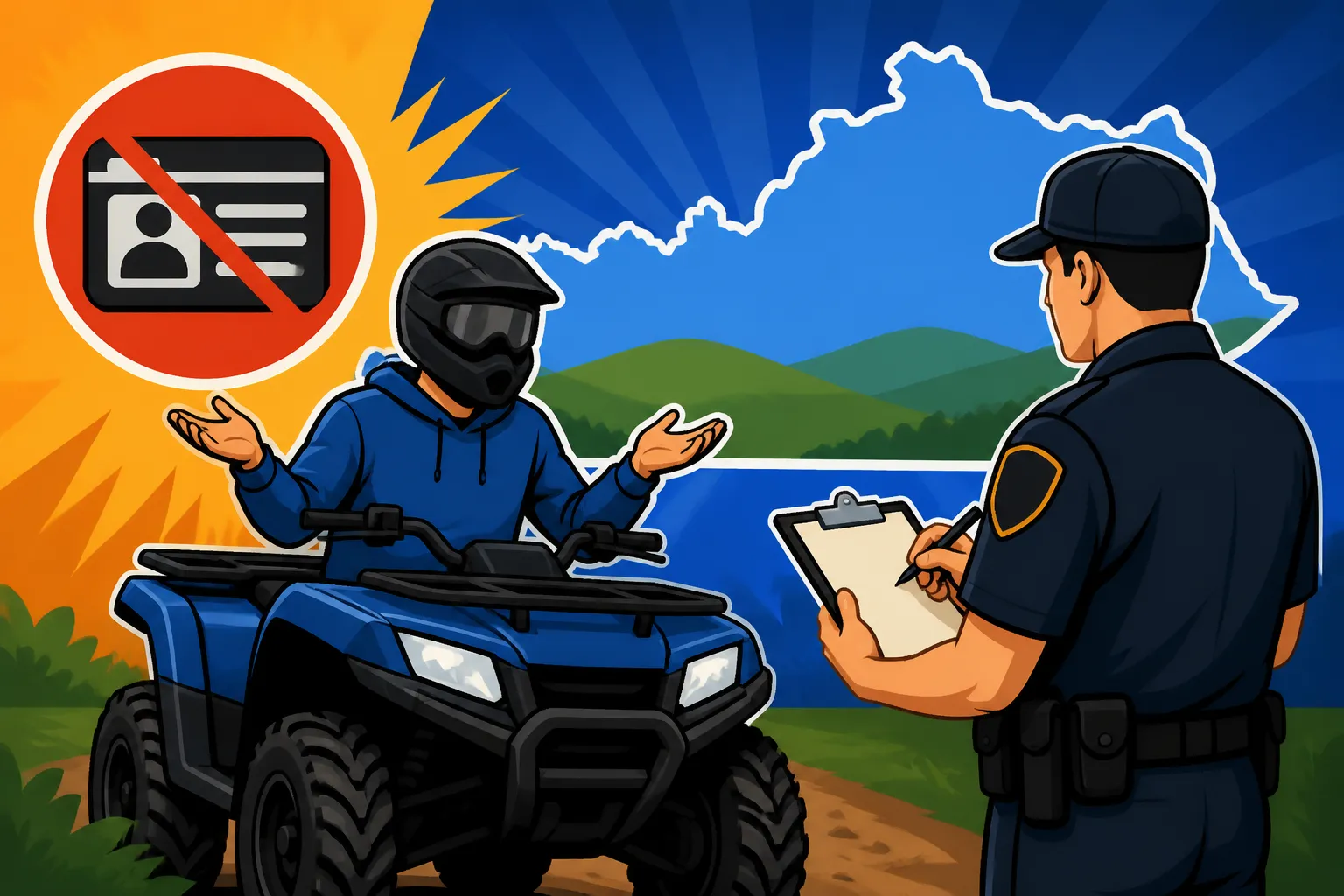
Kentucky Fines for Riding Without a Permit
Riding without a required permit in Kentucky can lead to more than an awkward conversation at the trail gate. The consequence depends on where you are, who manages the land, and what that riding area requires. The practical first step is to identify the exact place and permit rule; Kentucky does not use one statewide trail permit for every ATV or UTV.
What a permit violation means in Kentucky
A trail permit is permission to use a particular riding area under its rules. It is not the same as a title, a registration, or a document that makes a machine legal to ride everywhere. A permit from one park or land manager generally does not substitute for the permit required at another.
That distinction matters when you are trying to understand what “riding without a permit” could cost. There is no single statewide trail-permit fine that applies to every Kentucky riding location. Consequences depend on the land manager’s rules, the type of property, and whether the ride also breaks another law or rule.
For example, a privately operated off-road park may set its own admission and permit requirements. A federal recreation area can have its own pass rules. Riding on private property without permission is a separate issue from forgetting a park pass, and riding on a road where ATVs are not allowed can bring separate legal consequences. Those situations should not be treated as one generic permit offense.
A permit requirement may apply to the machine, each person, a particular activity, or some combination of those. At one location, the rider may need a permit tied to the vehicle. At another, each rider or passenger may need their own authorization. A group should not assume that one permit covers everyone simply because the machines arrived together.
If you are unsure which kind applies, first confirm the exact riding area and its current admission instructions. Do You Need a Permit for Kentucky Trails? explains why requirements depend on where you ride, while Why Kentucky Has No Statewide Trail Sticker covers the difference between local permits and a single statewide system.
A citation or removal from the property is not the only possible result. Depending on the operator’s policy and the circumstances, staff may direct a rider to stop, require the rider to leave, or explain how to obtain the proper authorization before riding further. A rider may also face consequences under a separate rule if they entered private land without permission, ignored a closure, or used a road illegally. Do not assume that paying an entrance charge after the fact automatically resolves every issue.
What could happen if you ride without the required permit
The exact response varies by riding area, so it is better to think in terms of possible outcomes than to rely on a supposed standard fine. A park’s permit rules may be enforced through its admission process and property rules. A public land manager may use its own enforcement procedures. If the conduct also involves trespass or another violation, that issue may be handled separately.
| Situation | Possible response | What to check |
|---|---|---|
| You arrive at a controlled entrance without a required pass | You may be turned away or told how to obtain the required authorization | Whether permits are available at the entrance and when it is staffed |
| You ride inside a permitted area without the required authorization | Staff may tell you to stop or leave, and a rule violation or citation may be possible | The current rules for that specific park or recreation area |
| A passenger lacks a required individual permit | The passenger may not be allowed to continue under the group’s permit | Whether permits are required per person, machine, or both |
| You ride on property without the owner’s permission | Trespass concerns may arise, separate from a trail-permit issue | Who controls the land and whether riding access is authorized |
| You ride on a closed trail or road | A separate closure or road-use violation may apply | Posted notices, gates, and current local rules |
This table is a planning aid, not a promise about what an employee, ranger, or law-enforcement officer will do. A rule can be enforced differently depending on the location and facts. If an official notice gives a fine or other consequence, follow the notice and contact the issuing office if you need clarification.
The best-known question is often, “What is the fine?” But the more useful question before unloading is, “What rule applies here, and what happens if it is not followed?” The answer may involve a permit charge, removal from the property, a citation, or another response. The exact amount, if a fine applies, should be confirmed with the land manager or issuing authority because fees and rules can change.
Also separate the permit issue from a machine’s title or registration status. Kentucky does not provide a universal trail sticker that grants access to all riding areas. A machine can have its ownership paperwork in order and still need a separate trail permit. Likewise, having a trail permit does not make an otherwise prohibited road trip legal. For the difference between the trail system and vehicle paperwork, see Kentucky Trail Permits Explained and Kentucky Rules for a Machine With No Title.
Check the rules for the place you plan to ride
Before loading the machine, identify the exact park, forest area, trail system, or parcel of private land. Nearby trailheads may be under different operators or land managers, each with distinct rules. A permit bought for one location should not be treated as permission to ride elsewhere unless the relevant providers explicitly say it is accepted.
Privately operated parks
At a privately operated park, check the current rules with the park itself. Confirm whether the permit is required before entering, whether it covers one machine or more, and whether every rider or passenger needs separate authorization. Ask about the purchase location and hours too. A permit that can only be purchased at a staffed office is a problem if you arrive after it closes.
Black Mountain, Leatherwood, and Rush Off-Road are examples of Kentucky riding destinations with their own operating arrangements. Do not assume that a rule at one applies at the others. For Black Mountain, verify the current process through Where to Buy a Black Mountain Permit. For Leatherwood, check What a Leatherwood Trail Permit Costs and confirm the current terms with the operator. For other parks, use their own current visitor instructions rather than relying on an old post, a map listing, or another rider’s recollection.
Federal recreation areas
A pass for a federal recreation area is not automatically a pass for a private park, and a private park permit does not replace a federal pass requirement. At Turkey Bay OHV Area, check the current instructions from the area before you go. How the Turkey Bay OHV Permit Works can help you understand the type of permit to look for, but verify current purchase details and operating information before traveling.
For riding opportunities in Daniel Boone National Forest, check the applicable rules and pass requirements for the specific route or area. Buying and Using the Daniel Boone Forest OHV Pass addresses that separate system. Do not infer that carrying a pass for one forest area gives access to every Kentucky trail.
Private property and leased land
A trail permit is not a substitute for the landowner’s permission. Some riding areas operate on land under a lease or other access arrangement, so the operator’s authorization matters. A rider who leaves a marked riding area, crosses a closed boundary, or enters adjoining land without permission can create a separate trespass problem. If you are riding on land that is not part of a public park or established commercial trail system, get clear permission from the person or organization with authority over access.
Roads, crossings, and closed trails
A trail permit does not grant permission to ride on a public road, nor does it override a closed-trail notice. A route that begins at a permitted riding area can still include segments with different restrictions. Check signs and gates along the way, and do not assume that a route shown on an older map remains open. [Kentucky Fines for Riding a Closed Trail] discusses why a closure can be a separate matter from a missing permit, and Kentucky Trail Closures to Check First offers a useful pre-ride check.
How to avoid a permit problem before unloading
A few checks before a ride are usually simpler than dealing with an access dispute at the gate or on the trail. Use this process for a day trip, weekend ride, or unfamiliar location.
- Name the exact riding area. Use the official name, not just a nearby town or trailhead. If several riding areas are close together, confirm which one you are visiting.
- Identify who manages access. It may be a private operator, public land manager, or property owner. Their rules determine which permit applies.
- Confirm who needs a permit. Ask whether authorization is required for each rider, each passenger, each machine, or a combination. Do not assume one person can cover a whole group.
- Check where and when permits are sold. Confirm whether you can buy one online, at an office, or only at a gate. Check operating hours and payment requirements directly with the provider.
- Ask whether the permit is valid for your planned route and dates. A pass can have limits on location, use, or validity. Verify the terms rather than relying on a permit from a different park.
- Read the current rules before leaving the staging area. Look for posted notices, closed trails, and boundaries. If staff give you instructions, follow them.
- Keep proof accessible. If the provider issues a physical permit, display or carry it as instructed. If it is digital, keep the confirmation available, while recognizing that a phone image may not replace a required physical permit.
- Confirm rental coverage separately. Ask the rental company whether a permit is included and whether it covers passengers as well as the machine. Do not infer coverage from the rental price or waiver.
The last point can matter when renting a machine. The rental provider and the trail operator may have separate requirements. Ask the rental company what is included, then confirm that the arrangement meets the park’s own rules. If the answer is unclear, contact the park before relying on the rental desk’s explanation.
For a group, assign one person to verify access for the whole plan, then share the details with every rider. This avoids the common mismatch where the driver has a permit but a passenger or second machine does not. Keep the confirmation, permit, or receipt in the place the operator specifies, and make sure the group knows what to do if staff ask to see it.
If you are stopped or discover you do not have a permit
Stay calm, stop riding when instructed, and ask which rule applies. If you are at a controlled entrance, do not bypass a gate or continue into the riding area while trying to sort out payment. If staff or an officer says you are not authorized to ride, comply with the direction and ask where you can find the written rule or the correct contact for questions.
If you receive a citation or written notice, read it carefully. It should identify the issuing authority, the alleged violation, and any steps for responding. Follow the instructions on the notice and meet any stated deadline. If the document is unclear, contact the office listed on it rather than relying on informal advice from another rider. A park employee can explain that park’s process, but may not be able to answer questions about a separate state or local violation.
Keep relevant records together: the permit or purchase confirmation, rental paperwork, payment receipt, route information, and any written communication about access. These documents may help clarify what you purchased and where it was supposed to be valid. They do not guarantee that a citation will be dismissed, but they can make it easier to explain the circumstances accurately.
If you believe you had valid authorization, explain the facts without arguing at the trail gate. Note where you purchased the permit, what it covered, and the route you followed. If the issue concerns a citation, use the review or appeal process given by the issuing authority. Do not ignore a notice because you believe the rule was unclear.
If you discover the problem before riding, the simplest option is usually to pause and contact the operator. Ask whether you can buy the required permit, whether the area is open, and whether your group’s permits cover each rider and machine. If you cannot confirm permission, do not ride there. A different destination with clear access rules is safer than treating uncertainty as approval.
Frequently Asked Questions
Is there one Kentucky ATV trail permit?
No single statewide trail permit covers every riding area. Permit requirements depend on the park, public land, or property where you plan to ride. Check with the manager of that specific location.
What is the fine for riding without a permit?
There is no one fine amount that applies to every Kentucky riding area. The response depends on the rules and authority involved, and another issue such as trespass or riding on a closed trail may be handled separately. Confirm current consequences with the relevant operator or issuing authority.
Does a permit from one Kentucky park work at another?
Do not assume it does. Permits are generally tied to a particular provider or area unless the providers say otherwise. Confirm that your permit is accepted on the exact route you plan to ride.
Does a rental include the trail permit?
Sometimes a rental arrangement may include some access costs, but coverage depends on the rental company and the riding area. Ask whether it covers the machine, every rider, and any passenger requirements, then verify with the trail operator.
Disclaimer
This article is for general informational purposes only and does not constitute professional advice. Laws, prices and regulations vary by location and change over time. Consult a qualified professional for guidance on your specific situation.